Showing posts with label History. Show all posts

Wednesday, May 24, 2017

Mornings on Horseback by David McCullough


Above is my breakfast this morning.  In the words of that great philosopher the Cookie Monster:

C is for cookie and that's good enough for me.

Today my writing is accompanied by all three movements of Pour le Piano by Claude Debussy performed by Gina Bachauer.

Years ago, the first time I moved to New Jersey, I was facing some hard financial times so my mother came up to stay with me and watch my toddler son while I worked.  Tuesdays were my day off so my mother, one of the most organized people I know, mapped out all of New York City and each week we would go and explore some part of the city.

One Tuesday it was the Roosevelt house.  Not only was it a fascinating tour but the information provided about our 26th President provoked an interest in that has lasted me the rest of my life.  I have read Roosevelt's own writings and have a couple of other biographies lined up after this one.


Mornings on HorsebackMornings on Horseback by David McCullough

My rating: 5 of 5 stars


If you're looking for a book describing Teddy Roosevelt's time in office this is not it. Lion in the White House by Aida Donald or Roosevelt's own autobiography would be where to start.

McCullough brings us to the brink of Roosevelt's political career and aside from a small afterward informing us of how all the Roosevelt children turned out, there he ends.

The book is still rich with information. Starting with Theodore Roosevelt, Sr, we get a solid and colorful background in which Teddy Jr grew up, as well as what sort of child he was which gives us insight into the sort of man he developed into.

Theodore Sr. was an intensely honorable and devout man. A strong Christian and the adoring and adored father of his children. A good third of the book narrates the close relationship Theodore Sr. had with all of his children.

He married a Southern woman, Mittie, the decade prior to the Civil War. Mittie was the quintessential Southern woman. Gorgeous, charming, flirtatious but completely in control of her destiny. Theodore must have fallen hard, even besotted. Their letters are filled with ardor on his part and teasing banter on hers.

They married and she, her sister, and her mother moved up to New York to live in the Roosevelt mansion. This must have been hard in many ways for the Southern ladies, New York being a drastically different culture than their dear Georgia. But it was also a blessing because a few years later, when the War broke out, they did not suffer the fate of the rest of their family and friends. Their home and all they knew was destroyed. Mittie's mother prayed she'd rather die than see the fall of Richmond. Her prayer was answered and she did die a year after the war started.

What Mittie's feelings were on the matter, we don't know because it seems to have been the culture at the time that one's feelings were not for exhibition. We see this later in her son, Teddy Jr, after the death of his first wife. He simply never speaks of her, not even mentioning her in his autobiography, yet from the records we know he loved her extremely.

The Roosevelts' lives would probably be deemed distasteful to modern sensibilities. They were unapologetically rich and lived a lavish lifestyle. Ironically, not because many people don't live that way now, in fact with our modern conveniences, the average person lives a more comfortable life than the richest person in the 19th century, but today it's gauche to be in favor of wealth, even if we enjoy it.

Teddy Roosevelt was sickly and an asthmatic. The Roosevelts traveled all over the world, taking an entire year to visit everything from Europe to India. This influenced Teddy in many ways and years later, as a grown man, he sought to replicate those experiences by returning to India and also living out west as a rancher.

Before that we read about his experiences at Harvard, and the impression he made on his fellow students. He was deemed a strange, awkward character with a high pitched voice, but he soon commanded their respect and he never lacked in confidence. Growing up in the Roosevelt household no doubt instilled a strong sense of self-worth.

One thing I must confess that I found disturbing was the utter delight in killing animals. Teddy describes with relish all the huge and powerful animals he hunted and conquered. I know there was a time when that was fashionable but I personally abhor killing for sport.

We also get to know Teddy's siblings. Corinne, the youngest, smart, devoted sister and the only one to live long enough to see another Roosevelt in office.

Elliot, the father of Eleanor Roosevelt, a tragic figure whose uncontrolled drinking put him into an early grave.

And the one Teddy was closest to, Bamie. Bamie had different physical handicaps, one being a curved spine. Her father treated her with the utmost care, usually carrying her everywhere and making sure she was deprived of nothing. Theirs was a special, close relationship.

And despite her physical challenges she turned out to be the most brilliant of them all, advising Teddy on everything from personal relationships to political directions. And I was glad to see that she did finally marry and marry happily, especially since everyone at the time had consigned her to "Old Maid" status. I would very much like to find a biography of this fascinating woman.

In conclusion,

If anything struck me the most it was the strong commitment and tender devotion Theodore Sr had towards his family.

The next thing would be the political shenanigans of the late 19th century and how Theodore Sr. did his utmost to eradicate the political corruption in New York and how this mantle was taken on by his son after the father's untimely and unexpected death while he was still a young man.

The courage both Theodores had in striving to remove the entrenched corruption and cronyism in the political arena of their time, how they fought against the majority of politicians, powerful crime bosses and indifference by the middle and upper classes toward the plight of the exploited lower classes is reminiscent of William Wilberforce's fight against slavery.


 I found this book to be an inspiring account of one of my favorite presidents.


View all my reviews

Thursday, October 13, 2016

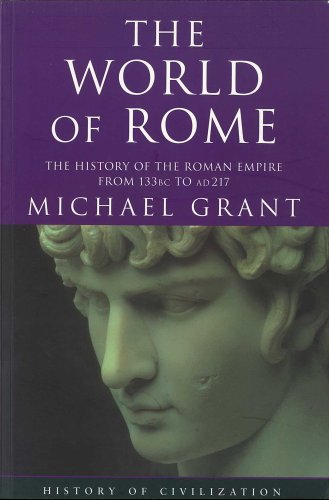
The World of Rome by Michael Grant

I'm listening to some lovely piano music, a Variations on a theme by Pierre Rode composed by Carl Czerny.  You can listen to Vladimir Horowitz playing the piece here.

https://images-na.ssl-images-amazon.com/images/I/41-A88ISqSL.jpg
I work out at a gym and because I find stationary exercisers terminally boring I have to read while using them.  Therefore while I jog away on the elliptical or step on the stair aerobics machine, I have a book on hand to while away the time.  This is especially helpful on the stair stepper which would be hard to get through if I didn't have my mind on something else to block out the sound of my calves and thighs squealing in pain.

Usually I can't read fiction because reading literature is not something to gulp down.  I read to savor the art of word choice, sentence construction and expression of ideas.  One can do that while toiling away on an exercise machine, I suppose, but I find it easier to read non fiction where I can just focus on the facts.

Hence, I just finished the World of Rome by Michael Grant.  Ever feel as though you uncovered a gem in the sand?  That is what this book is like.  It is one of the best histories of Ancient Rome I have ever read.

The book was published in 1960 and has stood well the test of time. I have had a hard time finding information on Grant today, because there is a popular YA author by the same name and his information kept popping up.

The back of the book says that Grant was President and Vice-Chancellor of the Queen's University of Belfast. He was a graduate of Harrow and Trinity college, Cambridge and is "universally acknowledged as one of the most eminent scholars of the classical Roman era."  I've added more information at the bottom of the post.

Grant is very even-handed in his study of Ancient Roman culture.  After giving a historical overview he breaks down every level of the society:  the rulers, citizens, subjects and slaves; their religious beliefs; and their art.

Part III, their beliefs was especially interesting to me.  He adequately compares and contrasts the different religious beliefs by people who believed in fate and the stars to those who were religious and also the philosophers.  Of course he shows the obvious Greek influence and also fairly compares the Christian and Jewish beliefs and their place in the Roman world.

One part that I found fascinating and I formed a conclusion (Grant does not say this in his book):  When Julius Caesar decided to overthrow the Roman Republic and established the rule of the Caesars, he guaranteed not only brutal despotism, but also the murder of every Caesar.  If a Caesar is appointed for life, then how are you going to get rid of him since you can't vote him out?  Really, shouldn't they have seen that coming or were they all too power hungry to think objectively? 

I am currently reading Suetonius' account of the Caesars and I think perhaps a good many of them were insane.  But then again,  were they any more insane than any of us would be without any checks and balances to stop us from gratifying every selfish whim?

Another provoking statement concerned Roman entertainment.  The Caesars knew if they could keep the population occupied with mindless entertainment, the coarser the better, they wouldn't bother thinking about how effective or adept their governing body was. 

Cato the younger, as well as more opportunistic politicians, had felt that the only sound and safe policy was to keep the populace quiet by entertaining them and subsidizing their food supply. (pg. 106 Part II. State and Society Chapter 3, Citizens of Rome)...

All subsequent emperors agreed that this dual formula of 'bread and entertainments' was the right one and participation in politics the wrong one, for the Roman proletariat. (pg. 107)

Hmmmmm......  Entertainment around the clock and free stuff...where have I seen that?  

I highly recommend this book to anyone interested in the subject.  It is a book I plan to return to again. 

Michael Grant has written several books, a few of which I have since ordered and eagerly look forward to reading.


Michael Grant CBE (21 November 1914 – 4 October 2004) was an English classicist, and author of numerous popular books on ancient history. His 1956 translation of Tacitus' Annals of Imperial Rome remains a standard of the work. Having studied and held a number of academic posts in the United Kingdom and the Middle East, he retired early to devote himself fully to writing. He once described himself as "one of the very few freelancers in the field of ancient history: a rare phenomenon".  His hallmarks were his prolific output and his unwillingness to oversimplify or talk down to his readership. He published over 70 works.  from Wikipedia

Sunday, April 10, 2016

Paris in the Past and Montmartre: Two illustrated history books by Pierre Courthion


I love Paris in the spring time
I love Paris in the fall
I love Paris in the winter when it drizzles
I love Paris in the summer when it sizzles
I love Paris every moment
Every moment of the year
I love Paris
Why oh why do I love Paris?

My answer is a little different than the song.  I love Paris because I love art and I love history.  If you do too, you will like these two books I'm reviewing today.  You'll be hard pressed to find them because they're out of print.  I found them at a book fair this past year.  They're a little worn but the insides are filled with rich information and small detachable prints of art.

http://ecx.images-amazon.com/images/I/51n3xV8QHGL._SL500_SY373_BO1,204,203,200_.jpg

Pierre Courthion, who was alive and knew personally many of the impressionist and post-impressionist artists provided the text for both of these books.  He includes quotes from conversations he had with Matisse, Modigliani and a few others.  Paris in the past starts all the way back to Julius Caesar who call the place "Lutetia".  The inhabitants of the region at the time were known as Parisii. It is not certain when Christianity was introduced but St. Denis and St. Genevieve (3rd and 5th centuries, respectively) are connected with the area by then called "Paris".

We then skip several centuries to the first great architect of the city who was King Philip Augustus in the 12th century.  From then on it's pretty smooth sailing with historical records and a reasonably accurate account of the artists and how well they preserved history through their art.
https://upload.wikimedia.org/wikipedia/commons/0/00/Entr%C3%A9e_de_Charles_V_%C3%A0_Paris.jpg
King Charles V entering Paris, ca. 1460
Hence we have wonderful Medieval miniatures of peasants, royalty, even religious persecutions and the burning of heretics, not to mention the Books of Hours that wealthy people used to pray.

http://special.lib.gla.ac.uk/images/exhibitions/month/mseuing3/E3_double2.jpg
Book of Hours
http://www.ancient-origins.net/sites/default/files/Jacques-de-Molay_0.jpg
Ordeal of the heretics by Jean Fouquet ca. 1420


 The book progresses to the Twentieth century while describing all the historical events in between with contemporary paintings.

http://worksofchivalry.com/wp-content/uploads/2014/10/12-Carroussel-place-royale-avril-1612.jpg
Tournament held on the Place Royale for the Marriage of Louis XIII, 1615 by Anonymous
http://veloursdelyon.fr/wp-content/uploads/2014/03/Le_sacre_de_Napoleon_Jacques-Louis_David_1805-1807_0.jpg
The Coronation of Napoleon, Jacques-Louis David (1748-1825), 1805-1807
http://www.artble.com/imgs/b/d/4/134968/july_28_liberty_leading_the_people.jpg
Eugene Delacroix (1798-1863) Liberty guiding the People, July 28, 1830
http://ecx.images-amazon.com/images/I/513nII8DHeL._SX258_BO1,204,203,200_.jpg 
 Montmartre is the same sort of book except that it traces the history of what was originally the countryside outside of Paris and is now a part of a northern corner inside the city.
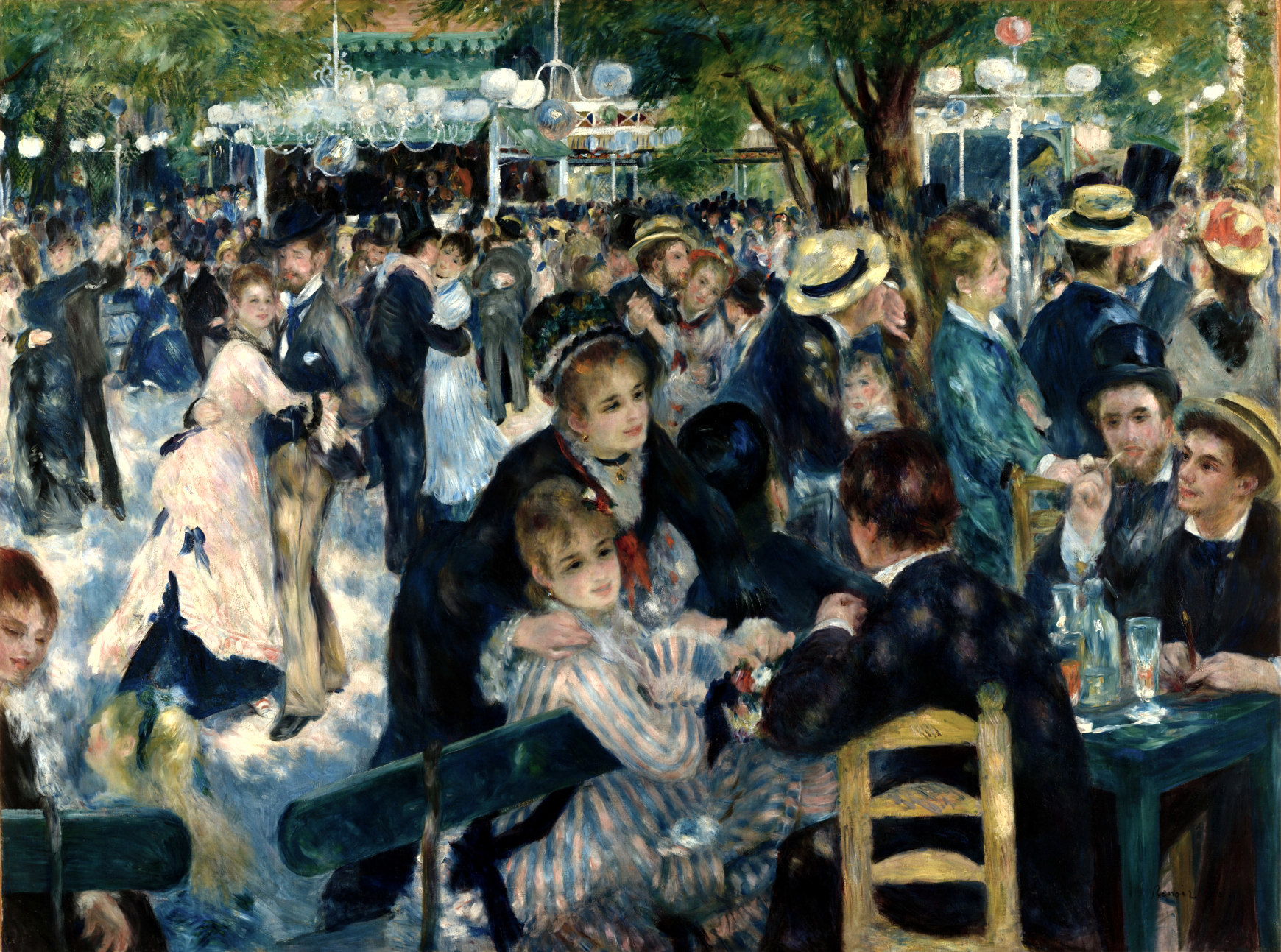
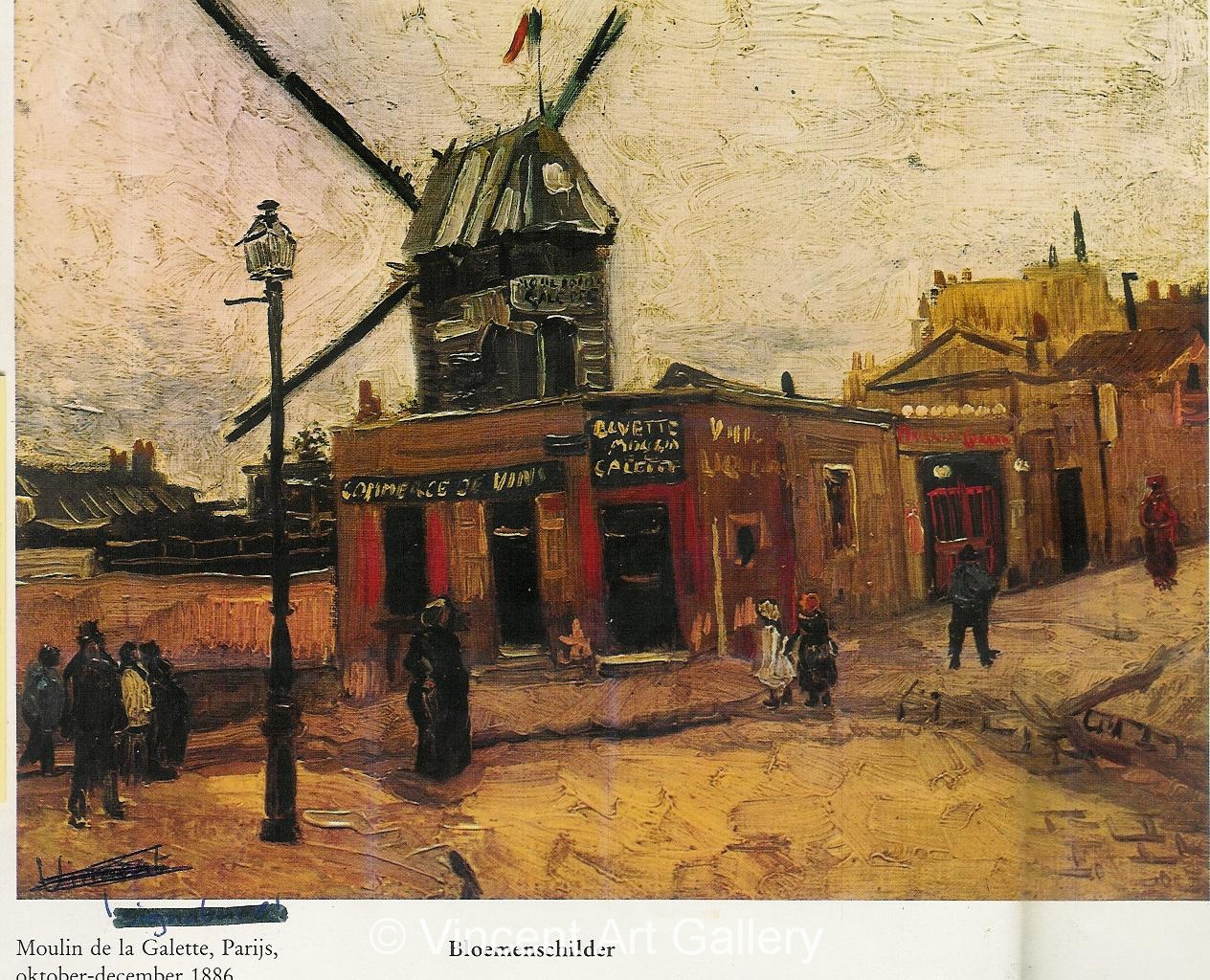
Apparently, Montmartre was the haven for many artists, especially those of the late 19th century and first half of the twentieth century.  The cafe, the Moulin de la Galette was a popular meeting ground for many artists such as Edgar Degas, Auguste Renoir, Vincent Van Gogh and Modigliani. Courthion devotes a chapter to each artist including but not limited to:

http://fineartamerica.com/images/artworkimages/medium/1/view-of-the-butte-montmartre-louis-jacques-mande-daguerre.jpg
General view of Paris from Montmartre, ca. 1830 by Louis Daguerre (1787-1851)


http://www.edgar-degas.net/images/paintings/women-in-front-of-a-cafe.jpg
Women in a cafe at Montmartre, 1877 by Edgar Degas (1834-1917)


https://upload.wikimedia.org/wikipedia/commons/4/40/Auguste_Renoir_-_Dance_at_Le_Moulin_de_la_Galette_-_Mus%C3%A9e_d'Orsay_RF_2739_(derivative_work_-_AutoContrast_edit_in_LCH_space).jpg
The Moulin de la Galette, 1876 by Auguste Renoir (1841-1919)

https://www.vangoghpaintings.com/paintings/JH1170,%20Le%20Moulin%20the%20La%20Galette.jpg
The Moulin de la Galette, 1886-1888 by Vincent Van Gogh (1853-1890)

Toulouse-Lautrec's beloved Moulin Rouge is in Montmartre.
https://upload.wikimedia.org/wikipedia/commons/e/ef/Lautrec_marcelle_lender_doing_the_bolero_in_'chilperic'_1895.jpg
The Moulin Rouge, 1895 Henri de Toulouse-Lautrec (1864-1901)

Other artists such as Picasso, Georges Seurat and Pierre Bonnard are also given miniature biographies and their relationship to Montmartre.  Incidentally, this is also the area where the American and British writers such as Hemingway, F. Scott Fitzgerald, T.S. Eliot, James Joyce et al. congregated at cafes but they aren't included in this book.

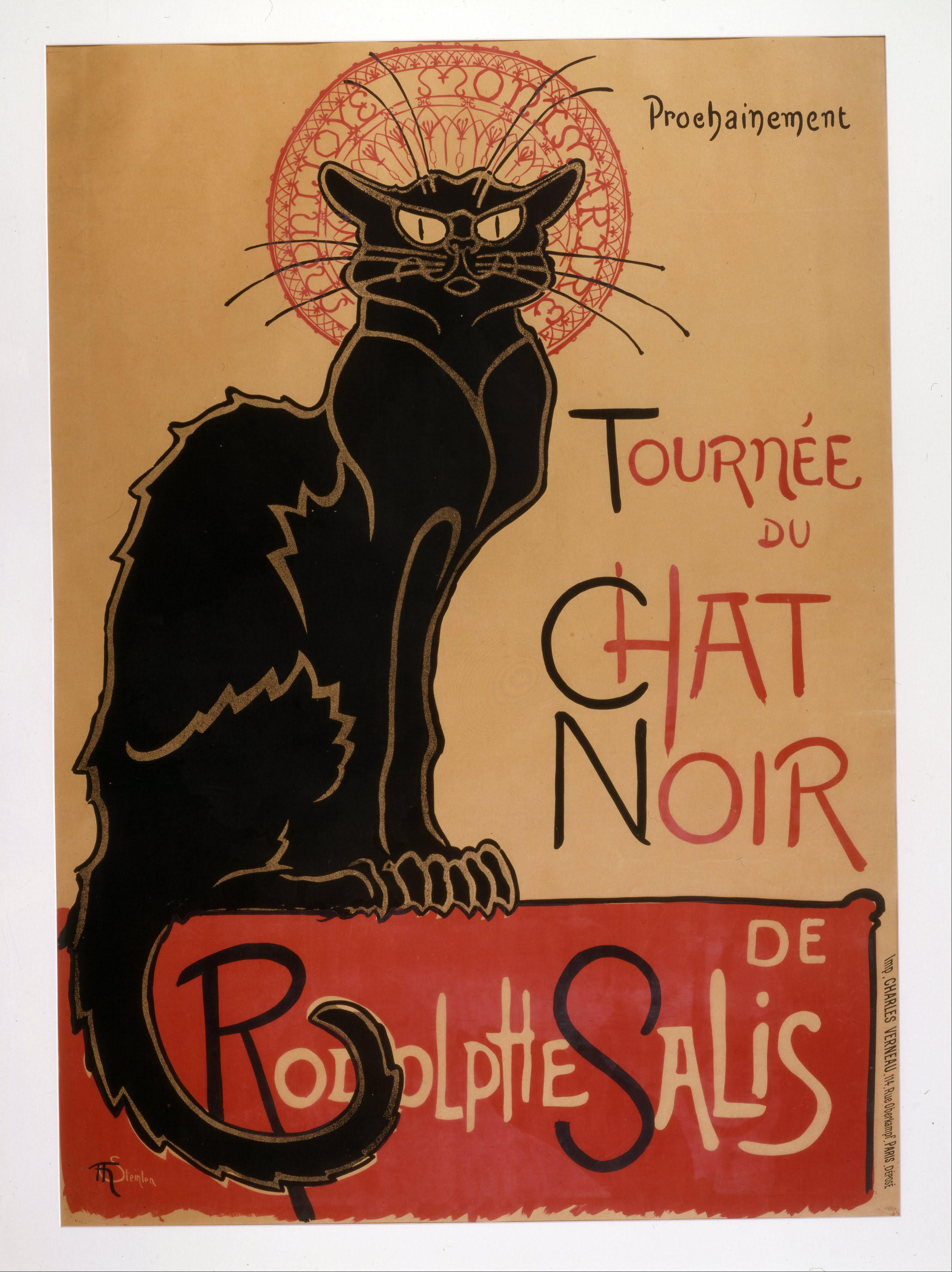
https://upload.wikimedia.org/wikipedia/commons/9/99/Th%C3%A9ophile-Alexandre_Steinlen_-_Tourn%C3%A9e_du_Chat_Noir_de_Rodolphe_Salis_(Tour_of_Rodolphe_Salis'_Chat_Noir)_-_Google_Art_Project.jpg
Le Chat Noir was an entertainment establishment in Montmartre in the 19th century
Neither of these books are very long, about 100 pages each, but they are extremely interesting and include many prints of the artists who lived, celebrated and- not least- painted Paris and Montmarte.

Sunday, February 21, 2016

The Splendid Century: Life in the France of Louis XIV by W. H. Lewis


 http://ecx.images-amazon.com/images/I/51yAS%2B4LPNL._SX381_BO1,204,203,200_.jpg

Anyone who has read the Narnia Chronicles or watched the movies know about C.S. Lewis.  What many people don't know is that Lewis had a brother, Warren Hamilton Lewis who was also a writer, and a good one at that.

Warren Lewis did not write fiction like his brother and he did not produce much, unfortunately for us, because what he did write is delightful reading, told with a good sense of humor and wit.

This Splendid Century is a charming account of life in France under the reign of King Louis XIV.  Lewis starts with the King himself and all his idiosyncrasies.  How he was raised- he became king at age four- and lived under the tyranny of Cardinal Mazarin until the despot finally died.  We learn of his eating and sleeping habits, his many mistresses-each a colorful personality- how all the court was expected to imitate the culture he created inside his palace.  Much of it is ridiculous and could hardly be believable except that absolute rulers can act like spoiled, idiot children because of no accountability. This section of the book reads much like a supplement or corroboration of Dumas' The Man in the Iron Mask (except there is no twin brother to the king).

From the King's personal habits, which were as particular as they were bizarre (he always slept with the sheets folded half down, winter or summer and you have to read for your self the table he kept and the eating habits he practiced and expected everyone in the palace to practice) to the people he was surrounded by in his court, in town and in the country, we are able to gather much of society's habits and caste system (one knocks on the doors of neighbors in town but in the palace one must grow the nail of one finger in order to "scratch"). If one wanted any financial support from the king, one stayed at court and let his land go to waste and ruin, otherwise it was assumed the king's patronage wasn't needed and Louis would withdraw needed funds to support the farmer and his family.  I'm not sure how this system lasted but it offers a lot of insight as to why there was a bloody revolution soon after.

Corruption was rampant.  Everyone was taxed mercilessly and consequently there was a lot of lying about property ownership and wealth.  There was also a significant lack of motivation to further one's prosperity since it was understood that no one got to enjoy the fruit of their labors.  Some of the tricks land owners used were rather humorous.  For instance there were those that would "sell" their land and move into a boat on the Seine and stay there until the tax man left, then "buy" it back again until next time.

The army wasn't any better.  The average French soldier was little more than a criminal ragamuffin snatched from the streets.  The Captains were commissioned with certain sums to draft soldiers but always drafted less than they were paid for and pocketed the rest of the money.  If an inspection occurred they borrowed soldiers from the next regiment and returned the favor when that regiment came up for inspection.  Another tactic was to grab local beggars and ruffians and stick them in line.  They were able to get away with a lot because there were no uniforms.  The way these "armies" treated the civilians where they were stationed isn't worth describing except to state that they acted like the criminals they were.  If it weren't for the King's Musketeers I frankly don't know how order could have been kept.

My favorite chapter was on the medical profession.  The Paris Medical school was jealous and made sure practically no one qualified for entry into their school and refused to acknowledge any other school.  In this way they accomplished the dubious distinction of keeping France short of doctors.  

Interestingly, surgeons were not considered doctors.  When looking at their origins, one doesn't wonder.  Surgery started in the barbershop and was little more than bloodletting and carving off of diseased limbs.  However, this eventually developed into the surgical operations we know today.  This didn't stop traveling "surgeons" to practice their skill on the countryside.  These itinerant surgeons worked on humans and animals alike and when they first started were "little more than assassins".  Still, practice does make perfect, so as the years advanced these men, and sometimes women, became as competent as the "trained" surgeons in town.

The Medical profession despised surgeons and refused to admit they were doctors.  A surgical school was founded outside of Paris and was invaded by irate Medical students and doctors.  A horrible fight ensued between the surgeons and the doctors, leaving several on each side knocked out and injured.  Really, someone needs to make a movie about that. 

In fact, either side was pretty appalling in their medical practices, which consisted largely of bloodletting.  Children as young as eight weeks old were bled, sometimes to death, to get rid of whatever diseases ailed them.

Another chapter describes the education of women.  King Louis' one time mistress and mother of several of his children, Mdme de Maintenon, started a school for girls, drafted some barely literate nuns as teachers and presided over the education of the daughters of the court and gentry.  An amusing description of their less than perfect education but perfection of manners is related.

The Church in all its goodness and not so goodness comes to light as does the plight of galley slaves.

The book finishes off with the great writers of the time and provides several pages of bibliography and suggested further reading.

Reading the book is a delightful trip through the courts of 18th century France and I enjoyed it as much if not more than the best movie ever made of The Three Musketeers.

There is a sequel called The Sunset of the Splendid Century which I intend to buy.  Stayed tuned for future reviews.


Sunday, January 18, 2015

Witchcraft by Charles Williams


                              http://ecx.images-amazon.com/images/I/51KQ7WEMKBL._SY344_BO1,204,203,200_.jpg


Charles Williams was one of the Inklings and good friends of Tolkien and C.S. Lewis.  Although his works are less known, perhaps due to his untimely death at forty-five, they have their own attraction.  

Witchcraft is a study of the art of sorcery through the ages.  It does not give a glamorous description or any salaciousness that seem to be hallmarks of contemporary studies on the subject. In his own words:

These pages must stand for what they are -a brief account of the history in Christian times of that perverted way of the soul which we call magic, or (on a lower level) witchcraft, and with the reaction against it.  That they tend to deal more with the lower level than with any nobler dream is inevitable. ...No one will derive any knowledge of initiation from this book; if he wishes to meet 'the tall, black man' or to find the proper method of using the Reversed Pentagram, he must rely on his own heart, which will, no doubt, be one way or other sufficient.  I have not wished to titillate or to thrill; so far as I can manage it, this is history, and...accurate history.

Williams begins with pagan times and records the acts of witchcraft in ancient Greek and Roman times.  He quickly moves on to the middle ages when there was a great conflict with the practitioners of Witchcraft and authority.

Interestingly, it was not the Church-inquisition notwithstanding- that diligently sought out and persecuted those convicted of witchcraft, it was the secular court.  However, it is important to remember that "secular" did not hold the connotations that it does now.  The court still grounded itself in religious principals.

Something else to understand:  The culture of that time produced different motives than they do now.  Today we have serial killers or societal deviants that engage in criminal activity and we say they have a chemical imbalance or some type of psychosis.  They didn't view things that way hundreds of years ago.  Things were seen on a spiritual level.  Not only were serial killers, perverts- what have you, accused of witchcraft, the perpetrators of certain crimes committed them believing themselves to be practicing witchcraft.

The crimes these criminals committed in order to attain supernatural power for themselves and over others were sordid indeed and if you read them you wouldn't protest the punishment that was meted out to the people who engaged in such horrible acts.

But this isn't to say that people weren't falsely accused.  Throughout Europe there seemed to be a hysteria against witchcraft that caused persecution far greater than there could have been witches.  After all, all one had to do was accuse someone, then the accused was tortured until they confessed.  If they did confess they received absolution, thus saving their soul from damnation.  They were still executed, but with the blessings of the Church bestowed upon them.

I thought about this from a Christian perspective.  In Roman times, Christians were compelled to renounce their "pagan, atheistic faith" or be tortured and killed. In this past century in Communist countries being a Christian prevented one from getting an education, owning land or getting a job.  A friend of mine from Hungary shared with me that her grandmother was a member of the Communist party.  On joining she had to agree that no living relative went to church or professed the Christian belief in any way. (Interestingly, on her death bed she told her children to baptize the grand children).

 In modern times, throughout Asia and Africa, Christians are persecuted for their beliefs.  Converting from Islam to Christianity brings the death penalty.  

So here comes the Middle Ages.  Europe is owned by the "Holy Roman" Church.  If I were Satan and I wanted to force people to renounce Christ how would I do it?  How about torture people until they confess to being witches?  Because if you're admitting to being a witch what are you also doing?  Renouncing your faith in Christ.  What does John 16:2 say?

...in fact, the time is coming when anyone who kills you will think they are offering a service to God.


The strangest part I found was the involvement of children and how many accused others, including their own family members of being witches. Why would a child do that?

Williams devotes whole chapters to different countries:  England, Spain, Germany.  There's some bizarre tales of the court of France prior to the French revolution.  Apparently the king's mistress practiced "Black Sabbath's" to maintain her hold over the king as well as killing off any potential threats to her position.

The last chapter is left for America and the Salem witch trials.  It all started with hysterical children.  Why did they do it?  Did they understand what they were doing?  And why did adults give them any credence?  It's easy to believe that a malevolent Spirit simply possessed a whole community-all believing they were serving God.  Satan must have been laughing his head off.

On record the pastors and judges who were involved later recanted and asked pardon for the offenses they committed against innocent people.  Not that that brought anyone back to life but at least they lived to regret their actions.

This book is strange, horrific and utterly fascinating.  If you would like greater insight into the psychic of the mind and how it operated throughout history, this is a good book for it.
   
                                                  http://upload.wikimedia.org/wikipedia/en/thumb/3/3e/Charles_Williams.jpg/200px-Charles_Williams.jpg


Monday, December 22, 2014

Inventing the Christmas Tree by Bernd Brunner translated by Benjamin A. Smith


I'm noticing that a growing trend among Christians is to forgo the celebration of Christmas.  I once belonged to a church that gave the holiday barely a nod.  No carols, no advent, a scant Communion service on Christmas Eve.  More than one friend informed me that the holiday has become too secular, too materialistic and its practices are more pagan than Christian.

This was all surprising, even shocking, to me because I grew up in a family that attended a church where the entire church year was celebrated.  Advent started the Sunday after Thanksgiving and was the day we put up the Christmas Tree, Nativity set, and all our other decorations.  Each Sunday we lit the advent candles, read the scripture for that week and sang carols.  We weren't taught to believe in Santa Claus, but we didn't care because presents are presents and coming from our relatives rather than the Jolly Old Elf was just fine with us.

After I left my parents' home I came to realize that not everyone was raised as I was.  This caused me to reevaluate my own customs and traditions.  Why do I celebrate Christmas?  There's no mandate in the Bible for it.  The only occasion that is explicitly called on to be remembered is the Lord's Supper and Christ's death and resurrection.

So why do we celebrate Christmas?  Are most people actually celebrating the Mass of Christ?  Why put a tree in our house and cover it with ornaments?

Because of my questions I have been researching the origins of many church traditions.  During this Christmas season I read a book about the Christmas tree.

Bernd Brunner is a German freelance writer who, according to the dust cover inset, "explores the intersection of cultural history and the history of science."

In Inventing the Christmas Tree, Brunner traces all the threads back to the earliest records of people decorating trees and keeping them in their houses.  The earliest record is 1414 in Estonia where a tree was set up in front of the town hall for a dance.  Another is in 1419 where the Freiburg Fraternity of Baker's Apprentices saw a tree decorated with apples, wafers, gingerbread, and tinsel in the local Hospital of the Holy Spirit.

At first the Church prohibited the cutting of trees for Christmas, but eventually the nobility and bourgeoisie began the practice of putting trees up and decorating them with presents in the form of cookies, nuts and fruit.  Later, the poorer classes also began to put trees in their houses as well.

The Evergreen was chosen because of its perennial greenness.  Greenery was celebrated prior to the Christmas tree or even Christianity.  The ancient Romans also celebrated with greens.  Still the color represented a belief in the eternal.  Eternal life, the immortal soul.  Candles were added as "stars".  This symbolized the Holy Spirit or the light that came into the darkness (John 3:19).

What I didn't know was that for many years Christmas trees were considered Protestant (the Luther tree) and even into the late nineteenth century Catholic aversion to Christmas trees was so strong they called it the "Tannenbaum Religion".  In 1909 two Benedictine monks spoke of the "fraud of the Tannenbaum tradition" in their Lexicon for Preachers and Catechists.  Anti-tree sentiment eventually lessened and I daresay that today there are as many Catholic households that contain Christmas Trees as Protestants in the United States.  It is still uncommon in Catholic countries.  In these countries small Nativity sets predominate.

Tree decorations also changed through out the years.  At first they were adorned with candles and all sorts of edible goodies such as sweets and fruits.  Sugar cookies were shaped to look like knights, birds, hearts, flowers or pretzels.  By the nineteenth century decorations with Christian symbols became common.

Silver thread also adorned the trees, some say this was to represent snow, others say angel hair, still others as a reminder of summer or of the threads that were woven into church vestments in the Middle Ages.

The final section of the book describes different tree stands, the practice of putting presents under the trees and the different sort of trees people choose to best represent their families beliefs and needs.

The book is illustrated with Vintage post cards of the turn of the last century.  All in all a very charming book.

So should we celebrate Christmas?  Are we celebrating the pagan past?  Are we being greedy for presents (I plead guilty on that one), has it become too secular?

I can only answer for myself.  I am an old fashioned traditionalist.  No one has to celebrate Christmas if they don't want to, but as for me and my house we will remember the birth of Christ through our cultural heritage and traditions.  Merry Christmas and God bless you all!


Tuesday, September 30, 2014

Time, Work, and Culture in the Middle Ages by Jacques Le Goff


One of my life long interests has been the Middle Ages.  I love the myth, legend, art, music and history of that time period.  I'm especially interested in how our civilization developed over the approximate thousand year time span that we now label the Medieval Age.

Jacques le Goff is a prominent French researcher in not only the history but the sociology of this time period.  He has written many books about Western Medieval culture.  This particular book deals with what the title says:  How was the concept of time, work and culture developed.

The book is divided into four sections:  Time and Labor; Labor and Value Systems; High Culture and Popular Culture; and Toward a Historical Anthropology.

In Time and Culture le Goff discusses the invention of our modern concept of time.  It never occurred to me that people counted time any differently.  He notes that at first, laborers worked according to the sun but only worked half days.  It was the laborers of the land that insisted on working longer hours so they could receive greater pay.  

Time was at first measured according to the Church.  Clerics regarded time according to Biblical texts and church tradition.  Therefore all time is God's time.  The day was divided up according to the different hours of the church as well as days, weeks and months in that every day had its own particular time in the Church Year where a particular mass was celebrated.  Different masses sung different psalms according to what time of the day or week or month of the year.  

The rise of merchants redefined time in many respects but I don't have time to go into it here.  But this leads us to the next point of this section:  work.  The church held some jobs in honor but some in contempt.  The laborer was at first held in contempt in the early middle ages although this changed by the time of the high middle ages.   The merchant class likewise changed attitudes towards honorable and dishonorable work.  At first it was considered sinful to be usurers which is why Jews held that occupation for hundreds of years.  This made Jews vulnerable to backlash and persecution when times became unstable and people's minds were easily directed to make scapegoats of the people to whom they owed money.  The Bible also speaks of being no man's debter hmmm...

At any rate this whole division goes into much greater detail than I'm able about the rise of labor and merchant classes, the development of time, its origins in the church and later within the merchant community.

The third section describes the development of universities and trades and professions.  Certain people were expected to go to universities, primarily clergy which is only natural considering that universities were developed within the church with the primary objective of training clergy.  This later expanded to include people who attended trade schools and artisans.  Those particular schools were eventually absorbed into the university system.

Still, these schools were primarily schools of theology and exegetical training.  Indeed, back then church, learning, and trade were not separated.  Secular university systems did not exist and every subject, math, science, language arts etc.. was viewed through the lens of Scripture which was considered the crowning science.

The final chapter tells us how  the Public Authorities outside the church gained influence in the Universities during the Renaissance.

The third section is very interesting to me as a musician because it traces the development of high and popular culture in folklore traditions and music. High culture has its roots in religious music and literature while popular culture are those tales and songs people told each other at home and around the fire.

The final chapter was thought provoking because it described the development of symbolic rituals.  Even how the hand shake and greeting with a kiss came about, what it meant and how each person performed them according to their station.  Medieval Christianity was rife with rites and symbols so naturally these became a part of the culture as a whole.  

A lord would take both hands of a vassal in his hands while the vassal always pressed his hands together as in prayer to the Lord.  Le Goff maintains that this, coming from inside church tradition was not a symbol of obeisance as a servant but of a son.  He asserts that the relationship between feudal lords and the people under their authority was not impersonal but seen by both parties as familial.  Just as Christians upon baptism became members of the Christian family, when serfs or villagers ritually show their deference to the knight who promises to protect them, they are publicly proclaiming fidelity to not just their master, but the head of their family. 

The knight, in turn, kneels before the Pope, acknowledging the head of his family is Christ.  When the King "knights" someone by ritually touching his shoulders with a sword he is making the same statement.

This book is far more involved than what I've written.  The most I can hope is to whet someone's appetite to read Le Goff's books for him or herself.


Thursday, March 20, 2014

The Arrogant Years: One Girl's Search for Her Lost Youth From Cairo to Brooklyn by Lucette Lagnado


Lucette Lagnado wrote an interesting article in the Wall Street Journal about the current push in certain academic circles to boycott Israel for all its crimes against humanity, specifically its treatment of  Muslims.  Her article was well-written and deftly addressed this latest trend among the "intellectuals" of our time to vilify one group of people while blithely ignoring the the atrocities committed by another.  There's a verse in the Bible that speaks of "straining a gnat and swallowing a camel."  It's not used exactly in this context, but it fits.

At any rate, this article sparked an interest as to who the writer was.  I looked her up and found she had written a couple of memoirs.  Her first book, The Man in the White Sharkskin Suit, focuses on the life of her father.  This second one, The Arrogant Years, centers around Lagnado's relationship with her mother and her own coming of age in an Orthodox Jewish community in Brooklyn.

I love to read about cultures and communities other than my own and Lagnado's book provides the reader with a rich, colorful account of life in an Old World household.


The book starts in the first half of the twentieth century in Egypt with her grandmother.  A small, nervous woman who had known wealth and status until her husband deserted her, spent her days sitting on the balcony of her small apartment drinking Turkish cafe and reading innumurable books.  She endowed this habit to her daughter Edith, Lucette's mother.  When Edith wasn't going to school she stayed by her mother's side on the balcony watching the busy streets below while drinking coffee and reading.

The book at this point digresses to fill in the background of the contemporary political climate of Egypt when Lagnado's mother and grandmother were young.  Jews played a prominent role in Egypt's government affairs.  Jews, Christians, and Muslims lived peaceably together.  Her mother eventually got a job teaching at a prestigious school and received the special patronage of the wife of the Pasha -an important government consulate.  As a result, she gained access to the Pasha's library, a treasure trove of thousands of books.  This was Edith's paradise. 

Eventually, Edith gave up her work, her friendship with the Pasha's wife, and her beloved library and, at her mother's insistence, got married.   In Egyptian-as well as Orthodox- culture this meant quitting work and staying home to raise a family.  Ms. Lagnado presents this as a sad development because now, instead of receiving daily intellectual stimulus and the reward of exercising her own teaching gifts, Edith became confined to a household, married to a man who spent his time carousing and socializing.

Edith now had the financial security her mother desperately wanted for her, but at the price of personal fulfillment.  At least this is how Lucette Lagnado describes it.  She was a baby when they left Egypt.  I wonder if this is how Ms. Lagnado's mother described her life (anybody who's stuck home raising children has to be miserable, right? ) or the conclusion she forms based on what her mother or others told her.

It didn't matter because by the 1950's, life changed for everyone  in Egypt with the rise to power of Gamal Abder Nassar and militant Islam.  Jews were ejected from every  walk of public life.  Finally, as with most of the other Egyptian Jews it was necessary for the Lagnado family to move. 

Many Jews moved to Europe and Israel.  The Lagnados moved to the United States and settled in an Orthodox Jewish community in Brooklyn, New York.

This is where Lucette's own memories serve as the basis for her memoir.  She describes her growing up in a Orthodox neighborhood, the different personalities that made up the membership of her synagogue and her defiance at religious traditions that separated men and women and assigned them to rigid roles.

Her family lost the wealth and status they enjoyed in Egypt. They now struggled to make ends meet.  Her dad spent his days trying to sell men's ties in subways, but finally gave up in the end, a defeated man.  He does not enter much into the story.  Perhaps because he detached himself from his family.  Maybe because her previous book centers around him.

This did not, however, dampen her mother's spirit.  She was determined to make sure her daughter got the right type of education.  Lucette describes her mother in loving terms as a resourceful, energetic and unrelenting person who was determined to make Lucette the person she had failed at becoming.  Lucette's older sister had already abandoned ship, shed her Jewish identity, and had moved beyond the borders of the narrow boundaries of their Orthodox community.  Edith's entire hopes and dreams were planted firmly on Lucette's shoulders.  Edith depended on her "Lou Lou" to reconstruire le foyer (rebuild the hearth), an expression Edith often repeated to her daughter.

I wished that Ms. Lagnado had spent more time writing about her brothers and sister but they are mentioned only peripherally in her book.  I wondered if her sister ever returned to her roots or did she stay away.  I don't know if the brothers left.  They don't seem to have stayed Orthodox.  Perhaps they chose to be culturally Jewish but no more.

Lucette, even though she rebelled at her mother's ambitions, did receive a private education and ended up going to Vassar.  This chapter of her life details her culture shock as for the first time she leaves her community and is exposed to people of other religious and economic backgrounds.  She was surprised to discover that Vassar didn't serve Kosher food.  When she asked, they tried to accomodate her, but it made her feel even more different than the other students.

Lagnado bounces back and forth between her struggle to fit into a society that makes her feel foreign and out of place and the tenacity of her mother.  After her children are raised and living with a husband who has checked out on life, Edith gets a job at the Brooklyn Public Library.  Once again she is surrounded by her favorite friends, books.  Unlike Lucette, Edith seems to have no difficulty merging with the ethnic diversity in her work environment.  She spends her days working hard and developing friendships with men and women from various cultural backgrounds.

The overall tone of the book is sad.  Lucette never seems to gain a sense of belonging.  The Orthodox upbringing that she fought against- or at least its chauvinism-turns out to be her refuge against an alien world.

At university Ms. Lagnado resents her fellow students whom she refers to as "WASPs"(White Anglo Saxon Protestants) because of their dominate culture and wealth.  A sullen tone pervades the chapters of her college life.   It gives the reader the impression that she somehow feels that an apology is owed to her by the WASPs.  As though they are responsible for making her feel different or for the fact that her family didn't have as much money.

Yet as she tracks the lives of the people in her childhood neighborhood, she shows that none of them stayed. They all moved on.  Most acquiring their own wealth and education.  Her brothers and sister, as well as herself, all prospered materially. She follows her friends, members of her synagogue, to wealthy Bronx neighborhoods, upscale estates or to Israel.  Her neighborhood is a good example of the typical upwardly mobile families that dominated our country before the welfare system caused economic stagnation and generational poverty.

 Even though I enjoyed this book, the tone is a melancholy one.  Ms. Lagnado doesn't end the book with any feeling of resolution.  She doesn't impart an attitude that she has finally made sense of her life.

 Lucette is devoted to her Orthodox upbringing and even though she challenged some of the beliefs, she finally chooses to return to Orthodoxy. Orthodox Judaism colors and shapes her identity.  But one thing stood out to me. Lucette is devoted to the Orthodox traditions and liturgy, yet still remains a stranger to God.  God is not mentioned much, except as Someone far away and uninvolved.

She ruminates on the Messiah.  She once had great hopes for His coming.  But as she looks back at history and around at the present, she decides there really is no Messiah.

This is especially interesting to me since, as a Christian, our whole religion is centered around Messiah.  I believe her conclusion is based on a misunderstanding as to who Messiah is.  Her idea of a Messiah is someone who is going to exclusively save the Jews from physical persecution.  In her mind this Messiah never came when the Jews needed Him and now there really is no need for one.

She discounts that everyone still dies and that the Bible makes it clear that death is caused by sin.  Therefore, Messiah is necessary because sin exists as a barrier between God and man and causes eternal death. This is still a problem which needs to be resolved. What mankind still needs to be saved from. Christians see this accomplished when Jesus Christ sacrificed himself and replaced the animal sacrifices that the ancient Jews practiced as a covering for their sins.  And it's not an exclusive salvation.  It's offered to everyone under the sun. Hence, if we accept this offering, we are saved from eternal death and into eternal life, even if we die physically.

There is another reason I found Ms. Lagnado's memoir so interesting.  Her self- identity rooted in her Orthodox culture is in sharp contrast to my own.  As a Christian I don't worry about cultural identity or preserving my traditions.  Someone from China or Nigeria or anywhere in the world, who shares my faith is every bit my brother or sister as anyone who grew up a "WASP" like me.

The other reason I enjoyed this book is because Lagnado successfully paints a beautiful, if sad, picture of the history of, not only her own family's story, but of many people: Jews, Coptic Christians and Muslims.  I recommend this book to people like me, who love try to gain an understanding of someone else's perspective on the world and who enjoys learning about the life stories of others, regardless if-or especially because- their ethnicity and beliefs differ from their own.

Further links:
Washington DC Jewish Community
NY Times Lagnado review
NPR
Jewish Book Council

Monday, August 12, 2013

Eiffel's Tower by Jill Jonnes


Jill Jonnes gives the reader a delightful and enlightening account of how one of the modern wonders of the world was built and the history surrounding it.

 Gustave Eiffel was commissioned to build an edifice to celebrate the Republic of France in time for the Paris World Exhibition of 1889.  Something that would impress the rest of the world and prove to the rest of Europe that a country did not need royalty to govern her people.

Predictably, most of Europe boycotted the Exhibition in protest, since they all still had Kings and Queens, even if, like in England's case, the royalty was largely a figure head and the country was practically run by a Democratic parliament.  Still, Queen Victoria and her retinue stayed ostensibly away.  (Her son and his wife sneaked into Paris to see it.  If Queen Victoria knew it, she didn't acknowledge it.)

Very much on France's side was America.  They not only attended in abundance but were amply represented in the Fine Arts section and especially on the cultural side.  One of the most interesting aspects of Jonnes' book is the side stories about what happened peripherally around Paris' Tour en Fer.

For one, William Cody, aka Buffalo Bill, and his Sioux Indians came.  They made a huge sensation with their Wild West reenactments, even if they presented a romanticized version of how the West was one.  We learn quite a bit about Annie Oakley, a person the French came prepared to be bored with, but were completely won over with her sharp shooting skills.  She not only shot holes in cards while racing around the tent on horseback but could shoot and slice the card in half sideways.  Jonnes also gives the back stories of these legendary figures which adds interest to the characters.

Another American that came and was feted was Thomas Edison.  He was continually  given dinners in his honor and was the toast of the town.  His inventions, such as the phonograph, were on display at the exhibition and lines wrapped around the fairgrounds as people waited their turn to speak into a device and then hear their own voice repeating their words moments later.

James Abbott McNeil Whistler is mainly the only American artist that Jonnes describes and he spent most of his life in France.  We learn about his temperament (fiery and atrocious-Degas said if he could paint with his tongue he'd be a genius) and his works.  His most famous work, Whistler's Mother, can still be seen in the Louvre.

But this is the Paris Exhibition, after all.  Even though Jonnes spends a generous amount of the book describing the visiting Americans, she also gives us insight into contemporary attitudes towards what today is considered some of the world's greatest art: The Impressionists.

The French Impressionists, Monet, Degas etc...were completely cut out of the Official
French Art Exhibit by the French jury.  So they bought their own venue at the Fair to exhibit their works and called it the Salon des Refusees (Salon of the Refused).  Vincent Van Gogh and his friend, Paul Gaugin, also set up their own venue.  History, of course, tells us whose art has endured.

But the most important part of the book is about Gustave Eiffel himself.  Throughout the book we learn of his life, his background, his other engineering feats-both the good and the failed (such as a disastrous attempt to create a canal and locks across Panama that left thousands bankrupt and impoverished and for which Eiffel was sent to prison).

We vicariously experience his struggles to finance his vision of the tallest tower in the world.  An engineering feat that would prove France's dominion as a Republic and reign in modern technology.  We are rooting for him as he and his workers labor desperately around the clock to have the tower built in time for the fair.  We learn how he used his concepts for railroad tracks and basically applied them vertically to create his tower.

It's amusing to us now to know that there was such protest against it.  Here's a sample of some of the remarks by certain well known contemporaries such as Guy de Maupassant, Alexandre Dumas  fils (son of the famous writer), and Charles Gounoud.

For the Eiffel Tower, which even commerical America would not have, is without a doubt the dishonor of Paris.  Everyone feels it, everyone says it, everyone is profoundly saddened by it, and we are only a weak echo of public opinion so legitimately alarmed....

  And for the next twenty years we will see cast over the entire city, still trembling with the genius of so many centuries, cast like a spot of ink, the odious shadow of the odious column of bolted metal.

It seems contemporary France did not possess much vision concerning its artists or engineers.  I'm sure the average French man thinks differently today.

Interestingly, the original agreement was that the tower would remain for twenty years after the fair and then be dismantled.  Fortunately, Eiffel was able to prove it's value as a telegraph tower during WWI.  By the time Eiffel died of a stroke at the ripe old age of ninety-one in 1923, his tower had become a permanent fixture of the Paris skyline.  "I ought to be jealous of the tower," he joked.  "It is much more famous than I am."

At 915.7 feet it surpassed the Washington Monument to become the tallest building in the world at the time.  The Americans, Thomas Edison the most vocal among them, promised to surpass the tower with something even taller in time for the Chicago's World Fair.

This was not to be, although a giant wheel  with gondolas which  took people up and around was invented by George Washington Gale Ferris, Jr for the occasion, it only topped out at 264 feet. It would take another forty-one years for American engineers to develop what would become  known as the skyscraper and the Chrysler building would finally dethrone Eiffel's famous tower.


But Eiffel should be jealous.   How many people know that the name "Eiffel" should have a possessive written after it? (The French still call it the Tour en Fer, "Tower of the Fair").  And let's not forget that it is also Eiffel's Statue of Liberty that greets people on a little island off Manhattan.

I bought this book.

Sunday, February 10, 2013

The Travels of Sir John Mandeville translated by C.W.R.D. Moseley


 I found this book in a school library. It had been donated.  The school was private and didn’t mind donating the book to me.  It’s a pity this book is obsolete because it is not only interesting but offers an invaluable insight to the workings of the medieval mind.

    Sir John Mandeville wrote this book around 1356 AD.  He claims that the book is a collection of his journaling while he traveled from Europe to the Holy Land and beyond across the Middle East, India and eventually ending up in China.

     While some scoffers think his travels went no further than the nearest library, one cannot deny that his book is filled with a fast flowing narrative providing plenty of rich detail of every place he visited.  Reading Mandeville’s writing is like experiencing a viewfinder flashing its pictures quickly past your eyes. 

       A dry account it isn’t.  Suffused with the value of relics and Holy Places only a medieval Catholic could endow, one learns not only of all the places in Israel and Palestine that were important to a Christian of the Middle Ages but all the relics and miracles that give each place its value.

      Mandeville leaves the Middle East and moves on to Persia, India and China.  One can verify his veracity as far as historical leaders go.  We know that the Kahns did rule most of Asia and Russia at the time but one has to wonder about the fantastical places where he purports to meet humans who have bodies and abilities that sound as though they come straight from Greek and Roman mythology.


        Whether Sir John actually traveled as he claims or the book is a product of a vivid imagination, his writing is fluid and eloquent and it is worth noting that the likes of Christopher Columbus and Leonardo da Vinci as well as many others possessed copies of his book and relied on it for hard geographical information.

       And as the back cover says,

 Sir John’s book demands that, as well as enjoying it, we take it seriously as an indispensable aid to our underwstanding of the world picture of the late middle Ages and the Renaissance.


For more information: