Monday, October 21, 2013

Gimmelwald and Murren: Biking down the mountain

In my last post on our European trip, I showed photos of our walk from Gimmelwald up to Murren, which is a small village higher up on the mountain.  These photos are from our trip back down the mountain.  In Murren we rented bikes and rode them down to the town, Lauterburren in the valley.  If coasting down a steep incline for two hours with the brakes applied the whole time counts as biking.


I thought these giant slugs were impressive.


The following is from an e mail I sent from Interlacken.

Hello again!  We didn't get to go to the top of the mountain after all because it snowed and became inaccessible. More than once I thought, "I wonder what Switzerland is like in the summer...oh wait..."

 Instead we walked a couple of hours up to the next village on the mountain, Murren.  I took about a zillion photos of picturesque houses with shutters and flowers, cows with huge bells around their neck.  As the cows walked around their bells resounded all over the mountain like a chorus of giant wind chimes.  


I believe this says in German that littering is forbidden.


In Switzerland we met many fellow English speakers from the UK, Canada, Australia and the US.  Most of them were young people who had come to experience the sporty side of Europe.  Above are a couple of hang gliders.


The most photos were of course taken of the awesome mountains.  Every step was a photo moment and I couldn't resist any of them. 


In Murren we rented bicycles and rode down the side of the mountain, which was basically one long coast with the brakes on, biked across the valley below at Lauterburren, then took the gondola back up the mountain to our hostel in Grimmelwald. 


Our diet has changed dramatically.  We have left the world of pasta behind us and are now on a full protein menu.  After we got to the bottom of the mountain we had lunch at a Bratwurst shop.  I remember eating at those in Germany as a little girl.  After biking (coasting? braking?) down a mountain for two hours, I can't tell you how wonderful a bratwurst tastes.


The following photos are views from the ride back up the mountain in the cable car.

Is it a gondola or cable car?  You know what I mean?  It's a room that is pulled up the side of the mountain by a cable attached to the roof.  Our hostel was on the side of the mountain.


Is it a gondola or a cable car?


After returning the bikes and gathering our luggage, we took the gondola back down the mountain, to the bus that took us to the train that took us to Interlaken and checked into our hostel there. Our hostel's name is Balmer's Herbage-which is the oldest private hostel in Switzerland.  It was easy to find because there were signs all the way from the train station through the town to the hostel.  

 I have to say the Swiss know how to do hostels.  The rooms are nice and atmospheric.  And did I mention they speak better English than us?


Our room at Balmers Herberge


View of the hostel from our room


These two photos show the maze we had to walk through to get to the hostel.

Tomorrow we take a train to Basel where we will fly to Paris.  On ward ho!!

Monday, October 14, 2013

The Heart is a Lonely Hunter by Carson McCullers


I was interested to read this book after seeing the movie starring one of my favorite actors, Alan Arkin.   The movie really hit a chord with me and the book is always better...so there you go.

Well... I don't know if the book is actually better.  At least as far as the message or storyline goes.  It is very different, however.

In the movie, Alan Arkin plays a deaf mute and gives a powerful performance without uttering a single word.   His character, John Singer, is living with a fellow deaf mute in a Southern town.  His friend is not quite right in the head and eventually his only living relative, an uncle, is tired of getting him out of trouble and has him institutionalized.  Singer promises his friend he will move near the asylum so they can still visit each other.

Singer moves to the same town where his friend is and rents a room from a family who is letting it to make extra money, since the father is injured and can't work.  The room belongs to a young girl, Mick, who initially resents Singers intrusion on their family.

The movie shows Singer reaching out to different people.  He buys Mick a record of classical music that she likes and lets her come to his room to listen to it anytime she likes.  He helps another man who is down and out and befriends him when no one else will.  They promise to meet and play chess.
He helps a black doctor (this takes place during segregation times) with deaf patients and to reconcile with his daughter who has a lot of anger against him.

All these people appreciate Singer's help but are too self-absorbed to realize that he is reaching out to them.  That he wants to develop relationships, friendships with them.  They aren't unfriendly to Singer, just too busy to make time for him.

Singer's loneliness is strident throughout the movie.  His only recourse is his deaf friend.  They have nothing in common except their deafness.  Singer is intelligent and works professionally.  His friend is a simpleton.


(Spoiler Alert!)

When his deaf friend becomes sick and dies, Singer sinks into grief and despair.  He goes to his room and shoots himself.

At the cemetery the Doctor and Mick stand at the grave site.  At last they fully understand their neglect.  The movie ends with Mick kneeling on Singer's grave telling him, "I loved you...I loved you."

Carson McCullers' story goes in different direction.

Singer and his deaf friend, Spiros Antonapoulos, do live together, but it is apparent that not only is Antonapoulos simple, he is spiraling into insanity.  His run-ins with the law reach a point where his uncle has him put in an insane asylum.

Singer doesn't move to live near his friend but he does move to another side of town and rents a room in a boarding house.  This boarding house belongs to Mick's family.

While Singer interacts with the transient, the Doctor, Mick and a man who runs a diner, his  relationship with them is the opposite of what it is in the movie.  McCullers creates characters filled with a consuming longing to be understood.  They each need an audience to express their views, their hopes, their visions.  They find this audience in Singer.

In McCuller's story, it is Singer who is the self-contained one.  He is kind and listens to everyone.  We are never told his opinion.  Everyone imagines that he is commiserating, sympathizing, understanding.  Basically, he is a blank page that each person fills with what they want Singer to be.

All Singer cares about is Antonapoulos.  There is only one time in the whole novel where we hear Singer's voice.  It is in a letter he writes to Antonapoulos.  In this letter he describes to his friend each person and what they want and care about.  He writes with compassion but also with a detachment that reveals that his friendship with each of these people is passive.  He welcomes them and listens to them but with a distracted air.  All he really cares about is his friend.  After writing the letter he throws it away as he does all the letters he writes to Antonapoulos (are you tired of pronouncing that name yet?).

The desire that drives each character in the book to reach out to Singer is the same yearning that he feels for his friend.  He counts down the days to see him.  Takes time off work to visit him.  When there he spends hours signing all his thoughts and ideas.

And Antonapoulos doesn't care.  He only shows interest if Singer brings him sweets. Otherwise he scarcely pays attention to him.  Singer's desire for friendship with Antonapoulos is as unrequited as the other main characters' need for him is.  It's confounding why Singer would pour all his energy into someone who is neither his intellectual equal or even mentally competent.

The only person who has any redeeming characters is the Doctor's daughter Portia.  In the movie she is angry and rebellious against her dad.  In the book she is the one who loyally cares for her dad, visits him regularly and comforts him.

But he can't really be comforted, he feels the injustice against black people too acutely.  He is a great believer in Karl Marx.  If only Marxism could become the prevalent philosophy in American government.  Then equality and justice would finally come to the black man and woman.  He spends his life trying to persuade his local community to unite and march with him on Washington.

No one will listen to him.  No one but Singer.  Each weekend finds the Doctor making his way to Singer's room where he spends hours unloading his heart.

When the Doctor isn't there, the transient, Jake Blount, is.  He also wants a Marxist takeover.  He wants it for the common worker.  Everything the Doctor believes will change the circumstances of black people, Blount believes will help the common worker.  The workers at the places where he receives temporary work laugh at him.  Singer is the only one who doesn't.

And yet, the Doctor and Jake have nothing to say to each other.  Once they ended up in Singer's room at the same time.  They both sat in awkward silence for an interminable hour and finally left, each resentful that the other had stolen "their time" with Singer.

Mick develops an adolescent crush on Singer and follows him around in the evenings.  She finds excuses to sit with him in his room or to show up at the diner when he's having dinner.

The final main character is Biff Brannon, the diner owner.  He plays the part of observer.  He watches all the other players.  In the end he keeps his conclusions to himself.

 McCullers enjoys sprinkling her novel with unnecessary vulgarisms. For instance, two people will have a conversation on the street and she'll mention a boy walking by, stopping to relief himself on the sidewalk, then moving on.  Call me obtuse, but I didn't see how that little detail added to the scene or was in any way a crucial part of it.  These insertions seem forced and affected.  I wonder about her motivation for including them.

In the Gospel Matthew 12:24 Jesus says, "Out of the overflow of the heart, the mouth speaks."  I think this is true of McCullers' book.  She sees people as self absorbed islands that long to be heard but are not and neither do they listen to anyone else.

Reading her biography, one draws the conclusion that this was indeed how she viewed life:  as something hopeless where love can never be achieved.  Her husband committed suicide as did a close female friend. McCullers was sickly, suffering from strokes throughout her life and finally succumbing to a massive one at the age of fifty. 

The movie version resonated the most with me.  I could sympathize with Singer's loneliness, his reaching out to people, but taken for granted until it's too late.  I wanted to crawl into the scene, grasp Singer's hands and say, "I will be your friend!"

I could identify with the desires of the characters in the novel.  Who doesn't want to be heard?  But I haven't found people to be as self-absorbed as McCullers apparently believed them to be.  I'm sure there are lonely people around us that we ignore, but I also believe in an omnipresent God who draws us to Himself.  Even when the world abandons us we are never abandoned by God.

Of course, after death there's the matter of being eternally separated with Him if we spent our lives rejecting him, but that's a subject for another time.  

That is the key to this novel.  Each person was seeking something that can only be found in a relationship with God.

Carson McCullers did not see life that way.  I hope she is not experiencing eternity through a self-fulfilling prophecy.

It's hard to believe that Carson McCullers wrote this book when she was barely twenty-four.  The writing is strong and direct.  Each person is clearly outlined and convincingly painted.  The dialogue is believable. The storyline cleanly constructed. The scenes flow fluidly from one place to another.  I would like to write like her.  Except I would include hope as well as despair.


$8.51 on Kindle


Wednesday, October 9, 2013

Third Day in Switzerland: Gimmelwald


Our trip was filled with trial and error.  In Interlaken we barely jumped onto our train before it left the station.  No moss growing on Swiss trains.  Ten minutes later the conductor came by, took our tickets and looked at them.

"You're on the wrong train,"  she said, stoically. 

Lisa and I looked at each other.  I did my usual panic dance while Lisa murmured, "Oh dear."  Throughout our stay in Europe Lisa was Dean Martin to my Jerry Lewis. 

 I was the one to have nuclear meltdowns when things went wrong, while Lisa would ponder the situation wearing a far off look on her face.  Guess who normally came up with the solution to our predicaments?

This time the conductor had the solution.  "This is no matter," she said smiling.  "We will simply let you off at the next station.  Cross to the other side and push the button on the wall of the building.  This will alert the oncoming train to make an unscheduled stop.  It will take you back to Interlaken where you must get on the correct train.   Voila."
And off she went to the next waiting tickets to punch.

We disembarked at the next station.  Lisa found the button on the wall of the little station house and pushed it.  She then walked over to a bench and sat on it.  She wore a contented, peaceful smile on her face as she enjoyed the beauty of the valley.  I whiled away the time by pushing the button several times just in case the train hadn't been adequately alerted.

A group of teenage girls were milling about across the tracks a ways off.  I noticed that their conversation escalated in volume and was punctuated by lots of wild giggling.  It occurred to me that perhaps this was for my son's benefit.


And did Derek notice?  Of course not.  He was too busy perfecting his karate kicks and jumps.  Maybe the girls thought he was showing off.  Maybe he was.  Maybe he was oblivious. Knowing my son, my vote was for the latter. 


View outside our dormitory window.  We shared a room with sixteen other girls. Derek and Ethan stayed in another room with the guys.   The bunk beds were cheek to jowl, making me feel as if I was sleeping on one big bed with a bunch of strangers.  I learned that exhaustion will enable you to sleep soundly anywhere.


After I frittered away the time by imagining all sorts of scenarios that included sleeping on the train platform overnight, the train did finally come and  stop for us.

Then our trip was a simple matter of getting on the right train which took us to Lauterbrunnen.  We arrived in time to see our bus leave without us.  We were starving so we ate at a guesthouse across the street.  We ate our sausage and kraut to the background noise of some very drunk Australian men who weren't discriminating in their language.  This made me mad since there were children in the restaurant. 

I'm not saying that if I were a man I would have had a "discussion" with them outside to teach them some manners.  But I am saying if there were only one of them I would have.
If that one was a woman.  A midget woman.  Suffering from anorexia.  Recovering from back surgery.

Instead I ate my meal in cowardly silence and fantasized about hurting three rude Australian men who don't have any better manners then to yell and swear inside a family restaurant.


Lisa's and my dormitory


After we finished we got the next bus to a cable car station.  We then took the cable car up the side of the mountain to Grimmelwald.  Our hostel was not far from the small platform where the car let us off before making its way up to the next village on the mountain. It's exciting to travel up a mountain this way.  The other people in the car were simply going home from work.  Can you imagine commuting like that? 

Looking outside the dorm window.


Our hostel called, Mountain Hostel

The following is from an email I sent to friends and family.  I've left some of the errors in so you can see the challenge in using a computer word document designed for another language:

Hello again.  Sleeping in a hostel with 16 other girls on the top of the mountain was not so bad.  There was a lights out all quiet rule so I was able to sleep.  This morning I made my way around a million other young men and women and got breakfast.  My only faux pas was helping myself to a guy's orange juice.  It was his own personal bottle but I thought it was for everyone.  I gave him my coffee token to make it up.  I still had my cappuccino this morning.  I canät get by without it.  I even composed a poem about it.  I call it Ode to Cappuccino. 


Ode to Cappuccino

Cappuccino, cappuccino
Cappuccino in the morning, cappuccino in the noontime
Cappuccino, cappuccino
Cappuccino when the sun goes down.

Like it?  I've written another for espresso.  It goes like this:

Espresso, espresso
Espresso in the morning, espresso in the noontime....

Today we take a tram up to the highest mountain in Europe and will then hike down it.  Then we go to Interlaken.  We'll spend tomorrow there and move on to Paris.  Take care.

We chose not to take the tram after all because the weather was iffy.  Instead we walked up the mountain to the next village, Murren.


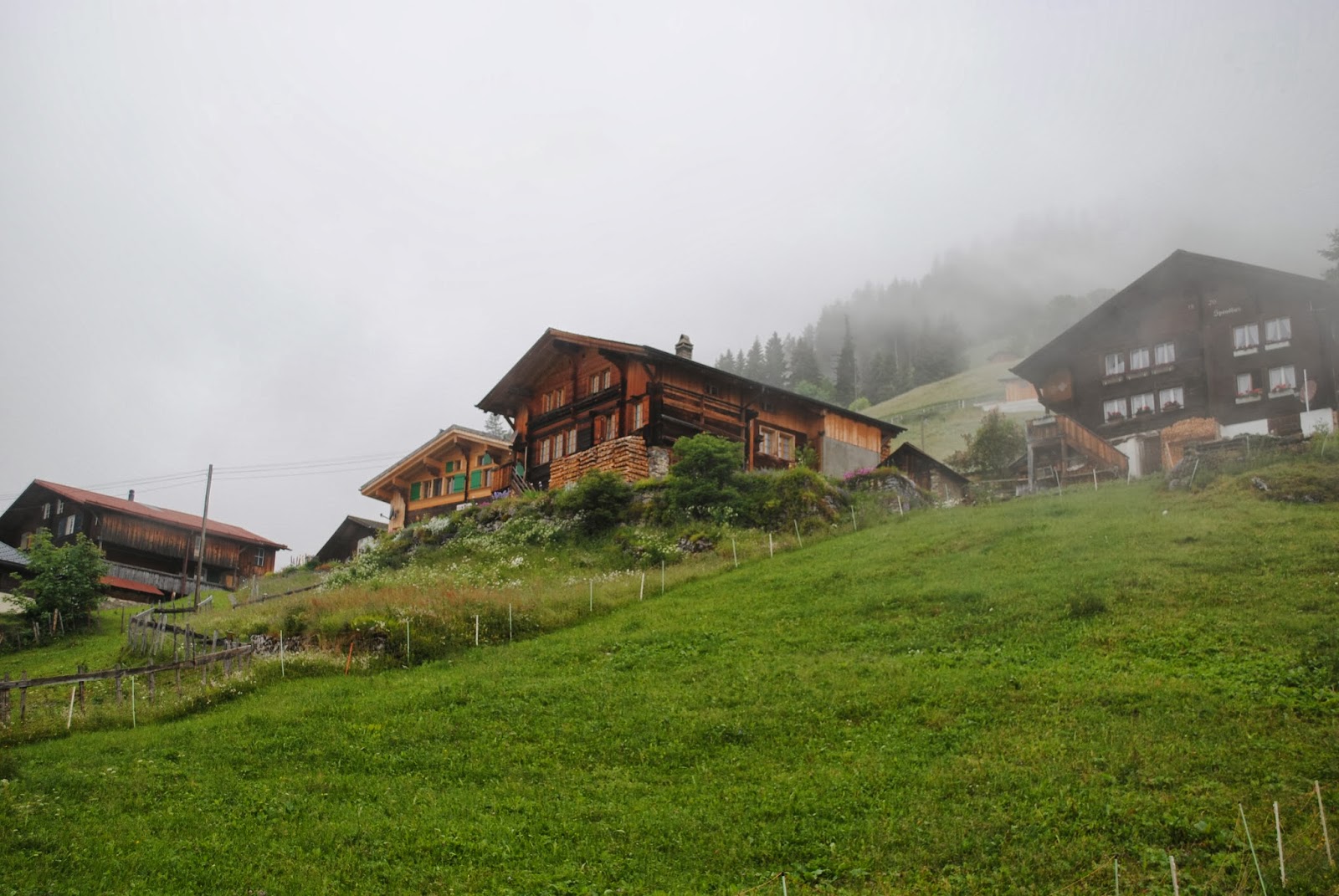
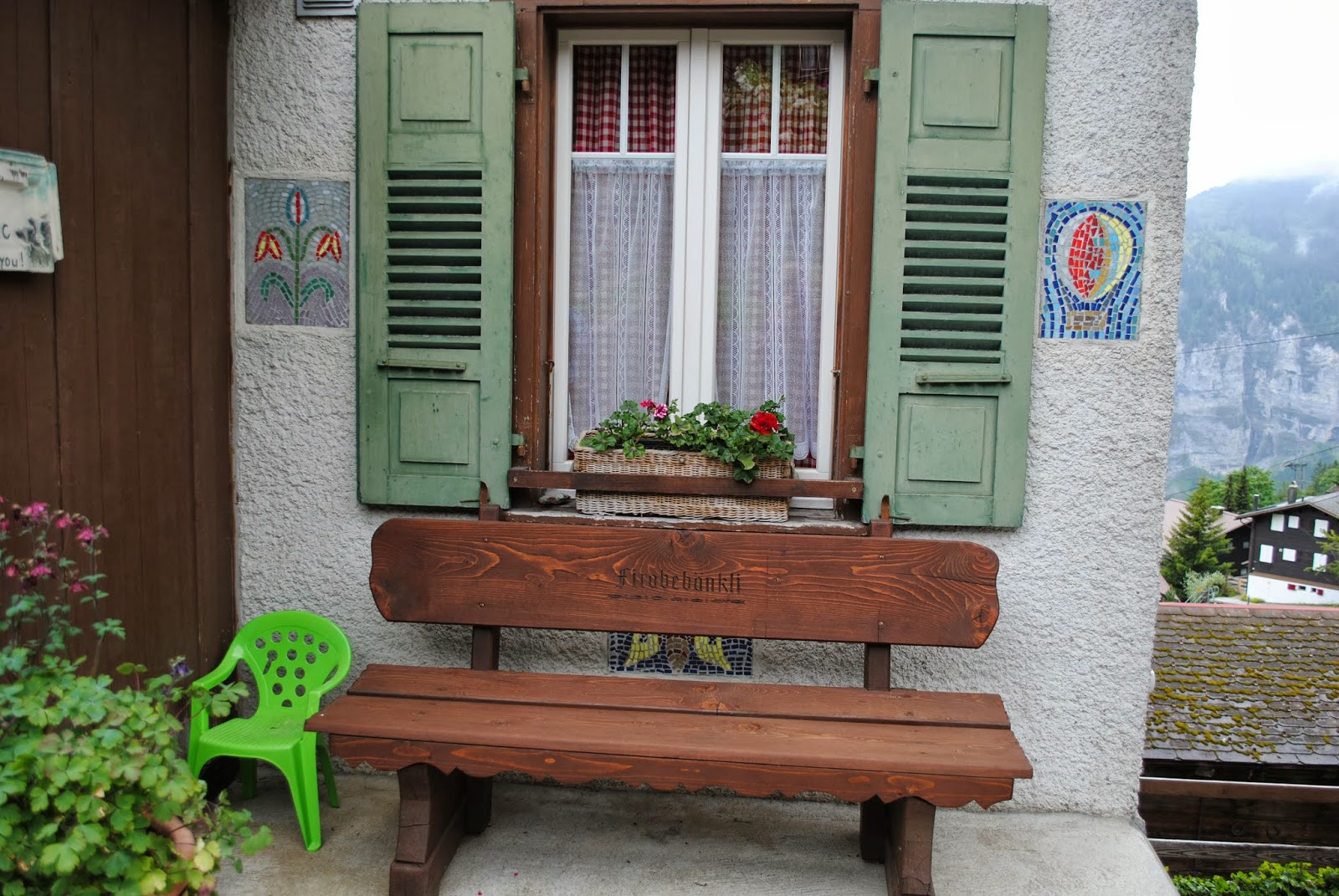
If everyone decorated their houses like the Swiss, the world would be a more beautiful place.


Murren


The Swiss remind me more of the American culture than the Italians (although I'm not sure people in New Jersey would agree).  They look like Americans, act like Americans...the only difference is that they speak better English.
Will write more later.  Very tired...going to bed.


The following photos are of a walk we took from Gimmelwald up the mountain to the next village, Murren.  


It took about an hour to walk.  Not that we were in any rush.  The scenery was breathtaking and we did  our best to savor every bit of it.


As you can see it was a steep climb.


These posts were put in to help slow avalanches.


Murren and Grimmelwald are nestled in-between three mountains:  Eiger, Monch, and Jungfrau.


Notice how we're looking down at the clouds?


More barriers to halt avalanches.


Cow:  "May I help you?"


Someone likes to hunt.


I took so many photos that I only have room for the walk up the mountain.  My next post will show our bike trip down the mountain.

Saturday, October 5, 2013

The Penal Colony from The Metamorphosis and Other Stories (Barnes and Nobles Classics)


The Penal Colony is the last story I'm going to review from this collection of short stories written by Kafka.  

The story is written in third person/limited.  We see everything through the eyes of a man referred to as the traveler, although we come to know through the dialogue that he is a doctor.  The traveler has come to visit a penal colony.  The officer who oversees the colony takes the traveler on a tour  of the facility.  It is really this officer who tells the story. 

While taking him around, the officer expounds on his philosophy on justice.  The officer considers any infraction of the rules, no matter how minor, to receive the consequences of justice.  This brand of justice is rigidly and mercilessly meted out by the lieutenant with absolutely no exceptions.  All infractions incur the death penalty.

And not just the death penalty, but death by torture.  The officer ends his tour by showing the doctor his piece de resistance.  The instrument that is used to torture prisoners and rule-breaking guards to death.

It is a gruesome invention that was designed to take hours to  kill the "criminal".  After it finally exterminates its victim, a hole is conveniently located beneath the machine to dispose of whatever is left of what once was a human being.

While the officer is explaining the instrument, the traveler notices a guard in chains.  Upon inquiring, he finds out that this soldier's job was to sleep in front of a captain's door but to wake up at every hour to salute the door.  One night the captain went to check to make sure the guard was really saluting his door on every hour.  When he finds the guard curled up asleep on the sidewalk he lashes his face with a whip.  The guard shakes the captain and tells the man to "throw away his whip or I'll swallow you whole!"

The captain reported the incident to the officer and the guard is now waiting to be executed in the machine.  The traveler is appalled but at the same time doesn't feel he can do anything to stop what is happening.

It turns out that the officer understands that a new Commandant is in power, unlike the old Commandant, this one considers the death machine inhumane.  The officer hopes by showing the traveler everything and explaining how things stand he will persuade the new Commandant not to interfere.

The traveler tells the officer that he has no choice but to be honest and tell the Commandant exactly what he has seen.  He is careful not to give his personal judgment on anything.

However, the officer knows enough of the new Commandant that he is the sort that does not believe in the Penal Colony's type of justice.  He knows that an era is about to end.

The officer knows that with the new Commandant, a new definition of justice will replace the old one and consequently redefine what the officer has termed "just".  Not only will the officer's executions be considered wrong, but will be considered criminal.  What does that make him? 

He looks at the traveler with understanding.  He assumes they both understand the situation.  The traveler does not understand but soon finds out what the officer means to do.  The officer believes he must carry out one more act of justice. Only this act of justice will conform to the new rules. The traveler watches in horror as the officer straps himself in the torture machine and dies horribly.

Again, this story raises a lot of questions in my mind.  What was Kafka getting at?  What was the message in this story?  Was he saying that morality is dependent on who is in power?  The traveler, who also serves as narrator, clearly finds the officers "justice" as wrong, even though he takes a passive stance.  

Kafka doesn't seem to be making a statement of relative morality because he is obviously trying to provoke the reader to a strong sense of injustice when regarding the hapless guard who is clearly being treated unjustly.  

Is he trying to make a thinly veiled comment on how he sees countries such as Germany or other European countries creating their own moralities based on the whims of despots?  

It's strange that the officer, who so gladly and easily condemned others to horrible deaths, carried his strange logic out to his own demise.  No one in real life would do that.  They would either repent of how they acted or go to their grave defending it.  Justice is carried out through outside parties (as in the Nuremberg trials).

And then there's the traveler.  Why did he feel so helpless?  Does he represent the rest of us when we see injustice happen but are too intimidated to stand up to it?  

Even the guard is portrayed as passively accepting his verdict.  He never shows outrage or a sense that his punishment does not fit the crime.

Yet in the end the traveler made it clear without stating his own opinion what he was going to do (report to the new commandant) and in the end his actions, albeit passive, did effect change.

Letters to Family, Friends and Editors is a book that is a collection of letters written by Kafka.  I would like to read it to see if it sheds any light on Kafka's intentions in writing his stories.


Kindle for .95


Or $10.99 on Kindle