
I read the book Fifteen Greek Plays by Oxford University Press (published 1943) while bouncing up and down on my elliptical. I read a play for each exercise session which meant exercising on the elliptical for up to an hour and a half per play.
This was not easy and I must admit I had a habit of checking to see how many more pages were left as I bounced and read.
On the positive side, I have lost twenty pounds since January and, frankly, reading while exercising makes a stationary machine a lot more bearable.
 |
| Hercaloo and I exercising and reading The Frogs |
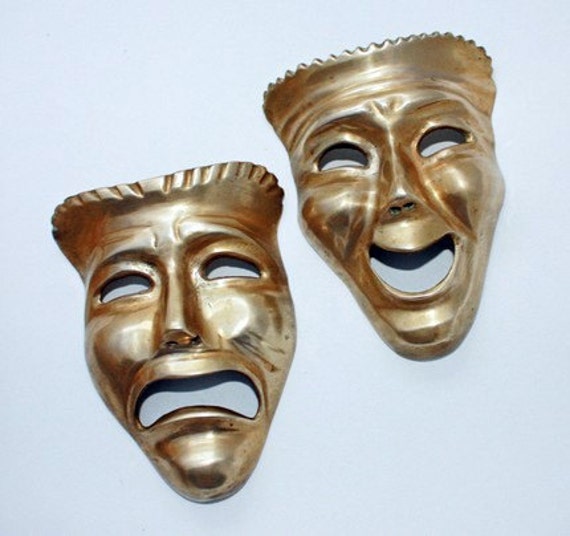
I have reviewed some of the plays on a previous post, I have not reviewed all of them, I don't feel particularly qualified to review any of them, but here are my impressions of the final two plays, one for each drama mask .
 Oedipus Rex by Sophocles
My rating: 5 of 5 starsOedipus is the son of the King of Thebes. He is sent away as an infant because an oracle prophesies that he will kill his father and marry his mother.
Not much to say. Can't fight the fates. It took Sophocles about fifty pages to arrive at that conclusion. This is one of three plays concerning this tragedy. The other two are Oedipus at Colossus and Antigone.
In Oedipus Rex, Oedipus has already become King (Rex) after, guess what, killing his father. Oedipus does not know that he is the murderer of his father who he thinks is the shepherd who raised him. After listening to an oracle telling him he would kill his father, he had left home and traveled to Thebes in order to avoid committing patricide. On the road to Thebes he kills his real father in an altercation. He spends a large part of the play searching for his father's murderer and upon discovering that he is the murderer and also guilty of incest, he gouges his eyes out. (Did I mention this was a tragedy? See unhappy face above.)
Most of this play is dialogue with the chorus coming in at the very end.
One thing worth noting. At first I thought the chorus was the third person narrator to break up the dialogue between the characters. It does provide that function on one level by making general observations about what is occurring. But the chorus also chimes in with a personal identity with emotions. Often the chorus is a lament at injustice and cruelty.
Such is the sad fate of Oedipus. All three plays are worth reading, not only because of their poetic eloquence (even in translation) but also for the sociological and cultural values one can learn from a people who play a role in developing the norms, values and culture we experience today.
View all my reviews

And now, as Monty Python would say, time for something different:
 The Frogs of Aristophanes: Acted at Athens at the Lenaean Festival B.C. 405; The Greek Text Revised with a Translation Into Corresponding Metres, Introduction and Commentary by Benjamin Bickley Rogers
My rating: 3 of 5 stars
The Frogs is a comedy, and a rather saucy, bawdy one at that, by Aristophanes. The god, Dionysus and his slave, Xanthias, go to Hades to retrieve the great tragic poets, Aeschylus and Euripides, because there are no good tragedy plays among the living anymore.
Dionysus asks his half-brother Heracles for advice on the quickest way to Hades. Heracles, after laughing uproariously at him, informs him of the quickest ways, all of which involve dying. Dionysus prefers to get there alive and, knowing that Heracles did it, dresses up in a lion skin, hoping to impersonate Heracles and with Xanthias arrive at a lake (isn't it the River Styx?). Charon ferries Dionysus across but Xanthias has to walk. Xanthias also gets to pretend to be a donkey on which Dionysus rides.
While crossing the lake a chorus of frogs sing. And that is all you're going to hear about them so why are they part of the title? Another mystery hidden from me when trying to understand Greek literature. Sigh.
While in Hades Dionysus trades places with Xanthias but this backfires on him as Xanthias, pretending to be Heracles acts offended with Aeacus, the doorman to Pluto's house, and demands Aeacus flog his "servant" (Dionysus) to prove his innocence. Later both Dionysus and Xanthias claim to be gods and are tortured to see if they are. The dialogue to this is pretty funny.
Aeacus: I'll give you blow for blow.
Xanthus: A good idea.
Aeacus: I struck you.
Xanthias (increduously) No.
Aeacus: Now then I'll strike the other. (Strikes Dionysus.)
Dionysus: Tell me when?
Aeacus: I struck you.
Dionysus: Struck me? Then why didn't I sneeze?
Aeacus: I'll try the other again.
Xanthia: Good gracious!
Aeacus: Not hurt you, did I?
Xanthias: No, I merely thought of the Diomeian feast of Heracles.
Aeacus: A holy man! 'Tis now the other's turn.
Dionysus: Hi! Hi!
Aeacus: But why these tears?
Dionysus: There's such a smell of onions.
And so on. It goes on for a while and each time Xanthias and Dionysus react in pain they find some excuse to explain away their reaction. It's pretty funny.
What I enjoyed, apart from the silliness, was the structure of the poem. How accurate Benjamin Bickley Rogers was I'll never know because I'm no ancient Greek scholar but his translation into English was highly successful in its rhythm and rhyme. I found myself rollicking along on my eilliptical as I read the "question and answer" dialogue. Here's an example:
I showed them scenes of common life,
the things we know and see,
Where any blunder would at once
by all detected be.
I never blustered once
their breath and wits away
By Cycnuses or Memnons clad
in terrible array.
The highlight of the play is when in the halls of Pluto, Dionysus and Xanthias come across Aeschylus and Euripides in a contest that aims at displaying for the audience a literary criticism of the aims and merits of each man's work.
Aeschylus wins and accompanies Dionysus back to Earth. Even so, Aristophanes shows a critical appreciation of Euripides and also Sophocles. The chorus are the voters who chant the same song the dead frogs were singing at the beginning of the play.
What I would surely enjoy is watching a performance, perhaps even in the original language.
View all my reviews


