
It is March first, Ash Wednesday. I am sitting outside in only slightly nippy weather. Hercule Parrot is on my hand as I type. Luckily he is light as a feather (ha!). My piggies are nibbling grass a few yards away. My dogs are patrolling the backyard. I'm grateful for them because they keep the Red-Tailed Hawks away from my pigs, although they do occasionally sit in the upper branches of my Oak tree (the hawks, not my dogs) and peer down like a couple of old men with their arms clasped behind their back. My pigs are well-fed. Could a hawk lift them?

By the way, I am listening to Maurice Ravel's Piano Concerto, 2nd movement as I write. It is simply one of the most beautiful, poignant pieces of music ever. I hope you will find a recording and enjoy it.
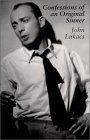 Confessions of an Original Sinner by John Lukacs
My rating: 3 of 5 stars
Lukacs was born in Hungary and as a young man went to live in England because his mother was an Anglophile and thought it was the only place for her son to become educated. He stayed there for school and college but returned to Hungary in time for WWII. His father was Roman Catholic (the religion he embraced) but his mother was Jewish and he was forced to fight in a Jewish battalion during the war.
After Germany's defeat, he realized that his country was going to become part of the Soviet "Iron Curtain" so he fled to America where he got a job teaching at a college. He has some interesting opinions about the responsibility Churchill and FDR had in letting Stalin have so much of Europe.
This book is filled with his memories but also his observations of Americans and comparing them to his own upbringing and also the culture prevalent in Europe at the time.
He has a habit of making some rather sweeping generalizations about American citizens, some of which I agree, others which I'm not sure it is completely accurate to make so broad a conclusion about so many people. But I think his is the perspective of an outsider who spent many years as a foreigner, feeling like a foreigner, being viewed as a foreigner, even though his goal was to assimilate into American culture.
He noticed that the average American was parochial in that they possess little interest beyond the scope of their immediate environment or culture. Little to no interest was shown him about his own background or history, even though it is very interesting and unusual.
Another observation was that over eighty percent of college educators are liberal and teach their classes accordingly. They filter every subject through the lens of socialist ideologies.
I thought this interesting as well as surprising since he made these observations back in the fifties and sixties. Lukacs remarks that there is a population of progressive elitists that believe the socialist model is the only experiment that can be successful and that America should look to Europe as a blueprint on which to construct our own society.
Never mind that the majority of immigrants in the world, including Europe, were (and are) applying for Visas to the United States. Lukacs considers these "elitists" to be out of touch with reality and can only preserve their vision by living in their self-made bubbles in the world of academia.
He notes that people out in the real world just want jobs and to pay their bills have a more pragmatic outlook.
I did not find much of his personal history interesting, except when he described his extreme loneliness for some years after immigrating because it was so hard to access people already entrenched in family and communities of which he had no part. As someone who has moved around a lot, I appreciated this because I experienced the same alienation.
He did finally marry and it was to a woman whose family could trace their ancestry back to the original settlers. His father-in-law was part of the "Old Money Aristocracy." When his wife died he married another woman belonging to the old Aristocracy, this time from the Old South. Lukacs does not say but I wonder if marrying these women was an unconscious effort on his part to finally belong to his chosen country. If his roots did not go deep, at least his children's did.
The information Lukacs presented was very interesting but his writing could be a bit dry. I hope that was not how he lectured to his class at University. There were certain musings, recollections and details that could have been eliminated to produce a more fluid content.
Nevertheless, this book is worthwhile and I recommend it.
View all my reviews


