Showing posts with label Mozart. Show all posts

Thursday, August 25, 2016

Mozart: A Life by Paul Johnson

 Guess what has come to live in my "salon" as a birthday present from my One and Only?


He also got me these:


     And a cake but that didn't last long enough to photograph.

 The piano is a 1981 Baldwin 6 foot 2 grand.  I gave away my 1920 Knabe player piano to a good home and upgraded.  We searched far and wide for a piano that possessed all the qualities I want: even action, bell like tone in the upper register, deep resonant bass and we finally found it in a piano that had been in a recording studio for many years.  It is such a blessing to play on this, especially since I have two recitals coming up, including one this Friday!


Yes ladies and gentlemen I am dishing out yet another biography of Mozart and I'm not even through reading all the biographies I've read on the man (I'm saving Otto Jahn's three volume work for last).  

The author of this book, Paul Johnson, believes that Mozart's Clarinet Concerto in A K622, is the most sublime of his works so I create a link here for your listening pleasure.  The clarinet doesn't come in immediately so, as they say, wait for it.


https://s-media-cache-ak0.pinimg.com/236x/b0/88/ba/b088bacdafe749bb1ff154d085cbb9be.jpg

Some of you may be thinking what else can anyone say about the guy.  We have a sentimental chronological time line dramatized with great license from Marcia Davenport.  We have a thorough and exhaustive description of the cultural surroundings and political climate in Robert Gutman's Mozart:  A Cultural Biography.  What is lacking?

How about a biography that focuses solely on the composer's music? 

Paul Johnson's book is short, a mere 164 pages long.  But each chapter goes into different parts of Mozart as a composer and how he mastered every part of music writing.

The first chapter discusses his ability to create music when he was still young.  Chapter two goes into great detail as to how Mozart mastered most of the instruments of the orchestra and consequently catered his writing to the unique attributes each instrument possessed. 

 He was quite flexible.  If a certain orchestra was lacking in, say, clarinets, then he quickly rewrote the work to accommodate what wind instruments were available.  Or not.  Sometimes he transcribed the parts to another section altogether.  Some orchestra works are the same piece with the emphasis on the brass and others on the reeds, each successful with the diverse timbre coloring that comes with each family of instruments.

Johnson does not avoid timelines completely.  In addition to meticulously recording what compositions were written when and where, he also includes, in Chapter Three, when Mozart lived in Salzberg, Paris, London or Vienna. He writes of his marriage to Constanze and how that affected his composing.

Chapter four is about Mozart's operas, when and how they were written.  It is interesting that even though some of Mozart's greatest compositions were instrumental, what carried his career were his operas.  He wrote twenty-three operas, four in the last few years of his life, two in his final year (and his first when he was only ten). 

The last chapter concerns Mozart's death.  Johnson attempts to dispel prevailing myths, such as Mozart died a pauper and alone.  According to Johnson, many people attended his funeral and he was buried as most people were then, in a public burial lot.

It is interesting that Johnson has a different take on Mozart's father Leopold than the previous biographers who cast him in an ill-favored light.  Johnson takes the opposite stance, that his father was not the over-bearing monster, trying to make himself through his son, but rather was mostly trying to bestow good sense on him.  Frankly, that is the conclusion I had gathered from only reading Mozart's letters.

He also insists that Mozart was not perpetually poor and that writing "begging letters" as he calls it were normal during a time when paper currency was rare.  Mozart and later his widow, paid their debts faithfully.  Unlike the conclusions of Davenport who asserts that Constanze learned good economy from her second husband, Johnson insists that she was financially sensible all along and that Mozart actually made very good money for the time period in which he lived.

He supports this with comparing the salary of Mozart to many other professions of the time as well as the life-style he kept.  Davenport and Gutman conclude that Mozart lived beyond his means.  Johnson argued otherwise and states that borrowing money was a common practice then.

Reading these three biographies, as well as Mozart's letters, made me realize that different people can access the same information yet arrive at varying conclusions.

The most charming aspect of this book is Johnson's analysis of Mozart's work.  He openly inserts his own opinion as to his favorite compositions and his descriptions made me want to  run immediately to my Spotify and download as many of Mozart's compositions as possible.

Mozart wrote hundreds of compositions and it is impossible to have all of them catalogued although Ludwig von Koeschel valiantly attempted in 1862.  That is why when you look at works by Mozart it will have a "K" followed by a number opus.  The "K" or "KV" stands for Köchelverzeichnis.


Even though this biography is brief, it contains a lot of indepth detail concerning the instrumentation of Mozart's work, which not everyone would find interesting.  However, I don't think it should deter even the lay person but encourage one to further appreciate the genius of Mozart and hopefully inspire them to listen to his music.


Sunday, July 3, 2016

Mozart: A Cultural Biography by Robert W. Gutman

The Symphonic Poem by Cesar Franck is playing as I write my latest book review. I guess I should be playing something by Mozart since I'm reviewing a biography of him, but I randomly turned on the Classical station and this is what is playing.


Mozart:  A Cultural Biography is the third biographical work I've read on the composer, including the letters which are probably the most revealing.

So far this is the best.  It is a scholarly work and quite exhaustive.  Not only does Gutman provide the chronology of Mozart's life but he fills in the back drop:  what was going on politically in Austria and Europe, who were the leaders, what philosophical movements were growing such as the enlightenment, and how that ran up against a population that was still devoutly Catholic.  Not much is spoken of the Reformation but perhaps that didn't come into play in Mozart's life.

What this book provides is a much more thorough picture of the life of one of the greatest composers known to the world.  Gutman accomplishes this on a external as well as internal level.

We see how the political landscape and leadership affected Mozart's thinking as well as his career.  The Enlightenment with it's vocal supporters such as Voltaire, Spinoza, Kant, Descartes etc..were gaining ground and influence, culminating in the French Revolution, had an impact on his career since the Esterhazy house of Austria became panic-stricken over the assassination of the Prince's cousin, Marie Atoinette. Prince Esterhazy as well as the Royal leaders of all Europe suddenly became preoccupied with any possible threat to their positions.

Mozart and his father and sister toured Paris prior to that and Mozart, later as a young adult, toured again with his mother.  Neither tours provided any success and perhaps the clouds of discontent  that were gathering were responsible as well as Mozart's inability to defer to nobility.

In Mozart's native country, Austria, we see the different leaders, those that appreciated music, those that didn't, their influence and tenuous relationship with Mozart. 


In the biography by Marcia Davenport, in addition to being a sentimental dramatization of his life, portrayed the composer as largely unappreciated and unrecognized until after his death.  Gutman shows a different picture.

According to Gutman, Mozart and his father couldn't comprehend aristocratic politics.  Instead of simply bowing and smiling to people undoubtedly less musically knowledgeable, they would take on airs to the point of being insufferably arrogant.  Needless to say, they didn't win many friends with people in positions of power.

Most of this was due to Leopold.  Leopold needs to go down in history as the worst stage parent ever.  He  relentlessly exploited both his children, forcing them all over Europe to tour, compromising their health.  It's a wonder Mozart lived as long as he did.

Leopold also had delusions of grandeur.  His letters show someone who is not above exaggerating and even lying about Nannerl and Amadeus' success and connections to different Royal governing officials.  If Mozart hadn't eventually cut himself off from his father, he possibly would  have been a social pariah for the rest of his life.

Fortunately for Mozart and mankind, he did.  He left his father's home in Salzberg and took up residence in Vienna.  Away from the influence of his father, Mozart was able to temper some of his more flamboyant tendencies and carve out a career for himself.

In point of fact, contrary to the impression Davenport gives in her book, Mozart was slowly but surely gaining a reputation. The last six to nine years of his life showed, if not monetary success (and he would have had that, if he had been a better manager of his money), a steady path to fame and finally legend.

Even there Leopold's tentacles tried to reach out.  Declaring himself to be on the edge of poverty, a good chunk of Amadeus' money went straight to his father and the support of his sister (his mother died while they were traveling in Paris).  He constantly orders through his letters, which were largely ignored by his son.

I will say, however, that as I read the letters between father and  son, I assumed that Leopold was being the sensible one while Mozart was the dreamer.  This may have been true, but Gutman paints a larger picture that shows just how domineering Leopold was and how inadequately he prepared his son for adult life.  Maybe he wanted him to be forever a child, dependent on him.

My book of letters are not complete.  Gutman quotes many letters that show a man who took a very long time to grow up.  His sense of humor is shockingly gross, akin to a twelve year old boy, even though Amadeus was in his twenties.  He seemed fixated on anal humor.

However, Gutman prints a letter of Mozart's mother and it is similarly coarse and vulgar.  Maybe it was a family trait, or even a natural part of Salzberg culture. Gutman makes several comparisons to the "peasant" class of Salzberg compared to the more sophisticated Viennese.  Since Mozart spent the remainder of his life in Vienna, perhaps it tempered his "lower" instincts.

A few things that Gutman revealed that I did not realize was his devoted and loving relationship with his wife Constanze.  When Mozart wrote to his father about his engagement to Constanze Weber, he predictably exploded.  He threatened his son with severance of the family and every dire outcome that would result in this uneven match.  Loyal to her father, Nannerl joined in league with him and both remained cold and aloof to both Amadeus and Constanze, even refusing them visitation in their home when they were in town.

Constanze has had a negative reputation as a flaky airhead of a wife who couldn't begin to comprehend her husband's genius.   We now know the source of that information came largely from Nannerl who determined to stay true to her father's position even after his death, a mere four years before his son's. 

In reality, Constanze was quite musical herself, coming from a musical family.  Her oldest sister, Aloysia, was a highly successful opera singer.  Constance, at first, was as impractical in money matters as her husband, but she grew to become quite competent in finances and was able to pay off all her husband's debts.

A side story is that initially, Amadeus was obsessed with Aloysia, and believed she was the love of his life.  She, however, took up with an actor so Mozart, being practical, turned his attention to the third daughter, Contanze.  Later in life, when her star had faded and she was old, unknown and poor while Mozart had achieved world renown, one has to wonder if Aloysia ever had second thoughts.  According to Gutman, she never tired of telling her sister, Constanze, that she was his "first and true love" and he never stopped loving her.  What a witch.

And it wasn't true.  Mozart's letters show an intense passion and tender care for Constanze.  He couldn't bear to be apart from her, felt incomplete without her.  And, without going into too much detail, was quite randy.  Mozart had a healthy sexual appetite and kept his wife in a state of almost constant pregnancy for the nine years of their marriage.

Which brings me to another surprising trait of the Mozart's and probably their contemporary culture. Maybe it was because children died so easily (Amadeus and Constanze had six children but only two survived to adulthood), but there seemed to be a callous disregard to children.

Children were shuffled off to a wet nurse while the parents went on their business.  Child-rearing seemed to be largely delegated to the servants.  Once Amadeus and Constanze went off on tour, leaving the newborn with a wet nurse and came back to find out the poor child had died three weeks previously.

In addition to cultural and personal facts, Gutman interlaces compositional analysis into his biography.  He uses quite a bit of subjective visual imagery when describing Mozart's writing techniques, especially his operas.  I suppose his objective is to provide the reader with insight into the deeper philosophical meanings and political messages Mozart was attempting but I found it all to be rather a bit of hand waving.

Mozart, it seemed, was never in robust health, but nevertheless kept up a frenetic schedule of composing and performing. This finally compromised his health and he became bedridden.  The doctors with their usual routine of emetics, enemas, and bloodletting did the rest. He died at the age of thirty-five.

Contrary to popular belief, he was not buried in a pauper's grave.  While it is true, the funeral was simple and no one accompanied the coffin (due to spread of disease), he was buried in a public grave with a small plaque.  Unfortunately, every ten years these graves were plowed  up to accommodate new inmates.  By the time anyone thought to preserve his body (something extremely expensive to do) it was too late.

Following her husband's demise, Constanze showed her true mettle and shrewd business acumen.  She toured with a company, performing and selling her husbands works, paid off all his debts, remarried a Danish Civil Servant, who, with Constanze wrote one of the first biographies of Mozart.

Ironically, Constanze and George Nikolaus von Nissen, her second husband's graves are located in St. Sebastian Church in Salzburg.  There is even a disputed photograph of her.  She was alive at the time of the photo in 1840, but not everyone is in agreement that the photograph actually shows Constanze.  Here's a link, if you're interested:
Constanze Weber 

This book is thirty-five chapters long and each chapter is about twenty pages.  It is, in my opinion, quite a scholarly work, probably containing more information than the average person wants to know about Mozart.  I however, thoroughly enjoyed it and even looking forward to reading what is considered to be the definitive biography of Wolfgang Amadeus:  the three volume work by Otto Jahn.
 https://upload.wikimedia.org/wikipedia/commons/3/3f/Wolfgang-amadeus-mozart_2.jpg
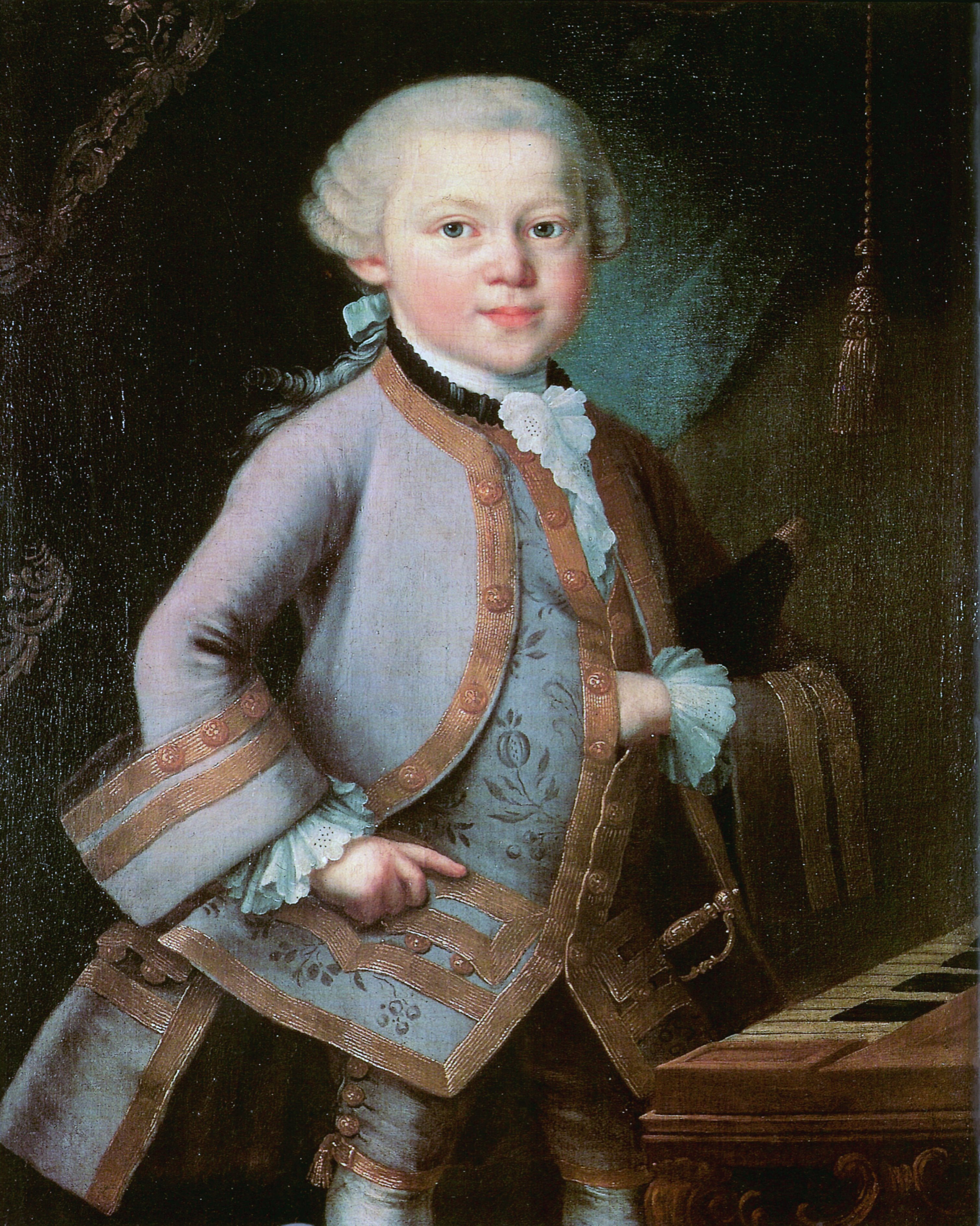
Wolfgang Amadeus Mozart
1757-1791


Other links:

http://www.wolfgang-amadeus.at/en/biography_of_Mozart.php 

http://www.biography.com/people/wolfgang-mozart-9417115 

http://www.ipl.org/div/mushist/clas/mozart.html 


Sunday, April 24, 2016

Letters of Mozart and Beethoven

 
Being a classical musician, I like to read biographies of the composers whose music I have performed.  Learning a piece of music is comparable to a relationship with someone.  You get to know the work, dig deep into all the different layers, melodies, musical sentences, harmonies, sounds that are supposed to be in the forefront, the ones that are supposed to be in the background.  Songs do speak,  and each musical sentence is saying something.  It's important to listen closely to what you are playing so you can successfully carry that message over to the audience.
Bosephus Hambone is trying to decide which Mozart biography to read first.

And of course, that doesn't begin to describe the amount of practicing involved just to be able to play the notes correctly.  People have called me creative because I am a musician.   That is not exactly true.  Strictly speaking, I am an interpreter of other people's creations.  

As ballet dancers interpret sound through the motion of their body, I must produce that sound correctly so that it communicates what the composer intended to express.

One of the things that helps me as an interpreter is to read up on the historical time periods of the composers.  I read everything about those composers and also look at the art that influeneced the composers.  I find that the art gives me a visual comparison to the aural experience I am trying to produce by playing a certain composition. 

 For example, what Rembrandt achieved with chiaroscuro in his paintings, Beethoven tried to create aurally.  Chiaroscuro is the sharp contrast between light and dark.  Here is a painting of Rembrandt to show what I mean:

http://bryanbeus.com/wp-content/uploads/2010/08/Rembrandt_night_watch.jpg

 If one listens to Beethoven's works, be it symphonies or a piano sonata, one can hear the great contrast between loud and soft, the whole orchestra playing, then suddenly one instrument playing.  Fast vs. slow; calm vs. passion.  His works are in constant flux between contrasting elements.

One thing I never did previously was read the letters of composers.  I don't know, I felt it was an invasion of privacy.  I have had a book of Mozart's letters for 28 years.  It was a gift from the organist at my church in high school.  Just a few months ago, I finally dusted it off and read it.  

What a delightful collection!  I then bought Beethoven's letters and enjoyed that too.  Here is a brief description of both:


Mozart's letters are all the joy, cheer, brilliant wit and love of life that is expressed in his music put into words.  The letters are primarily between the composer and his father.  It is easy to see the optimist, naive, little boy with a wicked sense of humor who never quite grew up.  All of his letters to his father are gushing about the latest friends he has made ("Count so and so loves my work he is going to commission me to write so many sonatas if I will travel to Italy with him etc...") 

And his father's response:  "Are you out of your feather-headed mind?!  I told you to stay in Vienna where you can get a real job with a commission at the court."

I'm paraphrasing, but you get the idea.

Back and forth it goes.  We learn a lot about the aristocracy and how they treated the little guy.  Mozart was apparently a little guy.  He was always strapped for funds and even though many wealthy patrons enjoyed his music, they weren't always intelligent enough to truly understand the genius behind it.  They often treated him disrespectfully.  Here's an excerpt from one of his letters:

So I presented myself.  On my arrival I was made to wait half an hour in a great ice-cold unwarmed room, unprovided with any fireplace.  At length the Duchesses de Chabot came in, greeted me with the greatest civility, begged me to make the best of the clavier since it was the only one in order, and asked me to try it. 'I am very willing to play,' I said, 'but momentarily it is impossible, for my hands are numb with the cold,' and I begged she would have me conducted to a room with a fire. 'Oh, oui Monsieur, vous avez raison,' was all the answer I received and thereupon she sat down and began to sketch in company with a party of gentlemen who sat in a circle round a big able.  There I had the honor of waiting fully an hour...

At last, to be brief, I played on the wretched, miserable pianoforte...however, Madame and her gentlemen never ceased their sketching for a moment, so that I had to play to the chairs, tables and walls...

Then as likely as not, they wouldn't buy his works, or they would take them and not pay him for them.  In short, Mozart was at the mercy of rich patrons who took advantage of him.  

And yet he never lost his sense of cheer and joie de vivre which permeates throughout all his letters, counterpointed by his father's thunderous ones which provides us with a rollicking "storm vs. cheerful exuberance" kind of literary journey.

Also evident in his letters is his deep religious fervor.  He changed his middle name to "Amadeus" which means "to love God". This is also expressed in all his music but especially in his masses. Mozart wrote over sixty religious works.  He said: 

I thank my God for graciously granting me the opportunity of learning that death is the key which unlocks the door to our true happiness.

And  also his animosity towards those he deemed immoral. He wrote of Voltaire:


The ungodly arch-villain, Voltaire, has died like a dog. I have always had God before my eyes… Friends who have no religion cannot long be my friends.

  The movie "Amadeus" portrayed Mozart as something of a womanizer but he wasn't.  While he enjoyed flirtatious banter with various ladies, he explained to his father his intentions of marrying were for a number of reasons, including that, frankly, he didn't want to catch a disease.  So Mozart was hopelessly romantic, which is evident in how he describes his beautiful, charming bride, Constanze, but also pragmatic.  They had six children, only two of who survived.

Unfortunately, Mozart was not good with his finances, which were already distressed by fickle Royalty who were erratic with their payments.  The last few letters in the book are addressed to a friend of Mozart who had lent him some money.  These letters contain painful to read pleas for more money to help the young composer get out of his desperate straits.

The last letter included is by Constanze, who is asking the same man for money to help settle the now dead composer's affairs.  A short epilogue is included to inform the reader that she was able to pay off all of her husband's debts.

https://upload.wikimedia.org/wikipedia/commons/1/1e/Wolfgang-amadeus-mozart_1.jpg 
Wolfgang Amadeus Mozart  1756-1791

 Bosephus has decided to start with the one by Marcia Davenport


Enthusiastically riding the wave of Mozart's letters, I immediately plunged into a collection of Beethoven's.  This was  after I read a good biography of his life by George Alexander Fischer.  I have others to read but this one had very good foot notes and was well written and was free on kindle so a gem all around.

As bouncy and effervescent as Mozart's letters were, Beethoven's are deep, deep waters with powerful surges, creating tidal waves of emotion.  They are not less or more beautiful but wonderfully different.

A few things surprised me.  While Mozart could be impish to the point of immaturity in mocking people he deemed of lesser talent, Beethoven was surprisingly generous.  In fact, he barely mentions anyone whose playing or composing he doesn't like but spends a great deal of time pouring out volumes of praise on those he did.  His praise is not superficial or melodramatic but filled with love and honor.  Among those composers he loved are J.S. Bach and his son, C.P.E. Bach.  He kept in contact with C.P.E. Bach's son and worked hard to help him promote his father's work.

He sings the praises of Mozart, who, in one generation, had gone from relatively unknown to a national hero.  

He also loved Handel, and also the poet Frederich Schiller-from whom he set the words to Schiller's poem, "An de Freude"-in English "Ode to Joy"- to the final movement of his Ninth Symphony (Joyful, Joyful, We Adore Thee).  

He had a rather one-sided relationship with the great German writer Goethe.  Beethoven loved Goethe and Goethe disliked Beethoven.   This was because of an incident that Beethoven brought upon himself.

Beethoven and Goethe were walking down a promenade where the Empress was walking with her retinue.  Goethe immediately stepped aside, took off his hat and bowed low until they had all passed.  Beethoven, on the other, kept walking and talking, forcing the retinue to move out of his way as he passed.  This shocked Goethe and he never had anything more to do with the composer.

This did not prevent Beethoven from admiring Goethe and he continued to write many works based on the writings of the great "German Renaissance man."

Another difference between Mozart and Beethoven as might already be imagined is that Beethoven did not do Royalty's bidding, they did his.  He stormed out of a Prince's house after a perceived insult exclaiming, "There are and will be thousands of princes, but there is only ONE Beethoven!"

One thing in Beethoven's favor is that Royalty no longer held a monopoly on the patronage of musical composition .  Primary funding came from publishers who bought the music and distributed it.  Many of the letters in my collection are highly entertaining epistles to publishers from Beethoven who lets them know in no unclear terms exactly where they can go if they do not copy his music to his exact specifications or give him a cent less than the amount he demands for them.

Beethoven's great emotion comes surging out of his letters in the same way music propels off the pages of his compositions.  He is almost bi-polar in his relationships.  One letter is telling a friend how much he hates him and the very next is an abject apology for "losing control of himself".

One of the interesting things is Beethoven's devotion to obtaining custody of his brother's son from the mother.  There are many court battles and as energetic and violent as Beethoven could be, the mother seems up to the task.  It is a horrible case and the nephew at one point attempts suicide.  Luckily he survives and eventually turns out well, a result he credits his uncle with.

Beethoven also loved many women, and to my surprise they loved him back and wished to marry him.  In the end, however, he chose celibacy and never married.  (I choose the word "celibacy" because that is the word used in the book.  I know that flies in the face of our present culture that can't believe anyone not a priest would be so, but there it is.)

It's probably easy to remain celibate when you're chronically ill and Beethoven was chronically ill.  As his hearing loss became worse, so did his spells of depression.  It is a mystery how he came to lose it.  Theories of congenital syphilis have been debunked because none of his siblings were affected with it and Beethoven was the oldest.  An autopsy showed his inner ears to be inflamed.  Probably and tragically it was something that could have been easily remedied today with antibiotics or tubes in the ears.

There were many other ailments, his liver, stomach, joints.  He seemed as he aged to become enveloped in constant pain.  He finally died at the age of fifty-seven.  An autopsy was performed per his request and his liver was found to be shrunken.  This could be due to many causes but the most likely is lead poisoning from drinking contaminated water and leaden cups.  His body was found to have sixty times the amount above normal.

There isn't enough room to discuss Beethoven's music but a few things I found interesting was that he only wrote one opera, Fidelio, because he despised the vulgar and immoral humor that was prevalent in that genre (Mozart, who wrote twenty operas, apparently didn't have the same compunction) .  He thought all music should be a religious experience.  His opera was about the undying faithfulness of a wife to her husband.  It was not popular during his lifetime, but later came to be understood for its greatness.

Then let us do what is right, strive toward the unattainable, develop as fully as we can the gifts God has given us and never stop learning.  L. van Beethoven


Some have disputed Beethoven's religious views.  He was born Roman Catholic but was not known for attending services.  However, his views are best expressed in his Masses, of which he wrote several, and especially his Missa Solemnis.  In the slow movement of his String Quartet No. 15 he wrote the title:  "Holy Song of Thanksgiving to God from a Convalescent".


No friend have I.  I must live by myself alone; but I know well that God is nearer to me than others in my art so I will walk fearlessly with Him.  L. van Beethoven

What I found to be the most rewarding aspect of reading these great men's letters is that it seems as if they are talking directly to me.  I am hearing their voice, crossing the boundaries of over a hundred years telling me their thoughts.  That cannot but increase a sense of intimacy with them and I know that my performance of their works will not be the same.

 http://a4.files.biography.com/image/upload/c_fill,cs_srgb,dpr_1.0,g_face,h_300,q_80,w_300/MTI2NTgyMzIxOTcyMjU5NDU5.jpg
 Ludwig van Beethoven 1770-1827