
Since today's review will be about Isaac Newton, I thought it would be appropriate to play some music by a contemporary musician.
Everyone knows, G. F. Handel, and J. S. Bach, but not everyone is familiar with Jean-Philippe Rameau. The composition, Nouvelles Suites (performed by Alexandre Tharaud) is a transcription for the piano. I love the harpsichord, but I have discovered that is not true for everyone and the piano has vastly superior expressive qualities. You can listen here.
This was a hard book to review, but I want to review it since I read it, however I review it with reservations about my ability to accurately assess the words of someone who history proves to be one of our greatest mathematicians.
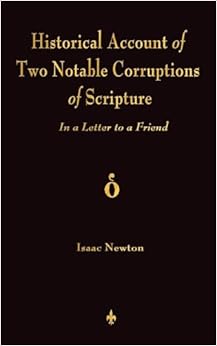
I'm not sure I entirely understand everything that Newton is asserting because almost half of the letter is in Latin and Greek. I presume this is because Newton is trying to prove his point by going back to the original languages of Scripture. And what is his point? That based on two scriptures that he claims have been corrupted, the Trinity does not exist. Or, to be more precise, Jesus Christ is not divine.
Before I explain his reasoning let me first quote the two Scriptures he is referring to.
The first is from 1 John 5:7,8
7.For there are three that bear record in heaven, the Father, the Word, and the Holy Ghost: and these three are one. And there are three that bear witness in earth, the Spirit, and the water, and the blood: and these three agree in one.
The above Verses are a direct quotation of the King James Version. Newton's argument with this translation is that even though it is directly translated from the Greek and Latin, it is only from later manuscripts that the un-italicized portion is inserted. The earliest manuscripts don't include them.
And indeed, my Bibles, which are English Standard Version, New American Standard, New International Version and Holman Christian Study Bible omit the un-italicized part altogether, although they include a foot note about later manuscripts including it.
To make it clearer to the reader, this is a direct quote from the English Standard Version of the same two verses:
7 For there are three that testify: 8 the Spirit, the water and the blood; and the three are in agreement
The other translations are no different than the above quotation.
Newton asserts that because in heaven, the Father, the Word, and the Holy Ghost: and these three are one. And there are three that bear witness in earth were later additions, these two verses were corrupted to make a false claim, namely that the Trinity (one God in three persons) is non-existent.
I will here point out that the foot notes in my English Standard Version Bible explains the verses this way:
The Gospel is not based on merely human testimony. John indicates that there are in fact "three that testify", namely the witness of the Spirit, the water baptism of Jesus (including the "Spirit descending on him like a dove") and the voice of the Father from heaven; Mark 1:10-11 and the blood (which "cleanses us from all unrighteousness"; 1 John 1:7). These three agree thereby providing persuasive confirmation for believing in Jesus as the "Son of God". The Old Testament taught that every charge must be confirmed by two or three witnesses.
Personally, I have no quibble with what Newton is expostulating concerning what might be extra-biblical Scripture. However, the question is, what is the original Scripture declaring?
For that we need to start with the beginning of the chapter. I will provide a link here so I don't have to retype everything: 1 John 5.
In a nutshell, John is stating that Christians' salvation is determined by their belief in Jesus as the Son of God because only He made the sacrifice by shedding His blood on the Cross and paying for the sins of all who believe in Him.
I will mention that the point is not whether the readers of my blog believe that or not, but rather what the Scripture is actually saying.
It seems to me that Isaac Newton, in one of the most tragic of ironies, misses the entire point of this passage of Scripture based on a portion of -what he considers-spurious words. I say what Newton considers to be spurious because the more I have been reading various sources concerning the scripture in question I am seeing good arguments for including as well as excluding those portions.
But even if that part does not belong there, so what? The context of the entire chapter is to clearly pronounce Jesus Christ as the Son of God.
Several passages of Scripture assert this. The most obvious passages would be John 1:1-5 and 14 (italics mine).
1 In the beginning was the Word, and the Word was with God, and the Word was God. 2 He was in the beginning with God. 3 All things were made through him, and without him was not any thing made that was made. 4 In him was life, and the life was the light of men. 5 The light shines in the darkness, and the darkness has not overcome it.
14 And the Word became flesh and dwelt among us, and we have seen his glory, glory as of the only Son from the Father, full of grace and truth.
And Revelation 1:8 and 17,18:
8 “I am the Alpha and the Omega,” says the Lord God, “who is and who was and who is to come, the Almighty.”
17. When I saw him, I fell at his feet as though dead. But he laid his right hand on me, saying, “Fear not, I am the first and the last, 18 and the living one. I died, and behold I am alive forevermore, and I have the keys of Death and Hades.
The Pharisees knew what Jesus was proclaiming when he forgave the paralytic's sins. John 10:33:
The Jews answered him, “It is not for a good work that we are going to
stone you but for blasphemy, because you, being a man, make yourself
God.”
Then there are Jesus' very own words, John 3:16:
16 For
God so loved the world, that he gave his only begotten Son, that
whosoever believeth on him should not perish, but have eternal life.
Now whether you are a Christian or not, no one can argue that Scripture in fact says this. Pick up any Bible and you can read it for yourself.
It mystifies me that Newton would write an 85 page letter to a friend, declaring an Arian viewpoint.
The other Scripture is 1 Timothy 3:16. Here it is in its entirety in the KJV that Newton claimed to be corrupted:
16 And
without controversy great is the mystery of godliness: God was manifest
in the flesh, justified in the Spirit, seen of angels, preached unto
the Gentiles, believed on in the world, received up into glory.
Newton's argument here is that the Scripture should not be translated "was manifest in the flesh" but should say "made manifest" in the flesh. My other translations say "manifested in the flesh". I can't comment because the subtlety is lost on me.
However, Newton's big argument is that theos rather than theon is used. One is the singular Greek form of God and the second is the plural. He says that it is clear that the singular form is the true form, therefore there is no Trinity.
Actually, that is wrong. Because the Trinity doctrine clearly states One God, Three Persons. So naturally, the singular for God would be used.
It is very possible that I am in way over my head with Newton's arguments. I have looked up several sources to make sure that I got his argument correct, so I'm not relying entirely on my own reading. But it completely eludes me how someone as brilliant as Isaac Newton could use such poor reasoning.
He ignores the entire Bible except for two scriptures and uses corrupted versions to base an entire thesis denying the Deity of Christ. And he takes 85 pages to do it! What he states, he states clearly enough on the first couple of pages then repeats himself for the next 83.
It's as though he spent a life time spinning round and round staring at his toes.
If someone wants to deny the truth of Scripture that is one thing, but to insist that Bible is not saying what it is clearly saying throughout the Old and New Testament defies logic.
But as I say, I may not be understanding Newton's argument. If anyone else has read this letter I would love to hear their input.


