Showing posts with label American. Biogrpahy. Show all posts

Sunday, April 12, 2015

Kafka Was the Rage by Anatole Broyard


Anatole Broyard came from a French Creole family that moved to Brooklyn while he was a child.  After serving in the Army he moved to Greenwich Village in 1947 to forge an identity for himself with the avante-garde sub culture of artists, writers and musicians, otherwise known as the "Beat Generation".

This was a time when Kafka was the rage, as were the Abstract Expressionists and revisionism in psychoanalysis. (pg.3)

Broyard's book is a memoir of his early years there before he went on to become a critic and essayist for the New York Times.

He writes mostly of his sex life.  First it's with an artist named Sheri who was a protege of the artist Anais Nin.  Broyard moves in with Sheri and they live in her filthy, dingy apartment.  Sheri comes across as someone who never cleans or bathes.  When Anatole asks for the key to the hall bathroom she tells him to use the sink.  When he tells her there are dishes in the sink she responds that they have to be cleaned anyway.  Months later when he moves out he notes that the same dishes were still in the sink.  Ew.

There are other women but it would get monotonous to describe them all.  What I suppose Broyard was trying to present as Bohemian and fascinating comes across as rather boring and not very hygenic.  It's strange because  he seemingly wants to present his life in the Village as one of freedom of sexual repression and intellectual stimulation.  

It's hard to know how intellectually stimulating it was because, while he mentions the bookshop he opened and that he and all his friends discussed Kafka, Hemingway, Mailer etc.. that he attended several classes on pyschoanalysis taught mostly by German Jews who had fled Germany, he never involves the reader in those discussions.  Personally I would have found that a lot more interesting than hearing about how strange and deviant his lovers were.

That begs the question.  He talks of how the forties was a time of unleashing the desires that had been bound by uptight cultural norms.  He is arrogant in his belief that they had so much more freedom than people who limited themselves to monogamy and family.  

Yet none of his relationships sound free.  He is interested in these women for their sex.  He describes nothing else about them except how strange they are.  He portrays himself as a naive inexperienced kid who is used and manipulated by these women. 

Sometime after breaking off his relationship with Sheri,  he visits his parents in Brooklyn to find Sheri there looking at old family albums, sitting on his mother's lap.  His mother doesn't want her there but doesn't know how to extricate herself from underneath her.  Then Sheri pushes the button on the recliner causing both her and his mother to flip backward.  This view of Sheri allowed Broyard's parents to see that she never wore underwear.

It seems to me it is Broyard that is being manipulative.  He wants us to find these women disgusting because he wants to justify abandoning them.  He uses the same strategy in describing the other women in the book.  

He manipulates the reader by what he fails to mention as well.  First of all, he wasn't some kid fresh out of high school.  He was a 26 year old coming out of the army.  Secondly, by the time he moved in with Sheri, he had abandoned a wife and daughter.

I think that freedom, in Broyard's sense, is another word for selfishness.  He waxes eloquent for several pages at how inhibited and repressed the American culture was back then about sex.  He found it impossible to believe anyone could be happy being married with children.

Speaking as a member of the monogamous club, I can attest that his belief is based on a faulty premise.  He proves this himself by showing in his book how empty and self-absorbed he and his social circle was.

He apparently came to this same conclusion because this memoir, which was left unfinished, was published by his wife of 29 years after his death. 


Sunday, April 5, 2015

A Treasury of the Great Children's Book Illustrators by Susan E. Meyer


Any of us who have had children have collected at least a superficial amount of books illustrating fairy tales and other fantastical stories written for children. This wonderful book  devotes a chapter each to twelve illustrators whose careers span from the Civil War to post WWII.

The author uses a formula for each biography:  where the illustrator was born, how they were raised, where they got their education, how their careers got launched and their unique style of illustrating.  Most of them are British but a few are from other countries.  Also described is the special relationship that some of them had with the authors.


http://www.carlemuseum.org/sites/default/files/554813436_shepard_01_web.jpg
 E.H. Shepard (1879-1976)

Such is the case with E.H. Shepherd and A.A. Milne.  Shepherd is best known for his Winnie the Pooh illustrations which made him hugely popular in America more so than in England.  He patterned Winnie the Pooh after a beloved bear of his own rather than the original.  This is obvious to anyone who has seen the original Winnie in the Children's branch of the New York City library.  Shepherd also illustrated The Wind in the Willows by Kenneth Graham.  Shepherd developed close friendships with both authors which may indicate why his illustrations are so endearing.


http://www.kismetgirls.com/arabian_tents/arabian_tents_images/alice_in_wonderland_mad_hatters_tea_party.png
 John Tenniel (1820-1914)

Not all illustrators and authors got along, however.  This is true for Lewis Carroll and his illustrator, John Tenniel.  At first Carroll wanted nothing to do with Tenniel's illustrations but the success of Alice in Wonderland forced him to admit that Tenniel's illustrations contributed to the book's popularity.  It took some persuading for Tenniel to illustrate the "abrasive" Carroll's Alice Through the Looking Glass. 


 Arthur Rackham (1867-1939)
Rackham's Mad Hatter bears a remarkable resemble to himself.
While Tenniel's illustrations for the Alice books are the most famous they are not the only ones, nor the most beautiful.  That award would go to Arthur Rackham.  At least the female characters are lovely.  His other characters are surreal and grotesque.  However, Rackham is most famous for his fairy tale illustrations with which he adorned many books, Grimm's, Aesop's, not to mention international collections.  He enjoyed inserting himself in the pictures as a goblin or some other creature.  In the above illustration for Alice in Wonderland, Rackham has drawn himself as the Mad Hatter.
                                                                   
http://spiritoftheages.com/AR%20AFB%20C3.jpg
The King's son demands the giant's youngest daughter to wed from The Battle of the Birds
   
https://roomcandy.files.wordpress.com/2008/08/beatrix-potter-illustration.jpg
The Tale of Jeremy Fisher
http://i.ytimg.com/i/IdtrAVeAyhgbqqC5Zl71ig/mq1.jpg?v=505049e4
Beatrix Potter (1866-1943)
      
Some of the illustrators wrote their own stories.  Beatrix Potter did this.  She wrote stories in letters to a young boy who was sick in bed for a period of time.  Years later, she asked for the stories back and luckily (!) the boy and his siblings had kept the letters and were able to give them to her.  She published these stories along with her own illustrations.  Thanks to a family that didn't throw letters away, Peter Rabbit and company were saved from oblivion.


http://www.artisallwehave.com/wp-content/uploads/2011/08/edward-lear-owl-pussycat.jpg
Edward Lear (1812-1888)

The Owl and the Pussy-cat went to sea

   In a beautiful pea-green boat,

They took some honey, and plenty of money,

   Wrapped up in a five-pound note. 

Edward Lear didn't illustrate his own stories but he did illustrate poems he made up.  His limericks are probably more famous than the drawings he created to accompany them.  The book of limericks that I own aren't even illustrated by him but by another famous illustrator, Edmund Dulac.


http://www.capuletart.com/wp-content/uploads/2011/11/firebird.jpg
Edmund Dulac (1882-1953)  from The Firebird

Dulac, a Frenchman, was a contemporary of Rackham.  He was influenced by middle eastern and oriental art and illustrated Arabian Nights, Russian Fairy Tales as well as traditional western fairy tales by Hans Christian Anderson.  The colors he uses in all his illustrations are filled with rich, vibrant color.


http://www.dorsetlife.co.uk/wp-content/uploads/710-ed-Wimborne-1.jpg
 Kate Greenaway (1846-1901)


 Another female illustrator is Kate Greenaway.  Her illustrations are a little dated looking now, but were loved for their idyllic settings filled with charming children.  Although, it has been remarked that "for all their playfulness and charm, Greenaway's girls are actually melancholy, dispirited, and strangely detached from period or place."

  Kate never married but she held a fairly intense relationship with her "lover in writing" John Ruskin.  He was her closest confidant and- even though they rarely met in person- her most faithful critic and biggest influence on her painting.


http://www.brainpickings.org/wp-content/uploads/2012/08/nielsen_eastofthesun7.jpg
Kay Nielson (1886-1957)

My favorite illustrator after Rackham is someone I had not known about before, Kay (pronounced "Kye") Nielson.  Nielson was a Dane who unfortunately died in obscurity but whose art has since made a comeback.  His illustrations reflect his Nordic background and are, in my opinion, exquisite.


http://artinsightsmagazine.com/wp-content/uploads/2013/02/48213.jpg
Howard Pyle (1853-1911)

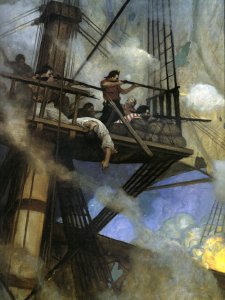
The last three illustrators in the book are American:  Howard Pyle, N.C. Wyeth and W.W. Denslow.

https://eavice.files.wordpress.com/2010/01/pirates.jpg

Pyle, a strict Puritan, relegated himself to historical legends and adventure novels about pirates, Indians, cowboys, Robin Hood and Arthurian legends by authors such as Robert Louis Stevenson, Daniel Defoe, and James Fenimore Cooper- as did his pupil N.C. Wyeth.  Denslow is famous for his Wizard of Oz paintings.
http://homeschoolcommons.com/wp-content/uploads/2012/06/wonderfulwizardo00baumiala_0081.jpg
 W.W. Denslow (1856-1915)


I found this book in the library but shortly after diving into it I ordered a good used copy online.  Of course what money I saved from buying the book for a couple of dollars has probably been countermanded by all the collections of fairy tales and the like that I've bought filled with the illustrations of these wonderful artists.