
There are no spoilers in this review.

Normally I do not read best sellers but after reading a review of the movie, I became intrigued. The premise is provoking.
A young woman commutes on a train into London every day. She passes by a row of houses with porches adjacent to the train tracks.
Each morning she sees a couple having breakfast on their porch. They are openly affectionate with each other and the woman, Rachel, enjoys watching them. In a way she feels a connection to them.
She has even named them: Jason and Jesse. Their happiness and marital stability gives her a kind of comfort. Because just four houses down is the house she used to live in with her husband.
Her husband still lives there, only now with his second wife.
This aspect of the novel which is pretty much all I knew about it, resonated with me because I used to live in places where I took a commuter train or a bus to and from work and home.
I also would see the same people either at the depot or along the way and one does develop a sort of imaginary connection with them. Not that I gave anybody names or fooled myself into thinking I had any relationship with them but I did enjoy the familiarity, if that makes sense.
That is where the similarity with my life and Rachel ends. We soon learn that nothing is as it seems, not even Rachel.
Without giving anything away, because I know a lot of you would like to read the book or see the movie, which is currently out, I'll just say that a murder occurs and Rachel has the horrible feeling that she is somehow involved, maybe as a witness, maybe something worse. When you read the book or see the movie you'll know why.
The book is written in first person, present tense. Normally I do not like that format but it works in this case. Mostly we get Rachel's perspective, but there are two others who also contribute a few chapters, which is well done and effectively serves to forward the story.
Having said that, this book does not encourage me to read any more best sellers.
It seems the unreliable narrator is in vogue these days. No one can be trusted, not even the person telling you the story. It was fascinating when Henry James used it, here it comes across as trendy. I noticed in other reviews many compared the book to Gone Girl, which apparently uses the same tool. The comparison did not persuade me to read Gone Girl.
No doubt many will enjoy this book. It is your typical murder mystery and the writing is well crafted.
I personally found the characters, all of them, sad, pathetic, empty, isolated and alienated. I felt no sense of satisfaction at the end. But maybe that's how books are written nowadays: without a moral compass or sense of purpose, only nihilism.
Is that the norm in popular novels nowadays? Creating characters that all suffer from Radical Attachment Disorder? I would be very interested as to why anyone would enjoy spending time immersed in stories like that. Isn't life bleak enough without fantasizing about it?
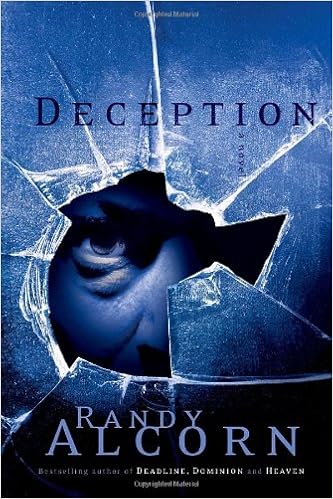
Deception is the third in a series of murder mysteries by Randy Alcorn and, in my opinion, this is the best written. It came ten years after the second book and he must have really developed his writing chops during that time.
Ollie Chandler, whom we met in the first two novels, though as a background character, is the star. He is a homicide detective, recently widowed, estranged from his daughters, and the ultimate cynical agnostic.
A professor of Philosophy and Ethics is murdered in his home and the evidence is bizarre. Dr. Palatine has a rope around his neck, three gun shots in his chest and several vials of blue ink injected into his veins.
On his computer is a message:
"I, Dr. William Palatine, do not deserve to live. I've crossed boundaries and forfeited my life. I admit my arrogance. I deserve judgement. I should be cast into a deep sea with a millstone around my neck."
Ollie arrives wearing his trench coat ( like Bogart in the Maltese Falcon, not a rain coat, "that's what Columbo wears") and fedora and accompanied by an Oregon Tribune journalist (the Chief's idea of creating good rapport with the press). He sees too many "bread crumbs", like someone was trying to leave a lot of different clues on purpose to cover up any accidental clues they might actually have left. They were left in a way only someone familiar with homicides could accomplish. This discovery leaves Ollie with an uncomfortable and risky conclusion.
What I liked about this book? Just about everything. It was a well developed mystery that left a bread crumb trail of clues that the reader could add up and arrive at a believable conclusion.
In addition to that, Ollie is just plain funny. He's a wise guy, quick-witted, sarcastic and cynical. The banter between him and the other characters are fun to read. I loved reading about Ollie. I was sorry the book was over and I hope Alcorn is going to write more about him.
In fact I'm re-reading it to my husband and I'm enjoying it all over again, especially since I know how it ends I can appreciate all the subtle hints and clues provided throughout the story.
Probably the only thing that someone wouldn't enjoy is that Alcorn is a Pastor and even though the protagonist is a non-believer, the story is written from a Christian world-view.
That does not make the story sickly sweet and syrupy. Alcorn does not shy away from the grittiness of life. In fact, he is more realistic than the author of Girl on a Train because Hawkins' characters are paper thin and people in Alcorn's novel, as in real life, have more dimension.
Alcorn shows desperate people in desperate circumstances but pierces the darkness with an otherworldly light, which allows the reader to sympathize with every character as they struggle with their personal demons.
I'm glad I read both, even though I enjoyed only one because they provided a sharp contrast and provided me with the opportunity to evaluate what I value in a good read.


