I'm listening to some lovely piano music, a Variations on a theme by Pierre Rode composed by Carl Czerny. You can listen to Vladimir Horowitz playing the piece here.
I work out at a gym and because I find stationary exercisers terminally boring I have to read while using them. Therefore while I jog away on the elliptical or step on the stair aerobics machine, I have a book on hand to while away the time. This is especially helpful on the stair stepper which would be hard to get through if I didn't have my mind on something else to block out the sound of my calves and thighs squealing in pain.
Usually I can't read fiction because reading literature is not something to gulp down. I read to savor the art of word choice, sentence construction and expression of ideas. One can do that while toiling away on an exercise machine, I suppose, but I find it easier to read non fiction where I can just focus on the facts.
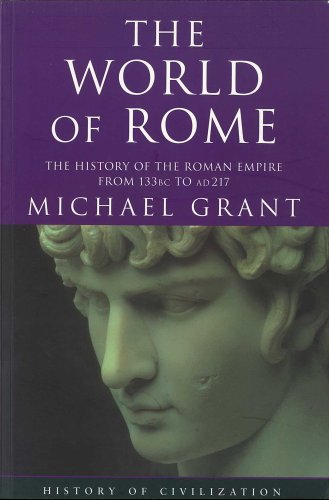
Hence, I just finished the World of Rome by Michael Grant. Ever feel as though you uncovered a gem in the sand? That is what this book is like. It is one of the best histories of Ancient Rome I have ever read.
The book was published in 1960 and has stood well the test of time. I have had a hard time finding information on Grant today, because there is a popular YA author by the same name and his information kept popping up.
The back of the book says that Grant was President and Vice-Chancellor of the Queen's University of Belfast. He was a graduate of Harrow and Trinity college, Cambridge and is "universally acknowledged as one of the most eminent scholars of the classical Roman era." I've added more information at the bottom of the post.
Grant is very even-handed in his study of Ancient Roman culture. After giving a historical overview he breaks down every level of the society: the rulers, citizens, subjects and slaves; their religious beliefs; and their art.
Part III, their beliefs was especially interesting to me. He adequately compares and contrasts the different religious beliefs by people who believed in fate and the stars to those who were religious and also the philosophers. Of course he shows the obvious Greek influence and also fairly compares the Christian and Jewish beliefs and their place in the Roman world.
One part that I found fascinating and I formed a conclusion (Grant does not say this in his book): When Julius Caesar decided to overthrow the Roman Republic and established the rule of the Caesars, he guaranteed not only brutal despotism, but also the murder of every Caesar. If a Caesar is appointed for life, then how are you going to get rid of him since you can't vote him out? Really, shouldn't they have seen that coming or were they all too power hungry to think objectively?
I am currently reading Suetonius' account of the Caesars and I think perhaps a good many of them were insane. But then again, were they any more insane than any of us would be without any checks and balances to stop us from gratifying every selfish whim?
Another provoking statement concerned Roman entertainment. The Caesars knew if they could keep the population occupied with mindless entertainment, the coarser the better, they wouldn't bother thinking about how effective or adept their governing body was.
Cato the younger, as well as more opportunistic politicians, had felt that the only sound and safe policy was to keep the populace quiet by entertaining them and subsidizing their food supply. (pg. 106 Part II. State and Society Chapter 3, Citizens of Rome)...
All subsequent emperors agreed that this dual formula of 'bread and entertainments' was the right one and participation in politics the wrong one, for the Roman proletariat. (pg. 107)
Hmmmmm...... Entertainment around the clock and free stuff...where have I seen that?
I highly recommend this book to anyone interested in the subject. It is a book I plan to return to again.
Michael Grant has written several books, a few of which I have since ordered and eagerly look forward to reading.

Michael Grant CBE (21 November 1914 – 4 October 2004) was an English classicist, and author of numerous popular books on ancient history. His 1956 translation of Tacitus' Annals of Imperial Rome remains a standard of the work. Having studied and held a number of academic posts in the United Kingdom and the Middle East, he retired early to devote himself fully to writing. He once described himself as "one of the very few freelancers in the field of ancient history: a rare phenomenon". His hallmarks were his prolific output and his unwillingness to oversimplify or talk down to his readership. He published over 70 works. from Wikipedia