I have joined a Classics Reading challenge at Books and Chocolate. I look forward to reading other's reviews and hope they visit my blog and tell me what they think of Crime and Punishment. I welcome all comments.
Robert Schumann's beautiful Piano Sonata No. 21 in B-flat D. 960 with its delicately exquisite third movement (wait for it, as they say on facebook videos). Alfred Brendel, one of my favorite performers, is the pianist (at the ripe old age of twenty-eight, the man recorded EVERY SINGLE composition for piano by Beethoven). You can listen along as you read by clicking on this link.
How does one review Crime and Punishment? I've chickened out trying to review other Dostoyevsky novels, like The Possessed (also translated as "Demons") because it was too great in scope. Therefore, I am not going to try to retell the story or attempt some in depth analysis- you can take a Russian literature class at your local college for that.
Instead, I am going to tell you what stood out to me and hopefully take only a couple of paragraphs in doing so.
Alert: There are major spoilers in this review!
Last week I wrote a review that concerned a real life ax-murderer. This week's review will center around a fictitious one. Yet for all that, Dostoyevsky reveals eternal truths about the human psyche that cannot always be gleaned from actual events (unless one philosophizes about them, like Dostoyevsky).
Our protagonist (or antagonist?) is Rodion Romanovitch Raskolnikov. Try saying that three times really fast. Also, Dostoyevsky, like Tolstoy, delights in having the different characters address each other with different names. So to some people he's Rodion, others he's Romanovitch and yet others Raskolnikov or some affectionate or formal variant of any of those names. It's a little hard to keep track at times.
Rodion, as I shall call him hence , is a penniless student, or former student, who lives I don't know how. I don't know how anyone in a Dostoyevsky novel doesn't starve to death and that is fiercely true for Rodion. I'm not sure he eats an entire meal anywhere in the story. He has a tormented mind. He wrestles with greatness and morals.
It is rather the same problem Frank Lloyd Wright dealt with: Is someone who is Great subject to the same morals as everyone else? Was Napoleon a murderer, Rodion ponders, or did he have the right to take the lives of so many through war because he belonged to an elite class of Greatness?
Unlike Rodion, Wright didn't wrestle with the problem or even toy with it. He had no qualms about what his Greatness entitled him to. I wonder what Wright's views were on murder: Was the man Carlton, who murdered Wright's lover guilty of murder because he was merely a servant, and would Wright be guilty if he (hypothetically) murdered Carlton?
You'll need to read my last review and Wright's comments on morals to appreciate what I mean (Wright felt moral laws were for the common masses, not geniuses like himself.)
Rodion decides that a hateful, spiteful shrew such as the old woman, Alyona Ivanovna,who he pawned his possessions to was not worthy of life and if Napoleon could kill (in war) millions, why couldn't someone else, just as superior, kill just one worthless old woman who cheated people and physically abused her sister?
So Rodion goes about staging the murder. He believes that he receives supernatural signs (he passes a couple mentioning that Alyona's sister, Lizaveta, will be out of the apartment on a certain evening). He acquires an ax from the gardener of his apartment, hides it up his sleeve, walks to Alyona's apartment, enters it and brutally bludgeons the old woman.
But things do not go as planned. When he finishes his dastardly deed, he finds Lizaveta has come into the apartment, so he feels compelled to finish her off as well.
Now arrives a philosophical problem. Did Lizaveta deserve to die? Was she just as worthless as her sister? She was kind and well-loved, always helping others. Rodion discovers that playing God with other people's lives does not make one a god-certainly not if gods are omniscient. He obviously did not foresee everything.
Narrowly escaping being caught by some workers, Rodion manages to leave the apartment and building unseen, return the ax, and return to his own apartment.
Like his counterpart, Ivan, in the Brothers Karamazov, Rodion finds his "Intelligent Rationalizing" makes him seriously ill (plus, as I mentioned, he won't eat; but at least he's not harassed by a demon as poor Ivan was). He is surrounded by people who love him. His sister, Dounia (I'm sticking to first names with everyone else) and mother Pulcheria come to St. Petersburg to see him (and to meet with Dounia's fiancee). His best friend, Dmitry, also stands by him. None of them know why he is so ill, but rally around him.
Aside from this primary plot device, there are the usual assortment of desperate characters that populate every Dostoyevsky novel.
A man, Marmeledov, once a successful public official, has drunk away all his money and himself out of a job. His drunkeness eventually kills him when he walks in front of a horse. He leaves a consumptive wife and four starving children who get beaten regularly by the wife who is beside herself in desperation. The oldest child, Mermeledov's daughter from a previous marriage, is thrust into prostitution by her step mother and through this profession is able to keep the family barely afloat.
This oldest daughter, Sonya, is an interesting study. Her circumstances are horrible, yet she is the one who has faith in humanity and in God. Because of her steadfast belief in right and wrong, Rodion finally turns himself in. She follows him to Siberia and lives near the prison as he serves his time. She becomes a consolation to not only him but to all the prisoners who come to regard her with great affection.
There are no boring characters in this book (or any book written by Dostoyevsky) and I could write pages about each one.
As in The Possessed, Dostoyevsky brings into view characters that forshadow the Socialists that eventually take over Russia, turning it and the surrounding countries into the Soviet Union. If the reader wonders how Communism rose up, read this novel and The Possessed.
Another character is a young idealist named Andrei who expounds on his ideas of nihilism and the equal sharing of property. He believes utopian bliss can only be achieved if private property does not exist. Andrei comes across as slightly ridiculous but possessing a basic sense of right and wrong which he shows when his room mate, a self-absorbed clod by the name of Luzhin, tries to humiliate Sonya to avenge himself against Rodion who persuades his sister, Dounia, not to marry him. Andrei rescues Sonya because he is an eyewitness to Luzhin's scheme.
Luzhin is wealthy but stingy and arrogant. He wants to marry Dounia because he perceives her as poor and helpless and therefore someone who would willingly marry and worship him out of gratitude for raising her up out of her dismal poverty. He likes the idea of lording over a woman who can only be his slave because of her desperate plight.
The reason Luzhin attacks Sonya is because he perceives that she and Rodion have come to care for each other.
One of the reasons I wanted to read this story again (I read it once in my twenties) was because I had read that the detective who investigates the murder was one of the inspirations for the creator of Columbo, the detective on the 70s television show.
And the verbal exchanges between Rodion and Detective Porfiry Petrovich are worth reading by themselves. The battle of the wits that ensues over several pages are quite suspenseful. The set up is the same as in Columbo. We already know Rodion did it and we breathlessly read as he darts and dodges every question Porfiry directs at him. Like a fisherman reeling in a particularly elusive fish, Porfiy deftly hypnotizes Rodion with psychological gymnastics that slowly ensnare him. Or almost snares him. There's a few twists and turns before it's all over.
As with all of his novels, Dostoyevsky thrusts the human dilemma before the readers' eyes: all men are desperately wicked. Yet he never leaves us without hope. There is no evil committed so great that is beyond redemption.

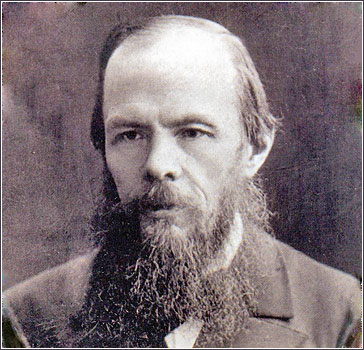
Fyodor Dostoyevsky 1821-1881