Showing posts with label Russian authors. Show all posts

Sunday, September 15, 2019

We by Yevgeny Zamyatin

Here is another Schumann:  Sonata no. 11, The Peharia.


I found my copy at a book fair and it was cheap.  You can tell it's pretty beat up so I'd like to get a better copy.  The problem is, from what I've read this is the best translator.  Penguin is probably my favorite paperback edition, but they have a different translator.  Maybe I'll buy it anyway, just to have an attractive copy, and, anyway, I can compare the two translations and see which one I like better.

Can I be a little snarky?  Years ago, I had a friend from Switzerland who, while I liked very much, if she thought you said something stupid, she could be quite sarcastic about it, in order to make you feel stupid.

I was mentioning that my mother liked to read a few translations of the same Russian novel to see which she liked better.

"Oh?" My friend asked with a sarcastic smile.  "Your mother speaks Russian?"

I was too busy feeling stupid to realize that she misunderstood me.  I didn't say my mother was comparing translations for accuracy, and my mother didn't have to know Russian to know which English translation she liked better.  

It does bring up something that does bother me.  Which is the best translation of a book?  The one that is the most literal or captures the essence of the meaning.  There are ways we express ourselves in one language that simply doesn't translate into another, so one needs to find an appropriate idiomatic equivalent.

I suppose we have to accept that a large part of an author's writing style will be lost.  Ah, well.

Here is my review as I published it on Goodreads.


WeWe by Yevgeny Zamyatin
My rating: 3 of 5 stars
I saw this book for a dime at a library book fair and I've read other people's reviews about it so I felt I should give it a go.

This is a science fiction/dystopian novel that is as chilling as it is fascinating. The narrator is living in a reality that has become perfect, thanks to basing it on mathematical principals. There is no "I" only "We". Each person has their identity buried in the whole, like a cog in a machine.

Things that make life worth living, like human relationships, romance, are replaced with satisfying physical urges, like sex. You don't even have to work up an artificial premise like at a bar. You simply take a number of the person you want to have sex with and a time is set up.

No one has a name, only a number. One's purpose in life is to make sure the "whole" is working. There is no soul. If you find you have one, you undergo an "operation" to remove it.

The narrator talks in delirious hyperbole to describe how absolutely wonderful life is under the "Benefactor", but cracks start to appear. The logic he has lived by isn't following through. Loose endings increasingly appear as he more and more desperately tries to resolve or suppress them.

His Achilles Heel is love for someone else. A woman. Her name is I-330, as his is D-305. Love does not fit into the equation set up by the Benefactor, only existence.

The story is beautifully written. I can see how the premise was the inspiration for George Orwell's 1984, but while I found Orwell's more understandable and consequently more bleak, Zamyatin's novel is far more poetic, but also harder to understand.

I found his metaphor's and vivid imagery rich and colorful, but I also wondered at times what was going on. The descriptions were psychedelic, to say the least. I had a hard time knowing whether the author was using metaphor or literal descriptions when stating that she "pierced me with the spears of her eyelashes." Or whether when I-330 spreads her pink gills out like wings....does she really have gills? Or what is he saying?

Maybe it was the translation. Mirra Ginsburg was the translator and from what I've read, she's the best. However, I am curious now to read another. Not that she wouldn't be the most accurate, but I wonder if I would find another translation equally mystifying.

At the end of the day, I am glad I read it and maybe I'll understand it better with a different translation or when I'm older and, hopefully, wiser.


View all my reviews


Here's a photo of a postcard that I sent across the world to a pen pal buddy.  Vintage photography is my favorite!

Sunday, July 24, 2016

Crime and Punishment by Fyodor Dostoyevsky


I have joined a Classics Reading challenge at Books and Chocolate.  I look forward to reading other's reviews and hope they visit my blog and tell me what they think of Crime and Punishment.  I welcome all comments.
 
Robert Schumann's beautiful Piano Sonata No.  21 in B-flat D. 960 with its delicately exquisite third movement (wait for it, as they say on facebook videos).  Alfred Brendel, one of my favorite performers, is the pianist (at the ripe old age of twenty-eight, the man recorded EVERY SINGLE composition for piano by Beethoven). You can listen along as you read by clicking on this link.

How does one review Crime and Punishment?  I've chickened out trying to review other Dostoyevsky novels, like The Possessed (also translated as "Demons") because it was too great in scope.  Therefore, I am not going to try to retell the story or attempt some in depth analysis- you can take a Russian literature class at your local college for that.

Instead, I am going to tell you what stood out to me and hopefully take only a couple of paragraphs in doing so.

Alert:  There are major spoilers in this review!

Last week I wrote a review that concerned a real life ax-murderer.  This week's review will center around a fictitious one.  Yet for all that, Dostoyevsky reveals eternal truths about the human psyche that cannot always be gleaned from actual events (unless one philosophizes about them, like Dostoyevsky).

Our protagonist (or antagonist?) is Rodion Romanovitch Raskolnikov.  Try saying that three times really fast.  Also, Dostoyevsky, like Tolstoy, delights in having the different characters address each other with different names.  So to some people he's Rodion, others he's Romanovitch and yet others Raskolnikov or some affectionate or formal variant of any of those names.  It's a little hard to keep track at times.

Rodion, as I shall call him hence , is a penniless student, or former student, who lives I don't know how.  I don't know how anyone in a Dostoyevsky novel doesn't starve to death and that is fiercely true for Rodion.  I'm not sure he eats an entire meal anywhere in the story.  He has a tormented mind.  He wrestles with greatness and morals.

It is rather the same problem Frank Lloyd Wright dealt with:  Is someone who is Great subject to the same morals as everyone else?  Was Napoleon a murderer, Rodion ponders, or did he have the right to take the lives of so many through war because he belonged to an elite class of Greatness? 

Unlike Rodion, Wright didn't wrestle with the problem or even toy with it.  He had no qualms about what his Greatness entitled him to. I wonder what Wright's views were on murder:  Was the man Carlton, who murdered Wright's lover guilty of murder because he was merely a servant, and would Wright be guilty if he (hypothetically) murdered Carlton?  

You'll need to read my last review and Wright's comments on morals to appreciate what I mean (Wright felt moral laws were for the common masses, not geniuses like himself.)

Rodion decides that a hateful, spiteful shrew such as the old woman, Alyona Ivanovna,who he pawned his possessions to was not worthy of life and if Napoleon could kill (in war) millions, why couldn't someone else, just as superior, kill just one worthless old woman who cheated people and physically abused her sister?

So Rodion goes about staging the murder.  He believes that he receives supernatural signs (he passes a couple mentioning that Alyona's sister, Lizaveta, will be out of the apartment on a certain evening). He acquires an ax from the gardener of his apartment, hides it up his sleeve, walks to Alyona's apartment, enters it and brutally bludgeons the old woman.

But things do not go as planned.  When he finishes his dastardly deed, he finds Lizaveta has come into the apartment, so he feels compelled to finish her off as well.  

Now arrives a philosophical problem.  Did Lizaveta deserve to die?  Was she just as worthless as her sister?  She was kind and well-loved, always helping others.  Rodion discovers that playing God with other people's lives does not make one a god-certainly not if gods are omniscient.  He obviously did not foresee everything.

Narrowly escaping being caught by some workers, Rodion manages to leave the apartment and building unseen, return the ax, and return to his own apartment.

Like his counterpart, Ivan, in the Brothers Karamazov, Rodion finds his "Intelligent Rationalizing" makes him seriously ill (plus, as I mentioned, he won't eat; but at least he's not harassed by a demon as poor Ivan was).  He is surrounded by people who love him.  His sister, Dounia (I'm sticking to first names with everyone else) and mother Pulcheria come to St. Petersburg to see him (and to meet with Dounia's fiancee).  His best friend, Dmitry, also stands by him.  None of them know why he is so ill, but rally around him.

Aside from this primary plot device, there are the usual assortment of desperate characters that populate every Dostoyevsky novel.  

A man, Marmeledov, once a successful public official, has drunk away all his money and himself out of a job.  His drunkeness eventually kills him when he walks in front of a horse.  He leaves a consumptive wife and four starving children who get beaten regularly by the wife who is beside herself in desperation.  The oldest child, Mermeledov's daughter from a previous marriage, is thrust into prostitution by her step mother and through this profession is able to keep the family barely afloat.

This oldest daughter, Sonya, is an interesting study.  Her circumstances are horrible, yet she is the one who has faith in humanity and in God.  Because of her steadfast belief in right and wrong, Rodion finally turns himself in.  She follows him to Siberia and lives near the prison as he serves his time.  She becomes a consolation to not only him but to all the prisoners who come to regard her with great affection.

There are no boring characters in this book (or any book written by Dostoyevsky) and I could write pages about each one.

As in The Possessed, Dostoyevsky brings into view characters that forshadow the Socialists that eventually take over Russia, turning it and the surrounding countries into the Soviet Union.  If the reader wonders how Communism rose up, read this novel and The Possessed.

Another character is a young idealist named Andrei who expounds on his ideas of nihilism and the equal sharing of property.  He believes utopian bliss can only be achieved if private property does not exist.  Andrei comes across as slightly ridiculous but possessing a basic sense of right and wrong which he shows when his room mate, a self-absorbed clod by the name of Luzhin, tries to humiliate Sonya to avenge himself against Rodion who persuades his sister, Dounia, not to marry him.  Andrei rescues Sonya because he is an eyewitness to Luzhin's scheme.

Luzhin is wealthy but stingy and arrogant.  He wants to marry Dounia because he perceives her as poor and helpless and therefore someone who would willingly marry and worship him out of gratitude for raising her up out of her dismal poverty.  He likes the idea of lording over a woman who can only be his slave because of her desperate plight.

The reason Luzhin attacks Sonya is because he perceives that she and Rodion have come to care for each other.

One of the reasons I wanted to read this story again (I read it once in my twenties) was because I had read that the detective who investigates the murder was one of the inspirations for the creator of Columbo, the detective on the 70s television show.

And the verbal exchanges between Rodion and Detective Porfiry Petrovich are worth reading by themselves.  The battle of the wits that ensues over several pages are quite suspenseful.  The set up is the same as in Columbo.  We already know Rodion did it and we breathlessly read as he darts and dodges every question Porfiry directs at him.  Like a fisherman reeling in a particularly elusive fish, Porfiy deftly hypnotizes Rodion with psychological gymnastics that slowly ensnare him.  Or almost snares him.  There's a few twists and turns before it's all over.

As with all of his novels, Dostoyevsky thrusts the human dilemma before the readers' eyes: all men are desperately wicked. Yet he never leaves us without hope.  There is no evil committed so great that is beyond redemption.
 

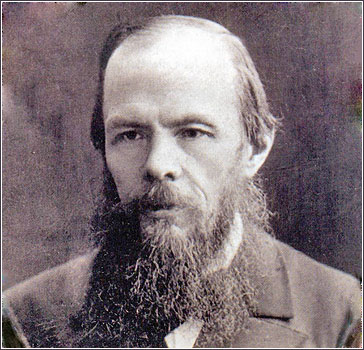
http://conversationalreading.com/wordpress/wp-content/uploads/2015/06/Dostoyevsky.jpg
Fyodor Dostoyevsky 1821-1881

Sunday, May 24, 2015

The Idiot by Fyodor Dostoevsky


Sir Percival Piggybottom shared his thoughts and insights with me on The Idiot by Fyodor Dostoevsky.  Amazingly, his opinions exactly reflected my own.  What can I say?  Great minds think alike.  Here's what we have to say.


I've said it before and I'll say it again.  Reading a novel by Dostoevsky is like stepping into a world wind.  There's no down time.  Just when you think a certain scene or situation is coming to an end, someone else shows up and away we go again with nary a pause for breath.  No character possesses neutral emotions either.  Everyone is either turning white with rage or red with...with...even more rage.

The story starts on a train where we meet our hero Prince Lev Nikolaevich Myshkin.  He is returning to Russia after many years in Switzerland.  On the train he meets Parfyon Semyonovich Rogozhin.  Little do these two men know but they are going to play profound roles in each other's lives.

While riding Prince Myshkin relates his background.  Some years past he suffered a mental break down and was sent to a hospital in Switzerland until he recovered.  Now, though still a young man, the Prince is returning to Russia.  He knows no one but hopes to make a few contacts.

Rogozhin immediately brings up the topic of a woman he is obsessed with, Nastasya Filipovna Barashkova.  He is going to propose to her.  He has raised an insane sum of money, which she has demanded, in order to achieve his desire: her hand in marriage.

Insane is an appropriate word here.  Because all the major players in this novel are insane.  Or desperate.  Or angry.  Or emotionally out of control.  Hence the unalleviated excitement that relentlessly rides the entire novel.

Nastasya is a fascinating character study in her own right.  One doesn't know whether to hate or pity her.  Born into a poverty-stricken family, she was orphaned very young but being very beautiful was soon taken up by Afanasy Ivanovich Totsky, a wealthy man of high society, who took her and basically kept her for himself.  No need to spell that out.

Being orphaned and helpless, Nastasya had no choice but to submit to Totsky's..let's call it what it is... sexual abuse.  But a time comes when Nastasya is no longer the helpless one.  She realizes that she holds Totsky's reputation in her hands, especially since he now wishes to marry into an important family.  Totsky understands that he is no longer the one in control of their relationship and his one objective is to get rid of her.  He attempts to acheive this by marrying Nastasya off to a clerk of General Epanchin who also happens to be the father of the woman he wishes to marry.

Totsky offers this clerk, Ganya Ivolgin, 70,000 rubles to marry Natasha. Ganya was pursuing General Epanchin's youngest daughter Aglaya but he breaks his relationship with her and everything looks settled.  Nastasya holds an evening party at her apartment to seal the deal.  

Why Ganya would want to marry Nastasya, other than for the money is beyond me. She lets her contempt for him be known at every opportunity.  She delights in making a fool of him.  And she has one last trick up her sleeve.  

Late in the evening Nastasya's party is crashed by Rogozhin and a bunch of rowdies.  He has come with the money Nastasya has demanded to marry him.  Nastasya grabs the money, throws it in the fire, and tells Ganya he can have it if he'll pull it out.  Then she runs off with Rogozhin.

  Where does the Prince fit in?  He loves Nastasya.  But not the way the other men do.  He feels compassion for her and he wants to save her.  He also proposes to Nastasya.  She understands his pure love but doesn't feel worthy of it so repels him.

Meantime there's Agláya Ivánovna.  Aglaya is a nut case in her own right.  She loves the Prince and wants to marry him.

Then she doesn't.

Then she does.

No she doesn't.  She hates him.

She's madly in love with him!

No, never!

That pretty much describes Aglaya. Strangely enough, the Prince also loves her and in a real romantic sense, but instead of doing the common sense thing and blow her off, his emotions corresponds to her mood swings.

I'm in ecstasy, she loves me!

I'm crushed, she hates me!

Yay!

Aaaaaa!

I really cannot figure the Prince out.  It's interesting how the other characters respond to him.  They all consider him a fool, even calling him an idiot to his face.  Yet, one by one, they each develop an attachment to him and soon find that they need him to turn to, confide in, be listened to.  He's the only one that genuinely loves and believes in the goodness in each person.

Dostoevsky digs deep into the human soul and bares the desperate sin that lurks there.  By doing so he reveals the light of God that shines on that darkness and disperses it.

There are no tidy endings in real life and Dostoevsky certainly doesn't provide any in his writing.  This book probably has the least satisfying ending of any of the books I've read, with maybe the exception of Demons (also titled, The Possessed).

Spoiler alert!  Don't continue reading if you don't want to know how the story ends.

As much as the Prince loves people, his belief in their inner goodness is finally shattered.  He finally breaks it off with Aglaya (or she breaks it off, who can tell?) and proposes marriage to Nastasya who, after living with Rogozhin, accepts.  

Everything proceeds as planned.  Nastasya, adorned as a princess, approaches the church where the Prince is waiting for her.  In the crowd she sees Rogozhin.  She screams and jumps into his arms.  They run off together.

After searching all over town and St Petersburg, the town where Rogozhin lives, he finally finds them.  Rogozhin, after hiding out in his family apartments, comes to the Prince and brings him home.  

The final part is surreal.  Rogozhin talks about all sorts of nonsense with the Prince but we finally become aware of Nastasya lying under a sheet on a bed in the corner of his room.   Both he and the Prince spend the night together discussing what to do because the body will soon begin to smell.

Eventually they are found out.  Rogozhin is sent to Siberia and the Prince truly becomes an idiot.  Relapsed into madness he is sent back to the hospital in Switzerland.


There is ever so much more to this story than can be related here.  I cannot begin to count the number of characters in the cast.  As my husband, Josh, said.  "How many people can fit into one room? Can you imagine a stage production of this story?"

Every character is a story all by him or herself.  But if you want those stories, you'll simply have to read the novel for yourself.

Percy says, "I would not have tried to love two women at once.  Wait.  Yes I would.  I'm a Guinea Pig.  That's how we reproduce."


https://rickrozoff.files.wordpress.com/2011/05/dostoevsky.jpg


Kindle .99


Friday, November 14, 2014

A Week Like Any Other Novellas and Stories by Natalya Baranskaya


Natalya Baranskaya is considered one of the Soviet Union's finest short story writers.  Most of her work was written in the 1960's but were eventually translated into English after the Soviet's fall.

A Week Like Any Other: Novellas and Stories is a collection of short stories. They are mostly about women and their lives in Soviet Russia.  It's important to remember she wrote these stories and they were popular in the Soviet Union during her lifetime.  Therefore don't expect any commentary on the harshness of living under a totalitarian regime.

Nevertheless, she does manage to convey the challenges people had trying to combine the ingredients every human wants for a meaningful life:  work, family, friendships.  Her writing is fluid and funny at times but mostly poignant.  It occurred to me that these stories couldn't really be classified as propaganda pieces because they don't spout tired cliches about how blissfully utopian life is under Communist rule.  I wonder if because, living inside that world, Branskaya thought she was presenting an idealistic life without realizing how hard that life was compared to Western countries.

In the first story, the best one I think, A Week Like Any Other, the narrator, a young woman, describes each day and hour of her week.  The pressures of getting up, getting the kids ready for school, breakfast for everyone, rush to work, rush to lunch, rush home to make a late dinner, get kids to bed, start over.

Inside that framework we see the woman's relationship with her husband --strained-- her children--neglected, although no more than any child who spends most of his childhood in daycare--her co-workers, the pressures to succeed and not miss any work regardless of her health or children sick.  She stays late, perpetually trying to get on top of her work, never quite succeeding.  

The story sounds tedious, but it is really quite interesting.  You are the invisible party to her life.  Sympathizing with her kids as they cry for her, hoping she and her husband stick it out, hoping she gets her work done and not get fired.

The other stories are shorter and perhaps not as interesting other than they show life in the Soviet Union.  One of the stories is much like the first one except it is told from a man's perspective.  A man who is trying to get ahead at work but is having to kow tow to ambitious bosses, watch what he says or how he reacts so there isn't a government investigation, and finally having to hide in exile until different leaders come into power that make it safe for him to return to work. 

  The government inspectors are not presented as people to be feared but rather as father figures who "take care" of everyone to make things right.  Nevertheless, there is an element of fear in knowing that there is an umbrella of authority watching every trite thing you do.  

I'm surprised the author got away with exposing such obvious intrusive tactics at the hands of the government.  Maybe this kind of intrusion was so normal under Soviet policy that it occurred to neither her or government censors there was anything wrong or abnormal about it.

What disturbed me was noticing how not very different life in America has become with all our "accountability" to government regulations.  We're not too far behind totalitarian regimes.

The remaining stories are about young women in love, not always requited, a young girl who wants to live with her father instead of her mother until she realizes he has mistresses, and a girl with a bad reputation in her village and how she copes with it, also how she causes it.

Each story provides a colorful view of Russian/ Soviet culture.  I don't know if I would read anything else by the author but I did enjoy this collection. 

Wednesday, November 6, 2013

The Fountain Head and Atlas Shrugged by Ayn Rand Guest Post: Joshua Wilfong


  • A friend of mine asked if I had ever read Ayn Rand. I said, "No. Wasn't she a proponent of the "elephants should rule the ants" philosophy? I asked him if he had read her books and what did he think of them. The following is his response.

    The Fountainhead focuses on personal talent and individualism. The protagonist is a talent visionary architect who refuses to adapt his designs to meet cultural norms. This works because he is a genius. The establishment is painted as lazy and lacking creativity.
    I always worry about this kind of encouragement of self direction. It works great if you are a genius but most of us are not. Her main point is the ability of a single human to succeed on their own merit and without support from society. This sentiment was echoed in other works of the time such as "Rollerball" (a movie about a sport player who was so good he didn't need a his team to win, and how he was hated for it).
    Her main Characters are examples of the spectrum of submission to society. Some wish they could be Roark (the architect) or fight him but, all represent levels of personal compromise (some simply lack talent and can only survive by copying established ideas).
    In the end all of Roark's horrible actions are validated by how talented and smart he is.
    Atlas Shrugged echoes some of these ideas on a corporate and national scale. The title discusses what would happen if the titans who hold up the world shrugged and walked away.
    Topics such as subsidies for companies that can't compete are discussed. The heroes are innovators who work hard to protect their businesses from overtaxing by the government and weak competitors who cry for "fairness."
    "Looters" is the term for people who break down monopolies or demand "fairness" in business. Nationalization is taken to extreme examples. The idea is that a business must fight to stay on top and if another can do it better then, naturally, the first will go away.
    Overall, Rand's examples are unbalanced and do support the Elephant idea you mentioned. I enjoyed cheering for the brave, smart, handsome heroes as they fight convention and an overbearing government. But, the untalented are cast to the side and there is little room for compassion. It fails to satisfy my Christian pallet.

    This is the first time I've posted a book review on my blog about books I've never read. If you have read these books, please share your opinions. 

    Joshua has his own blog where he kept a travelogue of his time in Antartica. You can visit it at: MacGuffin Hunting

Friday, January 6, 2012

The Brother's Karamazov by Fyodor Dostoevsky


I heard someone say once that certain books like War and Peace, or other similarly mammoth works should not be read before the age of thirty. I strongly disagree with that statement. I first read “War and Peace when I was twenty and it was a turning point in my life. It also initiated a life long love affair with Russian authors. Tolstoy led me to another Russian dynamo, Fyodor Dostoevsky. I also read The Brother’s Karamazov in my early twenties. It was one of those books of my youth that hit me like a lightening stroke.

Now I will agree that certain books can be read in different seasons of one’s life and affect you in entirely different ways. This was my experience with the book that has been called the summation of Dostoevsky’s life and work. I will not attempt to describe every detail of this masterpiece in the brief space I have here but what I do want to do is describe the impact the work has had on me each time I read it.

It’s hard to briefly summarize this book because there are so many characters with subplots intertwined around the main one but I will try: Fyodor Pavlovich Karamazov- a real swine of a man- marries twice and produces three sons, one from the first marriage, two from the second. He treats both wives abominably, probably drives them to their early graves out of stress and grief and completely abandons his sons.
The first son, Dmitri, is cared for by his father’s man servant and the other two, Ivan and Alyosha, are raised by an eccentric old woman who used to keep their mother as a maid servant.

Dmitri, grows up wild and unprincipled and is completely controlled by his passions. He is forever conniving to get more money from his father-whom he firmly believes owes him but he immediately loses whatever he gets through impulsive and extravagant living. To further add to an already flammable and hostile relationship, both father and son have fallen in love with the same woman, Grushenka. Dmitri is determined to get money from his father in order to run away with Grushenka and Fyodor is equally determined to spend his money in persuading her to come live with him.

Everything comes to a head when one night, Fyodor is found in his bedroom, murdered, his head smashed in. Dmitri is found in another town, with Grushenka, where he is throwing around a great deal of money-money that he supposedly didn’t have before that night. He also, unfortunately, has a bloodied pestle in his pocket. Naturally, he is the number one suspect since not only does he suddenly have so much money, but for the past few weeks he had been going around town breathing threats against his father-even at one point in a drunken rage writing a confession of his intention to murder him. And did I mention that he had already beaten his father to a bloody pulp once before?

Needless to say, Dmitri is arrested and put on trial.

Now. That is the plot outline and, in my opinion, the least interesting part of the whole book. What makes this book so fascinating are the characters and the universal truths about human nature and God that Dostoevsky reveals through his characters.

Let’s examine each character:

We’ve already met Fyodor –who personifies the ultimate slime ball. He’s selfish, he’s unprincipled-he lives to take advantage of others and has no sense of mercy or compassion on anyone’s suffering not even his own blood relatives. He is Dostoevsky’s Unregenerate Man Character.

Dmitri possesses the same unbridled animal passions as his father, but he’s different. Through it all he knows he’s a scoundrel and hates himself for it. He is Man at the point when he knows he is desperately wicked and cannot save himself yet arrives at the place-in Dmitri’s case when he’s on trial for murder-when he seeks that salvation.

But what about Ivan and Alyosha?

Ivan is an atheist. Through his own means he became university educated and lost any faith he may once have had in God. He is sardonic towards any belief in the metaphysical. He detests his father and Dmitri and more than once remarks that two animals trying to destroy each other is no sin but an inevitable, and in fact, desirable conclusion to their unworthy lives.

And then there’s Alyosha. He is the most lovable Karamazov because he so guilelessly and unconditionally loves everyone. He at first wears a monk habit and is mentored by a venerable and godly monk, the Elder Zozima. Through Zozima, Alyosha sees the love of Christ in practice. He in turn practices that love, authentically and passionately on his family members as well as everyone else he comes in contact with-more than one that doesn’t deserve such love.

Alyosha is the staple of the Karamazov family, even if the others aren’t consciously aware of it. All of them, father, brothers, as well as many other characters that come into play in this novel, turn to Alyosha as the means for a solution to their turmoil.

When I was twenty-one, I read Brother’s Karamazov for the first time. As a Christian, I trusted the author, also a Christian, to gently guide me to a nice tidy conclusion as to why my beliefs are right. That is not what happened. In a certain scene, Ivan throws every dart of Satan at Alyosha, explaining to him why there can be no God. I was not prepared for his attacks. They were not absurd. They were highly reasonable and at the time, for me, unanswerable. I didn’t lose my faith, but Ivan did give me a punch in the stomach.

I now realize that God wanted me to be confronted with these arguments so I could think my faith through and give a reasonable defense for it-not only to others but to myself as well.

The second time I read the book I was in my thirties. I must confess it was the wrong season to read it. My mind was so distracted with many problems that I couldn’t focus on what I was reading. It made me sad that a book that so excited and mesmerized me in my youth packed no punch. Had I become so jaded?

I am now in my forties and have just finished reading Brother’s Karamazov for the third time. With the eyes of maturity and wisdom and a peace and joy that I didn’t possess in my thirties, I was able to read this wonderful story with fresh insight and understanding. For one thing, I can see the genius of Dostoevsky as he uses the atheist, Ivan, with all his arguments to actually prove the existence of God.

He does this through a number of ways but I’ll point out one:

Ivan tells Alyosha that since there is no God, all things are permitted, even murder. It’s only when God exists that an established right and wrong can be put into practice. Of course this whole argument caves in on Ivan’s head when it IS put into practice and by an unexpected person.

You see, Dmitri, Ivan and Alyosha are not the only sons of Karamazov. There is a fourth son who was produced by a woman whom Fyodor raped. This son is raised in Fyodor’s house as a humiliated servant, treated with contempt and neglect by his own father. This son, Smerdyakov- becomes a devoted disciple of Ivan’s teaching and puts it into practice. Ivan realizes that to pontificate about no God, no morals is one thing.  But to actually live in a society that ignores God and uses no absolute morals to govern themselves produces a lawlessness where no one is safe. After that, Ivan is visited nightly by a demon who mocks him and throws back in his face every smug tirade he ever made against God and drives him insane.

I hope I haven’t given the book away. One still needs to read it for oneself to receive the full impact of Dostoevsky’s genius, besides I’ve left most of the characters out and many of them are the most interesting.

Stepping into a novel by Dostoevsky is like falling into a whirlwind and it is certainly worth the ride.