While I found Coming Up for Air interesting and also rather funny, I did not enjoy it as much as Keep the Apisdistra Flying and Burmese Days.
 Possibly
because, unlike the other two, this book was written from a first
person view point rather than third person as the other two were.
Not
that first person narration can't be successful, but Orwell's strength
seems to lie in describing the inner thoughts of the protagonist by a
third person narrator.
Also,
there is no real story line or character development. Largely it is a
man's, George Bowling's, attempts to return to the England of his youth.
It
starts with Bowling's present status which is a typical middle class
working man, married with children. He should be happy with what he
has, but he is not. He doesn't mind his children, his wife is a bit of a
shrew, but then what wife wouldn't be if married to him.
Bowling
does not make this conclusion and I'm not altogether sure Orwell is
implying it. It is what I conclude based on the loutish
character of Bowling.
Bowling
isn't a lout in that he's cruel or abusive. But he's not faithful and
he is selfish. He lies to his wife by keeping money squirreled away
from her and telling her he's off on business when he's actually
returning to his home town, Lower Binfield, which he hasn't been to
since he left it for the war (WWI).
What
he wants is a vacation all to himself and return to the town of his
youth. In order for us to fully appreciate his visit he hearkens back
to his childhood and describes life with his parents, his older brother
and friends and schools and everyone in the town.
He
particularly remembers a place near the River Thames where gigantic
carp swam in a water hole. He never got the chance to fish there. He
is determined to do so when he arrives.
He
recalls his first love, who he leaves for the war. He describes his
experience in the war which is not at all remarkable. Or rather it is
remarkable for a complete lack of action. He did, however, get quite a
bit or reading done.
The
first problem when Bowling arrives is figuring out exactly where the
town is. It has developed so much that it takes him some time to find
the original section where he grew up. I'm sure today it would be
called the "historic district".
He checks into a hotel. Considers mildly flirting with local women, perhaps enjoy a brief encounter, but nothing develops.
Bowling
buys fishing tackle but upon finding, after a lot of effort and
directions by people who "think they know" he finds the site of the carp
pool. It no longer exists because a new housing development has
supplanted it.
In
a nutshell, Bowling finds he can't go home again. His home is now a tea
shop, and his family's furniture is the antique decor, including
family photos, which still fills the rooms. What a strange feeling that
must be.
He did accidentally run into his first love. Or rather recognized her and followed her into a store. She is no longer the slim, attractive girl he was attracted to, but heavy and square and judging from the mundane gossip she is engaged in with the store owner, not educated.
Possibly
because, unlike the other two, this book was written from a first
person view point rather than third person as the other two were.
Not
that first person narration can't be successful, but Orwell's strength
seems to lie in describing the inner thoughts of the protagonist by a
third person narrator.
Also,
there is no real story line or character development. Largely it is a
man's, George Bowling's, attempts to return to the England of his youth.
It
starts with Bowling's present status which is a typical middle class
working man, married with children. He should be happy with what he
has, but he is not. He doesn't mind his children, his wife is a bit of a
shrew, but then what wife wouldn't be if married to him.
Bowling
does not make this conclusion and I'm not altogether sure Orwell is
implying it. It is what I conclude based on the loutish
character of Bowling.
Bowling
isn't a lout in that he's cruel or abusive. But he's not faithful and
he is selfish. He lies to his wife by keeping money squirreled away
from her and telling her he's off on business when he's actually
returning to his home town, Lower Binfield, which he hasn't been to
since he left it for the war (WWI).
What
he wants is a vacation all to himself and return to the town of his
youth. In order for us to fully appreciate his visit he hearkens back
to his childhood and describes life with his parents, his older brother
and friends and schools and everyone in the town.
He
particularly remembers a place near the River Thames where gigantic
carp swam in a water hole. He never got the chance to fish there. He
is determined to do so when he arrives.
He
recalls his first love, who he leaves for the war. He describes his
experience in the war which is not at all remarkable. Or rather it is
remarkable for a complete lack of action. He did, however, get quite a
bit or reading done.
The
first problem when Bowling arrives is figuring out exactly where the
town is. It has developed so much that it takes him some time to find
the original section where he grew up. I'm sure today it would be
called the "historic district".
He checks into a hotel. Considers mildly flirting with local women, perhaps enjoy a brief encounter, but nothing develops.
Bowling
buys fishing tackle but upon finding, after a lot of effort and
directions by people who "think they know" he finds the site of the carp
pool. It no longer exists because a new housing development has
supplanted it.
In
a nutshell, Bowling finds he can't go home again. His home is now a tea
shop, and his family's furniture is the antique decor, including
family photos, which still fills the rooms. What a strange feeling that
must be.
He did accidentally run into his first love. Or rather recognized her and followed her into a store. She is no longer the slim, attractive girl he was attracted to, but heavy and square and judging from the mundane gossip she is engaged in with the store owner, not educated.
Finally,
he gives up and returns home, deflated and depressed. But, alas, his
trials are not over. His wife checked up on him and found that he was
not at the town he purported to be in because the hotel he claimed to be
staying in was now defunct.
Her
natural assumption is that he was having an affair (there had already
been a precedent set). This time he was not but how can he persuade her
that he was just visiting his childhood home. He can't and the story
ends with an indication that poor George has quite a few weeks of
scolding and sleeping on the couch in store for him.
Returning to childhood is always a failed experiment. At least for George Bowling.
Political
language...is designed to make lies sound truthful and murder
respectable, and to give an appearance of solidity to pure wind. George Orwell

I have finally finished this book containing three novels by George Orwell. The first, Burmese Days, I reviewed last year and you can read the post here.
I set the book aside but last month read the remaining two stories.
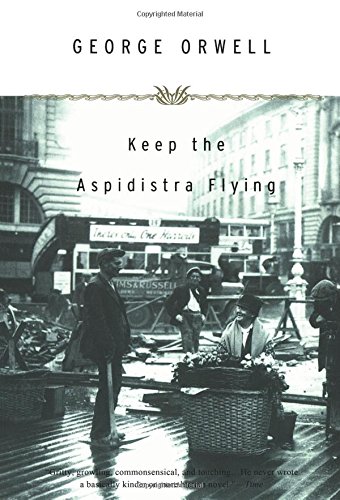 Keep the Aspidistra Flying comes largely from the viewpoint of Gordon Comstock, a poet, working at a bookstore while trying to launch his career as a writer. He is poor, lives in a lower income-but not the lowest as we later see- tenement house run by a persnickety landlady who exacerbates Gordon's already hard life with rules such as no smoking or making tea in his room. Not that Gordon observes any of her rules, it's just annoying to have to cover up his "crimes".
He wants to live solely as a poet but he's not rich. The money he makes at the bookstore is barely enough to pay his bills and keep him from starving, hence his is a grinding existence. He has a girlfriend but he can't afford to marry her. He shakes his fist at his lot. Yet it is his choice to live like this.
Gordon worked at a business where he wrote jingly sort of slogans for advertisement posters. He made a decent salary and met Rosemary there. But he felt this sort of work beneath his artistic soul, as if he were prostituting his talents. So he quit and began working at a bookstore for dirt wages where presumably he was able to keep his philosophical integrity intact. He smirks at the "riff raff" who came in to read best sellers and popular romances, since he himself only read literature.
Yet he despises a lot of the classic authors as well. Why are these "literary" authors considered so high brow when they write dreck, he moans to himself. Gordon leads a frustrated existence.
He has a girlfriend, as already mentioned, her name is Rosemary, but he can't afford to take her anywhere or do anything with her, least of all marry her. He absolutely refuses to take any money she offers although he's not above receiving funds from his sister, even though he knows she is sacrificing financially in order to help keep him out of dire straits.
His friend, Ravelston, is an ardent socialist or communist, and a firm believer in a social revolution that would equally disperse the income of the rich and spread it around to the poor. Since he himself is rich and on some level either doesn't make the connection that he would stand to lose a portion of his own money or, more realistically, he understands all too well that such "equal distribution" doesn't impact the rich as it does the middle class who, under such a system, are punished for earning wages by having a good chunk of their income taxed away, he can afford to be so "broad minded".
This has nothing to do with anything, but I imagine Ravelston looking like Russell Brand.
Ravelston does understand this, sort of; enough to make him feel guilty. He attempts to exorcise this guilt by befriending Gordon. It's his "see I'm mingling with the unfortunate" statement. Nevertheless, Ravelston enjoys life, lives in a comfortable apartment, and has a girlfriend with whom he enjoys everything that Gordon cannot.
Interestingly, Ravelston's girlfriend, also a member of his communist group, refuses to associate with Gordon or any of the lower classes, since they dress so poorly and stink. I think this reflects perfectly the Armchair Socialist in our day. They feel virtuous and fashionable espousing a theory that creates "equality" while enjoying their exclusive, elitist life; which is why they live in Aspen and not Harlem.
One could sympathize with Gordon if he wasn't so arrogant or so foolish. An American magazine pays him handsomely for a set of poems. Oh, what Gordon could do with it! Pay his rent, groceries, a couple of pack of cigarettes! What does he do? Blow it all away in one extravagent night.
He invites Ravelston and Rosemary on an evening at a restaurant but succeeds in making it a painful experience for everyone by being so wasteful with his money, refusing contributions from either his friend or girlfriend, that what could have been a nice month's salary is gone before the next day.
As if that isn't bad enough, Gordon has gotten himself so drunk that he ends up with a prostitute, assaults a police officer during a raid and wakes up to find himself in jail. Ravelston posts bail and, because the book store owner fires him for his conduct, allows Gordon to live with him.
What has any of this got to do with an Aspidistra? If, like me, you didn't know what an Aspisdistra is, it is a type of plant that people keep for decorative purposes. Gordon's apartment has one that he purposely neglects and abuses but the poor thing refuses to die.
When Gordon eventually leaves Ravelston and lives in an even grimier apartment, behold! another Aspisdistra is placed there by his current landlady. The plant seems to signify a middle class existence.
I say this, because in the end, Gordon at rock bottom, admits defeat. Not only has his life sunk to a Sartre-esque existence, Rosemary is pregnant. They must marry as far as Gordon is concerned. A strong pro-life statement produces this conclusion, which raises Orwell in my esteem.
Rosemary suggests she abort the baby. His response:
Though they were feet part he felt as thought they were joined together-as though some invisible living cord stretched from her entrails to his. He knew then that it was a dreadful thing they were contemplating- a blasphemy, if that word had any meaning.
'No fear!' he said. 'Whatever happens we're not going to do that. It's disgusting.'
He returns to the advertising company, receives his old job and enters into a middle class existence. He marries Rosemary and they move into a nice apartment, nothing upscale but appropriate for a middle income family.
One thing is lacking and Gordon goes out to buy it, but not without a row with Rosemary. He wants an Aspisdistra. Rosemary doesn't want such an ugly plant in her apartment but in the end Gordon gets his way.
The story doesn't end there. As they walk down the stairs to the florist, Rosemary stops suddenly.
'Oh Gordon!'
'What?'
'I felt it move!'
'Felt what move?'
'The baby. I felt it move inside me.'
'But it did really move? You're sure? You really felt it move?'
'Oh, yes. It moved.'
For a long time he remained kneeling there, his head pressed against the softness of her belly. She clasped her hands behind his head and pulled it closer...Somewhere in there, in the safe, warm, cushioned darkness, it was alive and stirring.
For all the dark and dreariness of Gordon's life, the story ends on a hopeful note.

Burmese Days is a fictitious novel based on Orwell's own experience while working with the Indian Imperial Police in the 1920s. If E.M. Forster wanted to prick the British conscience in A Passage to India, Orwell wants to bludgeon it.
The story centers around a small group of British people living in a remote part of Burma, working in the jungle. Their one venue for socializing and amusement is a country club where all the expatriates gather to get on each other's nerves and drink themselves blue.
There's only one woman, Mrs. Lackersteen. She pompous and racist, refusing to learn the language other than the basic guttural Urdu she needs to order about servants. Her husband is a drunken, lecherous lout who, when not drunk, engages in sexual escapades with native women.
Most of the British men there do, but Mrs. Lackersteen's greatest fear is to be raped by an Indian because she knows that is every Indian man's ambition.
The rest of the characters are just as odious with the exception of the ones that are pathetic. John Flory would fall into the latter category. Flory is the main protagonist of Burmese Days.
Not that he doesn't do things that are odious. He keeps a Burmese girl, Ma Hla May, that he doesn't love, doesn't even really enjoy sleeping with but else is there to do in the jungle? Then the Lackersteen's niece come to live with them.
Elizabeth is a young woman come from Paris where she was living with her mother until she died, her father having already passed. Flory cannot contain his excitement to meet and befriend Elizabeth and kicks Ma Hla May, out. He's callous about it but she doesn't leave without putting up a fight.
Ma Hla May knows no depths in which to debase herself to keep Flory from throwing her over. She prostrates herself before him, cries, pleads, begs, cajoles and demands lots and lots of money.
Flory knows that Ma Hla May cares nothing for him. She even has her own lover, aside from Flory. But she has told the village people she is married to him. This gives her an elevated status. She spends the money he gives her as fast as she can run from his house to the market to buy garish trinkets and sarongs that she adorns herself with and parades herself in front of the other villagers. This is what she is pleading for. Not love, position.
Flory knows he should put his foot down. But he feels guilty. So he continually plies her with the rupees she demands just to make her leave.
After that, he spends money on himself to look more like a gentleman. Then he introduces himself to Elizabeth. They go for long walks together, to the market, to native dances. By her side, Flory talks continually, poetically, of his experiences in the jungle, the natives, the customs, culture all of which he appreciates and enjoys. He is desperately lonely and this young woman is the life raft that he clings too.
Too bad Elizabeth is too close-minded to appreciate it. Orwell makes a commentary on human nature. Whether he believes this or he's simply trying to explain his characters' attitudes, I'm not sure. He states that whatever happens to someone, albeit ever briefly, in their formative years, this will shape and color a person's thinking for the rest of their life.
Flory has an purple-blackish birthmark that covers one side of his face. He was tormented for it when a school boy and has allowed his disfigurement to determine his self worth. It doesn't, however, deter him from pursuing Elizabeth, his loneliness overriding his usual diffidence.
For her part, Elizabeth spent two years in a school for rich girls. Her parents weren't rich but lived extravagantly. They weren't able to keep it up and soon sunk into financial straits. Elizabeth spends the rest of her life comparing her circumstances and the people she meets to those two years around the privileged upper class. Therefore, if one wasn't interested in sports, hunting and spending scads of money, you fell under her category of "beastly" and boring.
Flory is well read and a deep thinker. Needless to say Elizabeth finds him uninteresting, even offensive. His desperate need for a companion blinds him to this fact and while he perceives her displeasure he can't arrive at why.
But Elizabeth is out to get married. Her aunt has made it very clear that her stay with them is only until she achieves this goal. Since Flory is the only game in town, she determines to settle for him. It all seems a cinch, although I can't imagine Flory being satisfied with such a simpleton for long.
It isn't meant to be, however. A young hot shot Lieutenant and youngest son of a Lord has arrived with the Indian policemen. Lieutenant Verrall is good looking and that's the only nice thing anyone can say about him. He's cold, rude, offensive, prideful and anti-social.
This doesn't stop Elizabeth and Mrs. Lackersteen from snubbing Flory and chasing after Verrall. Verrall finally notices Elizabeth and they spend all their evenings together. This almost drives Flory mad with despair.
Elizabeth and her aunt wait for the marriage proposal that is sure to come any day now. It doesn't come. It never comes. Verrall loathes women. Elizabeth was merely his temporary amusement. When he's transferred, he leaves without telling anyone.
During all this, a riot occurs. This riot is no random act of frustration and gnashing of teeth by the natives. It has all been orchestrated by U Po Kyin. U Po Kyin is a local magistrate and there aren't enough words in the English vocabulary to describe what a two-faced, treacherous, hateful, spiteful, disgusting, overgrown, conniving weasel and hugely successful magistrate he is.
He is a master of destroying men's lives both Burmese and British. Through blackmail, bribery, anonymous letters, thievery and betrayal U Po Kyin works his way up the ladder of political echelon. His adversary is Dr. Veraswami who is as kind and innocent as U Po Kyin is evil.
Flory and Veraswami are great friends and enjoy debating over the virtues of the British Raj. Ironically, Dr. Veraswami argues in favor of the English presence in Burma, and English people in general while Flory insists they are nothing more than a blooding-sucking colonial power.
U Po Kyin makes it his mission to destroy Dr. Veraswami and Veraswami knows this. He pleads with Flory to elect him to the English country club because it would elevate his status in the community and immunize him against U Po Kyin's schemes.
At first, Flory cowardly refuses to stand up to the other members of the club, but when a second riot breaks out -one not planned by U Po Kyin- Flory develops a temporary backbone, single-handedly quells the mob, and demands that Veraswami be elected as the token non white member to the club.
Everything seems to work out well. Elizabeth has returned to Flory after Verrall's desertion and Veraswami is going to become a member of the club. Then Ma Hla May makes an atrocious scene in the middle of a church service demanding money from Flory. She purposely has made herself as hideous and terrible looking as possible and acts like a crazy person. She has to be dragged out of the building. Flory isn't up to the occasion. To make matters worse, his face turns so pale that his birthmark stands out in dark contrast.
This is what Elizabeth cannot forgive him for. Not having a mistress but for having such an ugly birthmark so grotesquely standing out. She coldly dismisses him. Flory returns to his house and shoots himself.
Because suicide is taboo in Burmese culture, Veraswami's reputation also sinks because of his association with Flory. He is not elected to the club but is transferred to some remote hospital dump to practice medicine the rest of his life.
And you can guess who put Ma Hla May up to it.
U Po Kyin is elected to the club and eventually earns the title of Deputy Commissioner. Everything goes according to his plan. He cheats people, abuses young women, ruins people's careers and even causes the deaths of his fellow Burmese. His wife chides him for his evil acts insisting that he will come back in the next life as a rat or snake.
U Po Kyin is not concerned. He has been saving up money to build pagodas at the end of his life to earn his way up to Nirvana.
I find U Po Kyin's attitude very interesting. Apparently he believes in the effectiveness of lip service. He seems to think that it doesn't matter how black one's heart is as long as one performs the correct deeds he will be rewarded the prize of the virtuous.
He drops dead of a heart attack three days after being elected Deputy Commissioner, before he is able to build the pagodas. One can form their own conclusions. Is he scurrying around as a rat or a snake? Can a rodent or reptile act in a way that would merit coming back as a higher life form after it dies? I've never seen a virtuous snake or rat. Or any animal. Certainly not my dogs. They'd be returning as roaches.
I'm reminded of Mark 8:36: What does it profit a man if he gains the whole world just to lose his soul?
The other question is, how accurate a portrayal does Orwell provide of the British colonialists? Is this a rather heavy slathering of the very worst in human nature or is Orwell being objective?
I agree with Graham Greene when he criticized Virginia Woolf and E.M. Forster for creating characters who "wandered like cardboard symbols through a world that was paper-thin...there was no sense of reality in their writings....to lose sight of 'the religious sense' was also to lose any 'sense of importance of the human act.'
Evelyn Waugh said, "Without God, an author could not give his characters reality and depth." I believe this is the answer. Neither Forster or Orwell create characters with much redeeming value and I've never met such a person.
As Pierre discovered in War and Peace, it is by first loving people one invariably finds things to love about them.
And yet, I found Orwell's characters fascinating even if they were types and caricatures rather than real. He draws so well and with such logical precision. If I disagree with his outlook, I appreciate his ability to express it.
This is the first of three novels by George Orwell that I will be reviewing. The other two, Keep the Aspidistra Flying and Coming Up for Air will be posted as soon as I finish reading them.


