Wednesday, September 14, 2016

The Poetic Wonder of Isaac Watts by Doughlas Bond, Medieval Monsters by Damien Kempf and Maria L. Gilbert; A Night on the Moor and Other Tales of Dread by R. Murray Gilchrist

Listening to Beethoven Symphony Opus 21, Symphony no. 1. Beethoven wasn't 28 years old when he wrote it.  You can listen here.

As usual the books are piling up so I will attempt to give you a drive by review on three of them. 

 Here we go:

http://www.bondbooks.net/POE01BH.jpg

The Poetic Wonder of Isaac Watts by Douglas Bond

 I read this book out loud to my parents while they were visiting here in August much to everyone's delight.  We all grew up attending traditional church and singing hymns.  So learning about one of Christianity's major hymn writers was a treat.

Isaac Watts is considered the creator of the English hymn and perhaps second only to Martin Luther to constructing Protestant hymnody. 

Like Beethoven, Watts was a child prodigy, writing poems at the age of eleven.  Watts grew up in a Puritan family and as such was not allowed into the Anglican Universities like Oxford or Cambridge but studied at what was then called a "non conformist" or "dissenting" university, Newington Green Academy.

Watt's never married, but wanted to, once.  He wrote extensively with a young lady who fell in love with him through his letters.  Upon meeting the very short, homely-faced man, she fell out of love with him but remained friends.  Watts spent most of his life with the wealthy Hartopp family, teaching their children and writing hymns.

Watts introduced the radical notion that one could create their own poetry put to music and sing it in the context of formal worship.  This seems normal to us, but back then only Psalms from the Bible was deemed appropriate for church service.

Watts wrote other things besides hymns.  He was also a powerful preacher and put many essays in book form.  Some of his books are definitely going on my to be read pile.  Being alive during the Enlightenment, Isaac believed that it was every Christian's duty to use their intellect.  One of his books is titled:  Logic:  or the Right Use of Reason in the 
inquiry after Truth with a Variety of Rules to guard against error in the Affairs of Religion and Human Life, as well as in the Science.  Quite a title.  Not pithy back then, were they?

Other books include:  An essay towards the Encouragement of Charity- Schools, for teaching the Children of the Poor to read and write;  The Doctrines of the Passions Explained,  Discourse of the Love of God and the Use and Abuse of the Passions in Religion etc..

This book adequately conveys the beauty and eloquence of Watts' thought and how he expressed his great love for God in the form of poetry.  It also gives a history as to how Watts came up with some of the more famous hymns he wrote.  After reading the book, I flipped through a hymn book to look at the hymns by Watts included.

Even more briefly:
https://images-na.ssl-images-amazon.com/images/I/61mTZE0GS1L._SX258_BO1,204,203,200_.jpg
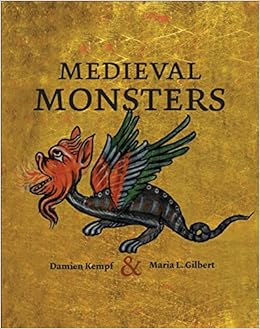
Medieval Monsters by Damien Kempf and Maria L. Gilbert

I simply adore Medieval art and this short volume gives pithy, if not always accurate, explanations of monsters painted in art.  It gives the legends, Biblical stories and histories to different mythical beasts.  The best part of the book is the colorful photos of the art it discusses.

And finally:

http://d2arxad8u2l0g7.cloudfront.net/books/1348345479l/1496306.jpg

A Night on the Moor and Other Tales of Dread by R. Murray Gilchrist.

I bought this book at a used bookstore thinking I had stumbled across a new author of scary and suspenseful stories of the 19th century, along the lines of M.R. James and E.G. Swain.  Well, yes and no.

Gilchrist, never married but lived with his mother and a male companion his whole life.  Perhaps that explains the misogynistic overtones of his stories.

The positive:  Gilchrist paints a lovely picture.  I can see the mists across the moors of England, the valleys, woods with dark verdure, and the unearthly beauty of the women who star in every tale.

Then there's this:  Every woman dies in a gruesome way. Oh sure, not in the same way and it's quite suspenseful. Occasionally the man dies at the hands of the woman.  In fact, most of the stories make you think that it is the man who is walking into a trap.   If that's your cup of tea, by all means get the book.  I'll mail you my copy.

The book did raise an interesting question.  Stories that take place on the Moors of England often refer to the supernatural or the residuals of past pagan beliefs of fairies, imps, and "little people".  We see this in books by the Bronte sisters, even Virginia Woolf as well as other writers.  Perhaps it is a part of the cultural heritage and make up of the people who were raised there.  As the American South is known for its Gothic tales and Ghost stories, maybe it's in the native north Englander's blood.

Certainly a topic worth exploring.

Well, that helped me catch up a little.  I think the next review can be about just one book.  Have a wonderful week.


Wednesday, September 7, 2016

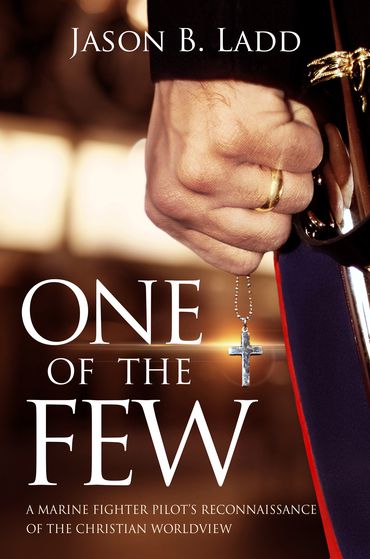
One of the Few: A Marine Fighter Pilot's Reconnaissance of the Christian Worldview by Jason B. Ladd


I opened an e mail one day that stated the following:

Sharon,
WARNING: THE FOLLOWING BOOK MAY BE SUITABLE FOR LICENTIOUS BOOK-PURCHASING FREELANCE MUSICIANS. 

Please let me know if you would be interested in receiving a copy and providing a review on Amazon and Goodreads.

How could I refuse a request like that?  Besides, being a Military Brat, not to mention living in Texas, a state that probably produces more Marines than all the other states combined, these sort of stories always hold a place in my heart. (My husband has just informed me that California produces the most marines, then Virginia; Texas is third but I don't believe it.)

Because I know that burgeoning authors are trying to sell their product, I went ahead and bought Jason's book for $2.99 on Kindle.

The following review is entirely my own opinion and I wish Jason professional success.

The downside of reading a Kindle is that I do not know how to turn back to specific pages to get my quotes or incidents correct; therefore this is going to be a generalized overview of the book with the intention of giving the reader as informed a review as possible.

https://publishizer.s3.amazonaws.com/media/thumbs/user_media/4037/images/b99aad35-f8d1-468e-b05f-a2471d97956c.jpg.370x755_q80.jpg

One of the Few is a non fiction account of Ladd's  spiritual journey from growing up nonreligious, developing questions as to whether there is an afterlife and finally embracing Christianity.

Jason grew up in a Military family, met his wife in high school while stationed in Japan and became a Marine.  He eventually got accepted into flight school and became a Marine fighter pilot.

That right there is the stuff adventure stories are made of.  Anyone in the material world is thinking: "Hoo yah! Captain America in the flesh!"

Ladd was deployed to Iraq and there are plenty of good stories here that rival anything Marvel's comics come up with, the more so because it's true.  

However, Ladd wasn't satisfied with adventure and valor.  There was something else he yearned for and felt was missing in his life.  Risking life and limb brought the subject of death up more than once and Ladd began to wonder just what happened when a person died.

"'What do you think happens when we die?' Karry asked.

'I don't know.  Nothing?  Blackness?'"(From the book)

Why are any of us alive?  I remember once I called a fighter pilot a "flight jock" to his face as a joke.  His expression told me that he didn't think that term was appropriate or funny.  Probably because he was a family man (I taught his son piano) and a church goer.  I feel certain that Jason Ladd wouldn't appreciate the term either. (And I've never called anyone that again.)

Because "flight jock" has connotations that someone is "macho" and "permiscuous" and not a deep thinker.  Jason Ladd's book shows that he is none of the first two traits and all of the last trait.

Each chapter begins with a quote from a secular thinker as well as a Christian thinker.  The comparisons are challenging and interesting.  Here are a few quotations:

"I've begun worshiping the sun for a number of reasons.  First of all, unlike some other gods I could mention, I can see the sun."  George Carlin

"I believe in Christianity as I believe that the sun has risen, not only because I see by it, but because by it I see everything else."  C.S. Lewis

"We are survival machines-robot vehicles blindly programmed to preserve the selfish molecules known as genes."  Richard Dawkins

"It is the very act of self-sacrfice that demonstrates that there is something more noble than mere survival."  Ravi Zacharias

Ladd describes the training he receives to become a Marine and eventually a fighter pilot.  He sees many parallels between his earthly experiences with spiritual truths.  He lists a number but I will only list a couple:  

After challenging his Sergeant to a pugil stick match, he makes the comparison that we cannot pound people who oppose our world view but must "display a life of love and service to everyone you wish to reach."

He goes on to describe getting bloody boots because he focused only on his toes and not on his heels.  He makes the analogy that "some worldviews focus only on the possibilities ahead and fail to address the damage they may leave behind."  And when, during training, one is walking through the woods half asleep we sometimes need to "be jolted awake in order to ask important questions."

A lot of what Jason Ladd discovers I had already arrived at so some of his conclusions were not new to me, like discovering that our present social climate does not respect the Christian world view.  This can be a challenge when you are used to being respected every time you walk into a building wearing that flight suit.  Ladd proves, however, that authentic faith overrides any concern over society's opinion.

Ladd has obviously read the Bible in depth, judging from his  references to it and one chapter is devoted to the need to read the Bible over and over again.  He compares it to flight training:  "Study tactics, fly by the book, and repeat.  Read, fly, repeat.  Read the Bible, live by the Book, and repeat.  Read, live, repeat."

"...(Man's) origin, his growth, his hopes and fears, his loves and his beliefs, are but the outcome of accidental collocations of atoms..."  Bertrand Russell

"A human being is a collection of atoms in the same way that Shakespeare's plays are collections of words, or Beethoven's symphonies are collections of notes."  Dinesh D'Souza

If you are interested in Military culture and how one man came to faith in Christ inside of that culture;  if you like to read modern war stories and how a fighter pilot comes to reconcile his worldly mission with his spiritual one, this is an excellent book and one I highly recommend reading.

Photo:  
Jason B. Ladd is an award-winning author, US Marine, and Iraq War veteran. Ladd served on active duty with the Marines for fourteen years and has flown as an instructor pilot in both the F/A-18 and the F-16 fighter jets. He is the founder of Boone Shepherd, LLC and creator of IndieListers.com, the largest live online database of book promotions results built by authors. He and his wife, Karry, are the parents of five children.

His book One of the Few was awarded as Finalist in the 2016 Next Generation Indie Book Awards.  (
From Amazon)


The following are links for further information on Jason and his books:

www.OneoftheFewBook.com

http://www.amazon.com/gp/product/B016X0HL84/

https://www.goodreads.com/book/show/26253930-one-of-the-few

Thursday, September 1, 2016

Robots and Murder by Isaac Asimov


Today is a review on books in the Science Fiction genre.  It is only fitting we listen to Hearts of Space.  You can listen here.

Robots and Murder is a trilogy comprised of three books:  The Caves of Steel, The Naked Sun and The Robots of Dawn.  I had read these books in college back when, thanks to a geeky friend, I had a fling with Science Fiction that lasted during my twenties.

By the time I had reached thirty, however, it had become a case of been there, done that.  No new concepts were being introduced to blow my mind, as they did when I was twenty and the hard core science fiction that I loved had somehow syncretized with fantasy, a genre I dislike, so that I could not see much of a difference.

Perhaps this was an inevitable outcome because all the new ideas of time travel, space travel, alien life forms, real and artificial etc. had been thoroughly mined and the only direction to take was toward made up worlds in other times and dimensions.  

Unfortunately, bereft of inventing new concepts, the writer needed to create well-developed characters and story lines.  This is only my opinion, but most fantasy stories suffer from a lack of good quality writing.  As far as I know, there is no Jane Austin or Ernest Hemingway writing fantasy.

Because their original concepts were fresh, a number of the members of the old school got away with mediocre writing.  This includes our author du jour, Isaac Asimov.  This isn't to say he doesn't make thought-provoking sociological commentaries and futuristic worlds with sophisticated technology.  In his trilogy he seems to take Earth's presence course to its logical conclusion as our technology becomes ever more sophisticated.  I say "seems" but that's another topic.


https://s-media-cache-ak0.pinimg.com/564x/1e/b6/f7/1eb6f7866f6337a21565e032529ded76.jpg
My all time favorite illustration for Robots of Dawn by Michael Whelan


Caves of Steel takes place on Earth.  We see a world that has become so overburdened with people that at one point in time, a number of people left to explore and settle other worlds.  The rest stayed home and retreated into domes.  In order to insure maximum survival for everyone, jobs are acquired and kept or lost then "declassified" which renders one incapable of ever getting a job.  Asimov doesn't explain, but I presume these people become welfare recipients.  Why this rule was invented I don't know since it would place a heavier burden on the rest of the population.

People travel on conveyer belts all over (or under as the case may be) the domed world, to work, to home...people live in tiny apartments and eat in community kitchens and wash in community bathrooms.  Food is synthetic and food tickets are highly coveted.  

The protagonist, Elijah Bailey is a detective and his job in all three novels is to solve a murder mystery.  All three mysteries surround robots.  On Earth, people are prejudiced against robots and want them out of their lives.  This makes it difficult for Bailey who finds that he has a partner who is a humanoid robot, R. Daneel Olivaw.

The murder is merely what propels the plot forward.  Asimov's real thrust is to show a dystopian Earth and how humans and highly intelligent robots would relate to each other. The same is true for the next novel, the Naked Sun.

In this story, Bailey has been sent to solve another murder on the planet Solaris.  Here we have a sparsely populated planet with several thousand robots per person.  The people here have a unique problem.  They can't bear to be around each other. 

Oh sure, they communicate and have relationships, going for walks, having dinner with each other, all the things people on Earth do except for one detail:  it's through three dimensional viewing.  Holographic telepresence is the only way Solarians will interact with each other. 

Of course, they get married and occasionally need to, you know, make children.  But this is done only when absolutely necessary and is presumably a traumatic experience for both parties.  Children are raised on farms and nobody knows who their children or parents are.

Again, the murder is solved by Bailey with the help of Daneel.

In the final novel we see Detective Bailey on the planet Aurora and a completely different set of mores.  Aurorans treat sex recreationally and is done casually with anyone (among mutually consenting partners, of course) and means nothing.  It's a truism that if you're intimate with everyone, you are close to no one.  And here we find that the Aurorans are just as alienated from each other as the Solarians are, but for opposite reasons.

I found The Robots of Dawn to be more interesting than the others because the murder victim, if you can call it that, is a robot.  Also because Asimov is far better at making interesting robot characters than human beings and this story spent a great portion with Bailey interacting with robots rather than humans, which made for better dialogue.

If creating robot characters was Asimov's strength, creating female characters was definitely his weakness.  He had a repertoire of two on each planet:  the petulant, moody, yet sexy girl/woman and the female Nazi.   Only Caves of Steel lacks the latter, which had only Bailey's emotional, irrational and irritating wife.

On the other two planets we had the above woman in the form of Gladia.  She has a role on both planets, having traveled from her home planet to Aurora.  The murders center around her home both times.  The other woman on Solaris and Aurora mainly serve to provide another character that Bailey interviews and must go into brain to brain combat with because each woman has serious anger issues against men and must conquer, Brunhilde fashion, all who enter her domain.  Asimov was married twice, I wonder if he based these women on his wives.

Gladia is an outlier on each planet.  She is socially outcast on Solaris because she wants greater physical contact with her husband, who naturally finds this horrifying and refuses.  Her husband is the murder victim and she is the primary suspect, having a motive.

On Aurora, she wants monogamy, something the Aurorans find laughable, so once again she is alienated.  Her only solace (before Bailey arrives) is her humanoid robot, Jander Panell who she decides to make her husband (I know, I know; don't go there.)  Jander ends up dead, well, his positronic brain has been frozen which is the equivalent of dead for a robot.  

This, however, does not make Gladia the primary suspect, because only one person in existence has the ability to destroy such a highly sophisticated robot's brain.  That is the roboticist who created Jander and Daneel.  He is the first to proclaim that he is the only one who could have done it but also says that he didn't do it.

The mystery in Robots of Dawn is well-developed and believable which is more than I can say of the first two books.  The verbal sparring that takes place between Elijah and the other characters are fairly well done, although, Asimov relies too heavily on every other character fencing with Bailey, even the ones on his side which seemed to provide mostly filler than dialogue constructed to move the story.

Asimov points out something else, whether intentionally or unintentially, I don't know.  He shows how life can be hard on a planet that is so overcrowded everyone is just trying to survive.  But he also shows how empty life can be even when all one's needs are met.  In other words, environment does not necessarily determine meaning and fulfillment to our existence.

Maybe he couldn't help it, but I found all the characters on every planet Asimov created to be little more than dolls a child plays pretend with and with as much dimension.  Something was definitely lacking.  I think I prefer the characters in C.S. Lewis' Space Trilogy.  Lewis had a better understanding of human nature, I think.  But I could be biased.


Thursday, August 25, 2016

Mozart: A Life by Paul Johnson

 Guess what has come to live in my "salon" as a birthday present from my One and Only?


He also got me these:


     And a cake but that didn't last long enough to photograph.

 The piano is a 1981 Baldwin 6 foot 2 grand.  I gave away my 1920 Knabe player piano to a good home and upgraded.  We searched far and wide for a piano that possessed all the qualities I want: even action, bell like tone in the upper register, deep resonant bass and we finally found it in a piano that had been in a recording studio for many years.  It is such a blessing to play on this, especially since I have two recitals coming up, including one this Friday!


Yes ladies and gentlemen I am dishing out yet another biography of Mozart and I'm not even through reading all the biographies I've read on the man (I'm saving Otto Jahn's three volume work for last).  

The author of this book, Paul Johnson, believes that Mozart's Clarinet Concerto in A K622, is the most sublime of his works so I create a link here for your listening pleasure.  The clarinet doesn't come in immediately so, as they say, wait for it.


https://s-media-cache-ak0.pinimg.com/236x/b0/88/ba/b088bacdafe749bb1ff154d085cbb9be.jpg

Some of you may be thinking what else can anyone say about the guy.  We have a sentimental chronological time line dramatized with great license from Marcia Davenport.  We have a thorough and exhaustive description of the cultural surroundings and political climate in Robert Gutman's Mozart:  A Cultural Biography.  What is lacking?

How about a biography that focuses solely on the composer's music? 

Paul Johnson's book is short, a mere 164 pages long.  But each chapter goes into different parts of Mozart as a composer and how he mastered every part of music writing.

The first chapter discusses his ability to create music when he was still young.  Chapter two goes into great detail as to how Mozart mastered most of the instruments of the orchestra and consequently catered his writing to the unique attributes each instrument possessed. 

 He was quite flexible.  If a certain orchestra was lacking in, say, clarinets, then he quickly rewrote the work to accommodate what wind instruments were available.  Or not.  Sometimes he transcribed the parts to another section altogether.  Some orchestra works are the same piece with the emphasis on the brass and others on the reeds, each successful with the diverse timbre coloring that comes with each family of instruments.

Johnson does not avoid timelines completely.  In addition to meticulously recording what compositions were written when and where, he also includes, in Chapter Three, when Mozart lived in Salzberg, Paris, London or Vienna. He writes of his marriage to Constanze and how that affected his composing.

Chapter four is about Mozart's operas, when and how they were written.  It is interesting that even though some of Mozart's greatest compositions were instrumental, what carried his career were his operas.  He wrote twenty-three operas, four in the last few years of his life, two in his final year (and his first when he was only ten). 

The last chapter concerns Mozart's death.  Johnson attempts to dispel prevailing myths, such as Mozart died a pauper and alone.  According to Johnson, many people attended his funeral and he was buried as most people were then, in a public burial lot.

It is interesting that Johnson has a different take on Mozart's father Leopold than the previous biographers who cast him in an ill-favored light.  Johnson takes the opposite stance, that his father was not the over-bearing monster, trying to make himself through his son, but rather was mostly trying to bestow good sense on him.  Frankly, that is the conclusion I had gathered from only reading Mozart's letters.

He also insists that Mozart was not perpetually poor and that writing "begging letters" as he calls it were normal during a time when paper currency was rare.  Mozart and later his widow, paid their debts faithfully.  Unlike the conclusions of Davenport who asserts that Constanze learned good economy from her second husband, Johnson insists that she was financially sensible all along and that Mozart actually made very good money for the time period in which he lived.

He supports this with comparing the salary of Mozart to many other professions of the time as well as the life-style he kept.  Davenport and Gutman conclude that Mozart lived beyond his means.  Johnson argued otherwise and states that borrowing money was a common practice then.

Reading these three biographies, as well as Mozart's letters, made me realize that different people can access the same information yet arrive at varying conclusions.

The most charming aspect of this book is Johnson's analysis of Mozart's work.  He openly inserts his own opinion as to his favorite compositions and his descriptions made me want to  run immediately to my Spotify and download as many of Mozart's compositions as possible.

Mozart wrote hundreds of compositions and it is impossible to have all of them catalogued although Ludwig von Koeschel valiantly attempted in 1862.  That is why when you look at works by Mozart it will have a "K" followed by a number opus.  The "K" or "KV" stands for Köchelverzeichnis.


Even though this biography is brief, it contains a lot of indepth detail concerning the instrumentation of Mozart's work, which not everyone would find interesting.  However, I don't think it should deter even the lay person but encourage one to further appreciate the genius of Mozart and hopefully inspire them to listen to his music.


Thursday, August 18, 2016

The Nine Tailors by Dorothy Sayers


My post today is about a murder mystery in a church among the bells.  A little history:  Church bell ringing goes back centuries.  The church bell heralded danger, death, marriage and festivities.  In England, the tradition of bell ringing went even farther to where their steeples house whole teams of bells.  The art (or science) of rope pulling became a firm part of the Church service.

Whole sequences that lasted for upwards of an hour or hours developed and were played before or after church services, sometimes everyday at the same time.  When I visited Bradford on Avon I arrived at the time Christ Church's bells rang, which was for an hour every day.  You can visit their web site here.  This tradition was handed down to America in the form of hand bells.  The rope pulling can be loud and long so I've included here a short piece of a hand bell choir playing Capriccio by Kevin McChesney which I think will be a little more aesthetically pleasing.  You can click here for the link.

However, if you're interested in the real deal, you can click here.

https://vulpeslibris.files.wordpress.com/2012/02/ninetailors.jpg

Dorothy Sayers did meticulous research on bell ringing and includes various types of bell ringing sequences. She also makes use of bell ringing terminology to provide clues to the mystery.  As much as I enjoyed the mystery, I will say I found the sections on bell ringing a little beyond my interest and skimmed over those paragraphs.

Other than that, however, Sayers makes a charming detective story, her ninth involving Lord Peter Wimsey.

Wimsey and his valet, Bunter, find themselves stranded in the town of Fenchurch of St. Paul after their car runs into a ditch.  It is New Year's Eve and the weather bodes ill.  For those of you who don't know (I didn't), the Fens are a marshy part of Eastern England, prone to flooding. 

Fenland is also known for its cathedrals and churches, hence the setting for Sayers' story.  Lord Wimsey meets the local Vicar, Theodore Venbales, a very friendly, if flighty Reverend who insists that Wimsey stay as his guest due to the bad weather and also because he needs a substitute bell ringer for the New Year service, one of his ringers having come down with the flu.  The Reverend has ambitiously planned a nine hour ring starting at midnight to usher in the new year.

A local Aristocrat, Lady Thorpe, dies the next day (requiring more pealing of the bells, ones that decode to the village that a lady of a certain age has died.  The bell sequence is different if a man or young person died.)  Lady Thorpe's death brings up the story about the robbery of the emeralds which were stolen, several years ago, at the Thorpe mansion, although they belonged to a relative who was visiting. The thief and the jewels were never apprehended.

So far so good.  But three months later, Sir Henry Thorpe, also dies.  Lady Thorpe's grave is dug up to admit the remains of her husband and to the shock of the grave diggers, they discover another body has been tossed in on top of the casket.  The hands have been cut off, presumably to avoid identification, and his face horribly disfigured for the same reason.

By this time, Lord Wimsey has gone, but he is called back by the local police to help discover whose body it is, how did he die and why.

If you want the solution you can read the book for yourself.  It is one of those fun, comfortable reads that should only take you an afternoon or two, ideally on a rainy day with a cup of tea.

I could not help compare Sayers' writing with Agatha Christie's.  A couple of observations:

One, Agatha Christie writes very good short stories.  Her stories are at their most effective if they provide a fast punch and a quick solution.  If she is required to develop the characters on a more than superficial basis as one would in a novel, she fails in my eyes.  Her forte is when she keeps the characters functional with minimal back story.

Conversely, I find Dorothy Sayers' novels to be far more enjoyable than her short stories.  I read her complete short detective stories and found only one or two that I considered worth reading.  The rest were "meh".

Her novels, however, allow her to fully develop her characters and she does so superbly.  I believe this is because, unlike Christie, Sayers created loveable characters.  Christie's characters are all equally selfish, which casts suspicion on all of them.  Sayers makes all her characters winsome and sympathetic (at least in this novel), making it impossible to  decide which one of these good people could have done it.

Now, just because her characters are likeable does not make them boring.  I find it interesting that the prevailing attitude seems to be that evil people are interesting and good people are boring.  Christie and Sayers together, whether intentionally or not, make a good case that bad people are boring and good people are fun to be around (and read about).

Dorothy Sayers was the only woman to belong to the Inklings, a writer's group that included J.R. Tolkien and C.S. Lewis.  I see common traits in her writing as theirs.  There is a coziness, a sense of comfort and contentment in the surroundings that I like.  The little details that they all add with the characters having tea, or brandy, sitting in front of fireplaces while torrential rains pour outside.  Yes, evil happens, but we can stand together and support and encourage each other.  In Christie's novels the characters are alienated from each other.

I suppose it has to do with the fact that I like British literature and lately I have been reading a lot of the stuff coming out of the first half of the twentieth century from both sides of the ocean.  I will be giving reviews of Graham Greene, another C.S. Lewis book of literature essays, and a biographies of Hemingway and Frank Lloyd Wright.

So, as they say in the U.K., Cheers, and have a jolly week!

Tuesday, August 9, 2016

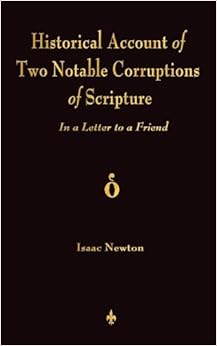
Historical Account of Two Notable Corruptions of Scripture: In a Letter to a Friend by Isaac Newton


Since today's review will be about Isaac Newton, I thought it would be appropriate to play some music by a contemporary musician.  

Everyone knows, G. F. Handel, and J. S. Bach, but not everyone is familiar with  Jean-Philippe Rameau.  The composition, Nouvelles Suites (performed by Alexandre Tharaud) is a transcription  for the piano.  I love the harpsichord, but I have discovered that is not true for everyone and the piano has vastly superior expressive qualities.  You can listen here.


This was a hard book to review, but I want to review it since I read it, however I review it with reservations about my ability to accurately assess the words of someone who history proves to be one of our greatest mathematicians.

https://images-na.ssl-images-amazon.com/images/I/31tb7G9ReWL._SY344_BO1,204,203,200_.jpg

I'm not sure I entirely understand everything that Newton is asserting because almost half of the letter is in Latin and Greek.  I presume this is because Newton is trying to prove his point by going back to the original languages of Scripture.  And what is his point?  That based on two scriptures that he claims have been corrupted, the Trinity does not exist.  Or, to be more precise, Jesus Christ is not divine.

Before I explain his reasoning let me first quote the two Scriptures he is referring to. 

The first  is from 1 John 5:7,8

 7.For there are three that bear record in heaven, the Father, the Word, and the Holy Ghost: and these three are one. And there are three that bear witness in earth, the Spirit, and the water, and the blood: and these three agree in one.

The above Verses are a direct quotation of the King James Version.   Newton's argument with this translation is that even though it is directly translated from the Greek and Latin, it is only from later manuscripts that the un-italicized portion is inserted.  The earliest manuscripts don't include them.

And indeed, my Bibles, which are English Standard Version, New American Standard, New International Version and Holman Christian Study Bible omit the un-italicized part altogether, although they include a foot note about later manuscripts including it.

To make it clearer to the reader, this is a direct quote from the English Standard Version of the same two verses:  

7 For there are three that testify: 8 the Spirit, the water and the blood; and the three are in agreement


The other translations are no different than the above quotation.

Newton asserts that because in heaven, the Father, the Word, and the Holy Ghost: and these three are one.  And there are three that bear witness in earth were later additions, these two verses were corrupted to make a false claim, namely that  the Trinity (one God in three persons) is non-existent.  

I will here point out that the foot notes in my English Standard Version Bible explains the verses this way:

The Gospel is not based on merely human testimony.  John indicates that there are in fact "three that testify", namely the witness of the Spirit, the water baptism of Jesus (including the "Spirit descending on him like a dove") and the voice of the Father from heaven; Mark 1:10-11 and the blood (which "cleanses us from all unrighteousness"; 1 John 1:7).  These three agree thereby providing persuasive confirmation for believing in Jesus as the "Son of God". The Old Testament taught that every charge must be confirmed by two or three witnesses.

Personally, I have no quibble with what Newton  is expostulating concerning what might be extra-biblical Scripture.  However, the question is, what is the original Scripture declaring?

For that we need to start with the beginning of the chapter.  I will provide a link here so I don't have to retype everything:  1 John 5.  

In a nutshell, John is stating that Christians' salvation is determined by their belief in Jesus as the Son of God because only He made the sacrifice by shedding His blood on the Cross and paying for the sins of all who believe in Him. 

I will mention that the point is not whether the readers of my blog believe that or not, but rather what the Scripture is actually saying.

It seems to me that Isaac Newton, in one of the most tragic of ironies, misses the entire point of this passage of Scripture based on a portion of -what he considers-spurious words.  I say what Newton considers to be spurious because the more I have been reading various sources concerning the scripture in question I am seeing good arguments for including as well as excluding those portions.  

But even if that part does not belong there, so what?  The context of the entire chapter is to clearly pronounce Jesus Christ as the Son of God.

Several passages of Scripture assert this.  The most obvious passages would be John 1:1-5 and 14 (italics mine).


1 In the beginning was the Word, and the Word was with God, and the Word was God. 2 He was in the beginning with God. 3 All things were made through him, and without him was not any thing made that was made. 4 In him was life, and the life was the light of men. 5 The light shines in the darkness, and the darkness has not overcome it.

14 And the Word became flesh and dwelt among us, and we have seen his glory, glory as of the only Son from the Father, full of grace and truth. 

And Revelation 1:8 and 17,18:

8 “I am the Alpha and the Omega,” says the Lord God, “who is and who was and who is to come, the Almighty.”

 17. When I saw him, I fell at his feet as though dead. But he laid his right hand on me, saying, “Fear not, I am the first and the last, 18 and the living one. I died, and behold I am alive forevermore, and I have the keys of Death and Hades. 

The Pharisees knew what Jesus was proclaiming when he forgave the paralytic's sins.  John 10:33:

The Jews answered him, “It is not for a good work that we are going to stone you but for blasphemy, because you, being a man, make yourself God.”

Then there are Jesus' very own words, John 3:16:

16 For God so loved the world, that he gave his only begotten Son, that whosoever believeth on him should not perish, but have eternal life.  

Now whether you are a Christian or not, no one can argue that Scripture in fact says this.  Pick up any Bible and you can read it for yourself.

It mystifies me that Newton would write an 85 page letter to a friend, declaring an Arian viewpoint.

The other Scripture is 1 Timothy 3:16.  Here it is in its entirety in the KJV that Newton claimed to be corrupted:

16 And without controversy great is the mystery of godliness: God was manifest in the flesh, justified in the Spirit, seen of angels, preached unto the Gentiles, believed on in the world, received up into glory.

 Newton's argument here is that the Scripture should not be translated "was manifest in the flesh" but should say "made manifest" in the flesh.  My other translations say "manifested in the flesh". I can't comment because the subtlety  is lost on me.

However, Newton's big argument is that theos rather than theon is used.  One is the singular Greek form of God and the second is the plural.  He says that it is clear that the singular form is the true form, therefore there is no Trinity.

Actually, that is wrong.  Because the Trinity doctrine clearly states One God, Three Persons.  So naturally, the singular for God would be used.

It is very possible that I am in way over my head with Newton's arguments.  I have looked up several sources to make sure that I got his argument correct, so I'm not relying entirely on my own reading.  But it completely eludes me how someone as brilliant as Isaac Newton could use such poor reasoning.

He ignores the entire Bible except for two scriptures and uses corrupted versions to base an entire thesis denying the Deity of Christ.  And he takes 85 pages to do it!  What he states, he states clearly enough on the first couple of pages then repeats himself for the next 83.  

It's as though he spent a life time spinning round and round staring at his toes.

If someone wants to deny the truth of Scripture that is one thing, but to insist that Bible is not saying what it is clearly saying throughout the Old and New Testament defies logic.  

But as I say, I may not be understanding Newton's argument.  If anyone else has read this letter I would love to hear their input. 


https://claudemariottini.files.wordpress.com/2014/10/isaac-newton-by-godfrey-kneller-1689-portrait.jpg


Monday, August 1, 2016

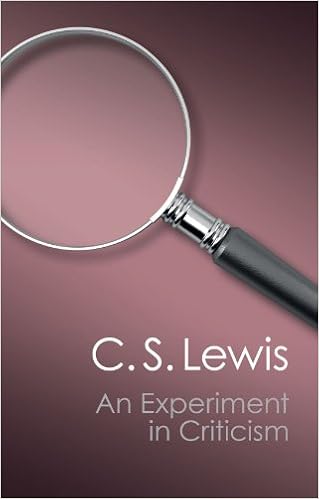
An Experiment in Criticism by C.S. Lewis


Sonata for Piano and Flute by Francis Poulenc is playing.  You can listen here. 

I am going to have to go on a book fast again.  It's simply getting out of hand.  This has come to my attention when I visit bookstores with my husband and buy books, then return by myself while he's at work and buy more books.

Today I had lunch with a friend.  Next door to the restaurant was a bookstore that was going out of business and clearing out their inventory.  So after lunch we strolled over there to see what might be on sale.

As I walked down the aisle to the Classics section a sales clerk looked at me and asked, "Weren't you here before?"  Unlike St. Peter, I couldn't deny it and nodded in the affirmative.  It was in fact, my third time to visit this particular bookstore in as many days.  Friday I went by myself.  Saturday, Josh and I drove by the sign and he suggested we go in.  Without mentioning that I had already gone, I said, "That's a great idea!" And bought yet another book.  

But I am proud of myself. Today I almost bought a book (George Orwell's 1984, Everyman's Library Hardcover in mint condition) but the sales clerk stopped me.  No, she didn't act as my bartender, telling me I had had one too many.  Instead she informed us (my friend and me) that if we waited a week, the prices were going to sink even lower.

Being the cheapskate that I am, that information gave me enough self-control to hold off buying.  I put Mr. Orwell on a shelf in the teen section between two Zombie novels.  I figure he'd be safe there.  If not, well, it wasn't meant to be.

I also noticed a book by E.M. Forester. It had A Room With a View and Where Angels Fear to Tread.  Now, I have both these books,  but not in the Everyman's Library Hardcover edition (mint condition!).

So we'll give it a week and see what happens.  And after that, the book fast!

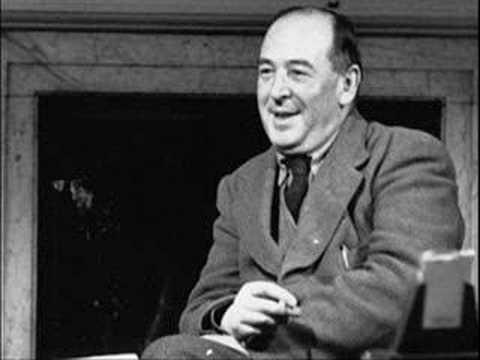
On to the book I've just read.  C. S. Lewis was a
Christian apologist, science-fiction and fantasy writer, literary historian, poet, cultural critic, and historian of words.  Thanks to Cleopatra at Classical Carousal, I learned of a collection of his essays that he wrote about reading books.

 https://images-na.ssl-images-amazon.com/images/I/41mBXdClBdL._SX317_BO1,204,203,200_.jpg

 An Experiment in Criticism is a series of essays that C.S. Lewis wrote about the habits of reading:  why does one read, to what purpose does one read and what kind of taste does one possess that motivates a person to read one sort of book instead of another.

What I like best about Lewis is his ability to perfectly express how I feel about something.  I tend to struggle to find the right words to fully communicate to myself and to others what it is I mean to say or feel about a subject.  If I read Lewis for no other reason it is to feel affirmed that I am not alone in my opinions and that someone has gone before me and already explained it.

No, I am not as smart as C.S. Lewis, but I do feel in good company.

One thing he adequately expressed was people's taste in certain kinds of books.  Once I was at a bookstore with my son and his friends.  One friend was pouring over a book written for Adolescents.  Now I'm not against books written for adolescents; well, actually most of them are tripe (feel free to correct me) but this one was especially tripe-y.  It was poorly written, dreary and just plain mediocre in thought and perspective.  I asked the boy, "Why do you want to read those books (it was a series)?"

He answered, "Because I find them interesting."

Yes. But that didn't really answer my question.  I wanted to know why he found them interesting.  Why did he enjoy reading a book that took you to a very small, unimaginative place.  I suppose if all you've ever eaten are pop tarts, you won't be dissatisfied until you've eaten at a 3 Michelin Star restaurant (if you ever do).  Same goes for our taste in literature.

Lewis tells us that bad taste is by definition, "a taste for bad books" (pg. 1).  He differentiates between "literary readers" and "unliterary readers".  He informs us that the "sure mark of an unliterary man" is he considers "'I read it already' as a conclusive argument against reading a work."  Literary people will read the same work countless times throughout their life.  

Another symptom between literary and unliterary readers is their discussion of the books they read.  Literary people think often to themselves about the books they read and discuss it with others.  Unliterary people "seldom think or talk of their reading." (pg. 3)

Lewis devotes a whole chapter to the unliterary.  Of course these kind of people come in degrees, but the lowest are those that won't read anything but the news.  They have no ear for rhythm and "vocalic melody".  They are unconscious of style.  Something must always be happening and happening at a rapid pace.  The unliterary reader reads only narrative because it is only there where he will find an "event".  He likes "strip narratives (today we would say graphic novels) and almost wordless films because in them nothing stands between him and the Event."

This reader is starting to sound a little like my son.  How have I failed?

Other interesting chapters describe myth and how they should be presented.  He tells us that most of them don't travel well in the abstract.  That there must a form to how the story unfolds or we could not stay interested.  He refers to Greek saga and epic.

One essay discusses fantasy and that the most fantastical tales are not Lord of the Rings or the Norse Edda or any other such story in which we clearly understand that the story would never take place in our own realities.  Lewis contends that the most insidious forms of fantasy are the stories that make the reader feel  as if they could.

Though they do not mistake their castle-building for reality, they want to feel that it might be.  The woman reader does not believe that all eyes follow her, as they follow the heroine of the book; but she wants to feel that, given more money, and therefore better dresses, jewels, cosmetics, (etc.) they might.  The man does not believe that he is rich and socially successful; but if only he won a sweepstakes, if only fortunes could be made without talent, he might become so. (pg. 55)

I believe that explains why certain deplorable novels (think mommy porn) are so popular.  According to this article, 40%of the highest selling independent self-publishing eBooks fall under the Romance genre.

And speaking of obscenity, Lewis has this to say:

We notice also that "truth to life" is held to have a claim on literature that overrides all other considerations.  Authors, retrained by our laws against obscenity-rather silly laws, it may be-from using half a dozen monosyllables, felt as if they were martyrs of science, like Galileo.  To the objection "this is obscene" or "This is depraved", or even to the more critically relevant objection "This is uninteresting", the reply "This occurs in real life" seems at times to be thought almost sufficient. (pg. 61)


And I could not agree with his final chapter more.  He bemoans the practice in most colleges (then and now) where students are not taught to read a book and derive their own personal experience from the novel or short story, but are told by the professor what to think concerning them.  Lewis contends that a criticism of a story does not teach you the truth of the story but rather the story tells one how to consider the criticism.

I see this as especially true today when it seems that certain novels, written by Victorian male writers I might add, are interpreted today as championing feminist causes.  Personally, I did not derive that from those stories.  Call me a prude (I know I am, I'm not ashamed of it) but I saw those heroines as unhappy selfish, adulterers, not empowered women, shrugging off the "shackles of matrimony and children."

Lewis suggests that "a ten or twenty years' abstinence both from  the reading and from the writing of evaluative criticism might do us all a great deal of good."

This is the first book in a series that C.S. Lewis wrote and I will be reviewing.  Has anyone else read these criticisms?  What is your opinion?

https://i.ytimg.com/vi/JHxs3gdtV8A/hqdefault.jpg

Further links:

https://apilgriminnarnia.com/2016/08/04/a-canon-listcsl/ 

http://www.cslewisreview.org/preface-to-c-s-lewis-life-works-legacy/

Official C.S. Lewis website

http://www.biography.com/people/cs-lewis-9380969#early-life