Saturday, July 6, 2013

Wuthering Heights by Emily Bronte


Like my review of Jane Eyre, I give everything away because I assume most of you have read the book.  However, if you like surprises, read no further.  I would point out that the story of Heathcliff and Katherine is much more complicated than what any of the movies show.  They simply don’t do justice to the many sides and colors of the characters in this novel.


Wuthering Heights is one of my favorite novels, one that I’ve read many times and just recently read again.


It wasn’t always my favorite. The first time I read it I was in high school.  I didn’t enjoy reading it; I was only waiting for Katherine and Heathcliff to die so they could burn in hell as they so richly deserved.  Why does evil always seem to overpower good in so many books?  I thought.  Why can’t goodness put up a fight?


Later in my twenties I picked the book up again and skimmed through some of the passages.  I came across certain parts that I saw in a new light.  I saw that the people who seemed so weak and ineffectual at my first read were not quite so helpless after all. In fact, good does win out and it does in a way that is less obvious but closer to real life than is portrayed in many Victorian novels.


The events in Wuthering Heights start during the American Revolutionary War, even though this contemporary historical event is never alluded to.  It ends thirty years later in 1801.  Part of this lack of any reference to important historical events may or may not have been intentional on Ms. Bronte’s part but it certainly reinforces the sense of isolation that surrounded the Moorish wilderness and the people who inhabited it.


Katherine Earnshaw and her brother, Hareton are young children waiting for their father to return from a distant town.  They are eagerly awaiting the presents their father has promised them.  Their father finally returns, but instead of receiving presents, they are presented with a little foreigner, an abandoned gypsy child. 


The orphan is named Heathcliff and the name serves as both his first and last name for the rest of the story.  The father dotes on Heathcliff, Hareton develops a maniacal hatred for him and Katherine, after her first angry outburst (she spits on him) over the loss of her presents, develops with Heathcliff a close friendship.


While the father is alive, Hareton barely tolerates Heathcliff and physically abuses him as much as he is able to get away with.  Unfortunately for Heathcliff the father dies and Hareton, who is now a young man, is head of Wuthering Heights (which is the name of the estate).


Heathcliff and Katherine endure a living hell at the hands of her brother.  Heathcliff loses his place as a member of the family and is made to work as a servant.  Hareton leaves both Heathcliff and Katherine’s upbringing to the oppressive Joseph, an old servant who is as harsh and merciless a Pharisee that ever blighted the earth.  When he wasn’t boring them with long sermons, he was pouring venomous proclamations over their head, informing them of what horrible sinners they were that ever blazoned a trail to hell.


Hareton had a flighty little wife whom he adored and who kept him preoccupied.  She tragically dies of tuberculosis while still a young woman.  Tragically for Heathcliff and Katherine that is.  Hareton never recovers from his grief and sinks into a life of alcoholism, depravity and abuse.  If he was cruel to Heathcliff before, he works at outdoing himself now.


All Heathcliff and Katherine have are each other.  They escape to the Moors where they spend most of their days rambling about. Their common experience of abuse and neglect bond them tightly together. This is how they spend their childhood and adolesence.


Then a circumstance happens that changes everything. Katherine becomes friends with the children from a neighboring estate.  Edgar and Isabella Linton are introduced into Katherine’s life and for the first time she learns to become a lady and relatively civilized.  Linton falls in love with Katherine, who is by this time a teenager and extremely beautiful.  He proposes and Katherine agrees to marry him.


Nellie, the housekeeper of Wuthering Heights, and incidentally the narrator of the story, chides Katherine for so blithely abandoning Heathcliff.  Katherine explains to Nellie that she is marrying Edgar for Heathcliff’s sake.  She insists the money and status she will acquire through marrying Edgar will be used to elevate Heathcliff from his degraded state.


This is a naive, if not outright dimwitted, attitude on Katherine’s part.  Edgar and Isabella have shown nothing but disdain and contempt for Heathcliff.  They cannot look beyond his slovenly appearance, coarse manners, or the fact that he belongs to a different and what was considered back then to be an inferior race.


When Katherine confides her plans to Nellie, she doesn’t realize that Heathcliff has overheard her.  He runs away and disappears for three years.


When he returns, Katherine is married to Edgar and living at Thrushcross Grange, the Linton’s estate.  The Lintons’ parents have died by this time, leaving a group of very young and inexperienced people living by themselves.  Woe to them.


Here the tale turns into what could be titled, “The Revenge of Heathcliff.”  Heathcliff presents himself to Katherine and the Lintons and a pretty formidable picture he makes.  No longer the ragamuffin servant, Heathcliff is dressed and talking like a cultivated gentleman.  His accent is slightly foreign, maybe American, which leaves Nellie and the reader to wonder where he has spent his time, maybe fighting in the American wars?


Katherine immediately renews her friendship with Heathcliff and doesn’t bother hiding not only her affection but her passionate love for him, much to Edgar’s consternation.  This leads to a final confrontation between the two men that ends with Heathcliff being banished from Thrushcross Grange.


How does Heathcliff spend this time?  By gambling with the by now, permanently drunk and half-crazed Hareton.  Heathcliff eventually wins all of the Earnshaw property and wealth and perhaps even helps quickens Hareton’s death, although Hareton carved a pretty brilliant path to self-destruction and hardly needed anyone’s help.  This leaves Hareton’s son, also named Hareton, a pauper and ward of Heathcliff.  Although Heathcliff keeps young Hareton illiterate and works him as servant (as he was treated by the father) he nevertheless develops an affection for him, perhaps because Hareton, who also suffered abuse and neglect from his father had developed a similar fierce fearlessness as Heathcliff did. 


Possessing Wuthering Heights is not enough for Heathcliff and he determines also to possess Thrushcross Grange.  He does this by wooing Isabella.  He manages to persuade the innocent and very, very naive Isabella to run away with him.  She soon learns to regret her decision.  If Wuthering Heights was written today I’ve no doubt the readers would be treated to more graphic descriptions of just how badly Isabella was treated a la Fifty Shades of Gray.  Being a Victorian writer, Bronte kept things subtle so as to clearly convey to the reader that Isabella’s plight was a grim one without robbing us of our imaginations.


Katherine cannot cope with the conflict between her husband and Heathcliff.  She throws herself into a passion which leads to a brain fever and eventual death.  Before she dies she gives birth to a baby girl, also called Katherine.  Bronte doesn’t inform us of Katherine’s pregnancy until after she has died.


Katherine dies half way through the novel.  The rest of the novel involves Heathcliff as a cruel and tyrannical overlord to the people at Wuthering Heights and eventually at Thrushcross Grange which comes into his possession after Isabella bears him a son.


Isabella and Edgar both die young which leaves Heathcliff with everyone’s children.


Again, this is where the story begins to turn around again.  At first when I read this book I could not see it, but now I clearly see how Emily Bronte created wheels inside of wheels. 


Heathcliff has wreaked revenge on everyone.  So he should be satisfied, right? 

Actually, no.  With the exception of his own son, called Linton, the children of Hareton, and Katherine and Edgar show that they have strength of character after all.  They just needed trial and tribulation to bring it out.  Interestingly, Heathcliff’s own son is sick and weakly but just as hateful and spiteful as Heathcliff is.  He is selfish and peevish to the point where Heathcliff can’t bear to be around him.


I must confess I also enjoyed Isabella and the way she learned to enrage Heathcliff with her tongue.  He could degrade her, imprison her, verbally and physically abuse her, but the one thing he couldn’t do was shut her up.  She made herself such a thorn in his side that when she eventually ran away, he didn’t pursue her.


The other children, young Hareton and Katherine, overcome their initial degradation at the hands of Heathcliff and rise to surpass him, even though they are still in his power. 


Heathcliff, in the end, realizes that even though he can take away their money, wealth and names, he can’t conquer their spirit. 


More than that, he realizes that all he ever wanted was Katherine.  For the twenty years following her death, Heathcliff believes that her ghost has been haunting him.  In the end he dies in the prime of health and still young but no cause of death can be found.


The story ends with Nellie affirming to her listener (a young man who only comes into the novel at the beginning and the end and serves no purpose other than to be the audience who listens to Nellie’s story) that many people have witnessed the ghosts of Heathcliff and Katherine wandering the Moors together.


I take that back.  The man does serve a purpose because he offers another first person narrator in addition to Nellie, who really provides more of a third person narrative even though we know it is she who is telling the story.  This man presents the characters to us from his own point of view, having met Heathcliff, young Hareton and Katherine at the beginning of the book when they are having a rough time of it, and at the very end, after Heathcliff’s death. 

And, come to think of it, he provides another purpose because he is a typical 19th century dandy.  His cultivated, aristocratic person throws into sharp relief the remoteness of the characters in the story as well as the desolateness of their surroundings.  Next to him, Heathcliff and the rest seem even more strange.

This has led some to wonder if Emily Bronte was making it questionable if Nellie was telling the truth.  After all, she’s just a maid, whiling away the time by spinning yarns and sharing gossip about the people she works for to a bored visitor who is laid up with the flu.  We only have her word for it.


 Personally, I don’t think so.  I think it was simply a narrating device that Emily chose.  She wanted to tell the story in the first person so she needed a first account witness and she wanted an audience member who is marginally a part of the story so Nellie could tell the story to him rather then speaking directly to the reader.  It also allows her to give two different “camera angles,” if you will, of her main characters.


Another attribute of this novel is the psychology involved.  I suppose one could explain Katherine’s wildness and Heathcliff’s almost psychotic behavior to the unprincipled and abusive lives they lead under Hareton Earnshaw. But why isn’t the same true for the young Hareton when he was raised the same way under Heathcliff?


That is another aspect of the novel that I found thought-provoking.  There were those, such as Heathcliff and Katherine, and to a lesser extent Isabella, who became hardened, strong willed and selfish due to their treatment.  Then there were Edgar Linton, young Hareton and young Katherine whose trials caused them to rise to the occasion and become better people than they were when their lives were easy (even though Hareton’s life didn’t become easy until after Heathcliff’s death.).  Why is that?  What was Emily Bronte trying to say?


She gives some clues in her descriptions of each of her characters before bad things happen to them.  Emily conveys each person’s attributes and how they blossom to their full potential when they undergo hardship.  One has to read the book to fully appreciate this. Bronte would have made a great behavioral scientist.


Later, after Heathcliff’s death, Hareton’s property returns to him as does young Katherine’s to her.  I’ve told you everything else.  Should I also tell you that Hareton and young Katherine fall in love?  Their relationship starts out stormy but turns to devoted friendship-while still under Heathcliff’s iron fist, mind you-and eventual marriage which finally  returns and unites Wuthering Heights and Thrushcross Grange under their rightful owners.


Really what makes this such a great novel?  Is it the story line?  Maybe.  To me what makes the story enduring are the vividly drawn characters and their richly constructed dialogue, something I can’t recreate in this review. Bronte uses beautiful vocabulary and a delicious style of speech that doesn’t exist today. I enjoy reading certain passages over and over again just to let the words roll around in my mouth.  I relish her tart wit and dry humor. It sparks my imagination. Our language has devolved over time.  Compared to then, today we talk like a bunch of monkeys.


I could go on but this story really supplies the reader with so many different angles and topics to consider that I think I could continue to read it every year and still discover some other nugget that Emily Bronte was trying to show through her one and only novel.  It was published a year before her death at the age of thirty-one. Wuthering Heights is credited with being the first Gothic novel and introducing the concept of the “anti-hero.”


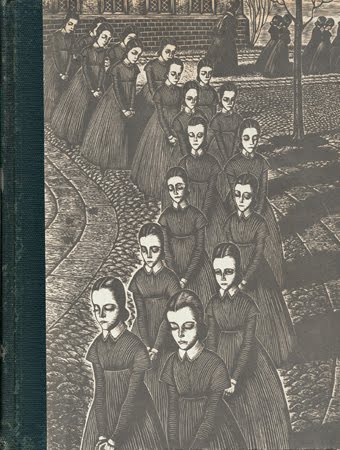
My copy is an old 1943 hardback that is illustrated with the original woodcut drawings.  It is part of a boxed set with my Jane Eyre copy.  It has an introduction by Emily’s sister, Charlotte, that offers insight into her sister as well as her own clearly expressed opinions of Emily’s masterpiece.  (Hint:  she didn’t think it should have been written.)

I hope my review has encouraged its readers to get a copy (or dust off your old copy) and read one of the most brilliant books written in the English language.


.99 on Kindle


Saturday, June 8, 2013

Jane Eyre by Charlotte Bronte


    The first time I read Jane Eyre, I was sixteen years old.  When I finished my thoughts were filled with disgust:  How did I possibly enjoy all the teen romance books I had previously read when they were nothing but a bunch of drivel?  This book is what true romance is all about!


      Since then I have read Jane Eyre several times, the most recently a couple of weeks ago, and each time I’ve read it I’ve gotten something more out of it.


Spoiler Alert!


       I suppose everyone has either read the book or seen one of the many movies made about it,   Just in case, know that I will be giving away some crucial plot developments so if you don’t know the story, don’t rob yourself of the thrill of surprise, shock and discovery by reading my review.


        An orphaned girl, Jane Eyre, is sent away to live in a strict boarding school where she suffers abuse and neglect.  After graduating she gets a job as a governess to a young French girl at a manor, Thornfield Hall, out in the country.  She eventually meets the Master of the house, Edward Rochester, and, as time progresses, she falls in love.


       Why does she fall in love?  For the first time, someone treats her with respect, treats her as his equal.  Spends time with her, enjoys her company as much as she enjoys his.  She fights against her feelings because she knows their stations in life will prevent them from ever marrying.


        In addition to that, it appears Rochester intends to marry another.  A young woman from a neighboring manor seems to have won his affections.  Blanche, tall, as beautiful as a Spanish princess, strong willed and high spirited has made it clear that she determines to have Rochester for a husband.  Who can fight against her beauty, her charms, her passionate personality?


        Not Rochester.  He talks to Jane often of his nuptial plans.  She tries to bear it but one evening she is over come with emotion.  The most romantic scene in the whole book, and my favorite ensues:


        Do you think I can stay to become nothing to you?  Do you think I am an automation?-a machine without feelings?  and can bear to have my morsel of bread snatched from my lips, and my drop of living water dashed from my cup?  Do you think, because I am poor, obscure, plain, and little, I am soulless and heartless?  You think wrong!-I have as much soul as you, - and full as much heart!  And if God had gifted me with some beauty, and much wealth, I should have made it as hard for you to leave me, as it is now for me to leave you.  I am not talking to you now through the medium of custom, conventionalities, or even of mortal flesh:-it is my spirit that addresses your spirit; just as if both had passed through the grave, and we stood at God’s feet, equal, -as we are!”

       “As we are!” repeated Mr. Rochester “-so,” he added, enclosing me in his arms, gathering me to his breast, pressing his lips on my lips: “so, Jane!


  It turns out, that Rochester was purposely provoking Jane in order to draw this confession out.  There is a lot of witty dialogue in this section of the novel, including some telling ones on the mercilessness of the upper class towards the people “beneath them.” 


        Rochester declares his mutual love for Jane and they plan to marry.


        They don’t marry, however, due to the fact that at the wedding altar, someone announces the Rochester has a wife still living.  This pre existing wife turns out to be a lunatic.  Rochester tempts Jane to still stay with him. He claims their love does not need to be bound by conventional norms.  Which is another way of saying, “Be my mistress.”


      Jane shows her mettle by tearing herself away from Rochester and running away under the cover of the early morning, flees to she knows not where, and almost starves to death before ending up in an obscure village at the house of a minister, St John the Baptist, and his sisters, Diana and Mary.  A whole sub story occurs here as Jane learns to live again and enjoy her life with her new found friends.


      Again, Jane is tempted.  Not by love this time, but still by one who wants to marry her.  St. John the Baptist wants her for a wife so she can travel with him as a missionary to India.  Again Jane shows her mettle by standing strong against one who has a powerful personality and is determined to bend her to his own will.


      The contrast between Rochester and St. John are dramatic.  Rochester has black hair and coal black eyes.  His personality is one of passion and fire.  St. John is as handsome as an Adonis with blonde hair and blue eyes.  He is as icy and Rochester is fiery.


        I found this section of the book especially fascinating because St. John does not try to tempt Jane through love or romance but by manipulating her conscience.  He does not tell her that HE wants her to come to India but that GOD does.  If she refuses to come, she is not opposing St. John but rebelling against God.  The dialogue that ensues back and forth between Jane and St. John is compelling.  But although St. John gives forceful reasons, uses inflammatory language and religious “powerspeak”  to vanquish Jane’s objections, she’s up to the challenge and counters his every point.


      St. John doesn’t give up, however, and it seems victory is his through wearing Jane down through attrition.

           But just as Jane is ready to give in to his demands, something unexpected happens. 


           There is a lot of religious symbolism and many implications that God’s hand is involved in each turn of event in the story, but this is the first time in the novel where the story delves into the obvious supernatural.


             Jane runs out of the house, listening intently to something.  What has she heard?  Rochester’s voice calling to her.  Is she mad?  She doesn’t know, she doesn’t care.  She packs and returns to Thornfield Hall. 


             By this time, Jane has become independently rich.  It turns out she wasn’t completely abandoned but had an Uncle living in the Caribbean.  This Uncle is also the one who had connections to Rochester’s wife’s family and through a series of coincidences was able to prevent Rochester’s bigamous plans.  However, the episode so upset him that he became seriously ill and eventually died. He left all his money to Jane Eyre.

       Jane is now not only rich, she is filthy rich.  Through the inheritance she discovers that St. John and his sisters are her cousins (Yes, cousins married back then. Let’s move on.) She generously divides her riches with her cousins, which still leaves her a very wealthy woman. 

      She returns to Rochester to find him a shattered man.  His lunatic wife had finally succeeded in setting Thornfield Hall on fire and, as he was trying to save her, she jumped from the roof to her death.  A beam falls on Rochester causing him to lose an eye and one of his hands.

     Jane doesn’t care about his mutilated state and since they are now free to marry, they do.  Together they travel the world, keep house, have children and are frequently visited by Diana and Mary, St. John having finally left for India without her.


       As a teenager I identified with Jane Eyre because I was shy and withdrawn.  I had my few close friends but much of my time was spent indoors either practicing the piano or reading books. I could identify with her sheltered existence, her need to experience the world, to fall in love....


       Later, in my twenties, I had fallen in love, gotten married...so I no longer needed vicarious romance but I still loved Jane because of the inner fire that is buried inside her tiny frame until it is ignited- not only by love, but by having the strength to do what is right when every thing inside of her wanted to do what was wrong.


       As the years and a divorce went by, I once again connected to Jane because I understood her struggle to survive and, after procuring a secure living, suffering through loneliness and depression because humans were made to do more than just exist.  I felt her longing for something more.  For a relationship with someone who was her intellectual and emotional equal.  I also respected her determination to sacrifice this desperately needed relationship in order not to compromise her Christian beliefs.


      The Christian symbolism throughout the novel did not become obvious to me until this last time when I read it.  One example is when Jane tells Rochester that she dreamt of a maniac coming into her room and the next morning finding her bridal veil torn in two from top to bottom.  (Matthew 27:51)


  And, of course, the conclusion that reflects Matthew 5:29-30.


    Besides all that, Jane Eyre has those wonderful ingredients that make it an enduring novel.  Powerful, multidimensional characters, strong dialogue and not only an outer, overlying story, but many underlying stories.  And, I’ve already mentioned the religious symbolism.


      In another few years, I’ll have entered into another season of life.  I wonder what I’ll discover in Jane Eyre then?
Charlottte Bronte 1816-1855

      This will be my last post for a couple of weeks.  I'm taking my son on a trip to Europe as a graduation present to him.  I won't tell you where we're going, I'll just say Buon Viaggio, Auf Weiderluege, Au Revoir, y hasta el tercero de Julio! God bless!


.99 on Kindle


Sunday, June 2, 2013

The Writing Life: Writers on How they Think and Work; A Collection from the Washington Post Book World Edited by Marie Arana


Marie Arana has compiled a collection of fifty-five writers from several different genres.  Each chapter starts with an introduction by Arana who gives a brief biography and commentary on the writer and is followed by an essay by that writer.  Most writers talk about what they write about and why.  Many of them go into how they come up with the material, organize it and flesh it out.  Others give interesting perspectives on specific cultural or sociological situations.


Part one is titled, On Becoming a Writer.  Several popular writers provide essays on how they became writers.  Authors include Joyce Carol Oates, James Michener, Mary Higgins Clark and John Keegan. 


Part two is called Raw Material where writers give the reader an insight as to where they gather their material.  Authors include Alice Mc Dermott, Jayne Anne Phillips and John Edgar Wideman.  George P. Pelecanos explains how he comes up with his crime stories.


An especially interesting essay is by Scott Turow titled, Can Whites Write About Blacks?  I thought his insight to the racial tension between the two races was perspicacious.  This particular essay was one of the most well articulated and researched of all of them.  Not that all the authors didn’t write well, but Turow’s lawyer background must have given him the ability to deal with a sociological theme in a way that was informative and absorbing.  It was also interesting to discover that the author of Presumed Innocent and The Burden of Proof wrote his books on the train ride to his law office and continues to practice law.


Parts three and four (Hunkering Down and Old Bottle, New Wine) include authors from different genres, such as historical writing (David McCullough) and science fiction (Ray Bradbury).  Other authors include Patricia Cornwell, Stanley Karnow, E.L. Doctorow, and Umberto Eco. Some, like Eco, discuss the problematics involved in translating a book from the original language into another.  Richard Selzer, who is a surgeon, writes on how he uses his job to provide plot lines and accurate information to his stories, which, naturally, center around doctors and hospitals.  Others tell us how they research for the historical nonfiction. Ray Bradbury gives us some extremely interesting background to his life and what his intentions are with his stories (“they’re all metaphors”).


Part Five, Facing the Facts, are a collection of authors who write nonfiction.  Carl Sagan has an essay here and so does Jimmy Carter.  Stacy Schiff lets us know that each of her biographies are love affairs and letting each of them go is extremely difficult.


The final section, Part six (Looking Back) has essays of authors, Carol Shields, Jane Smiley and Ward Just.  My favorite was of Michael Chabon, although I can’t help feeling a little bit jealous.  How many of us would die to have a college professor submit our work to a literary agent, without telling us, and end up with a nice, fat, writing contract? Chabon eventually wound up winning the Pulitzer Prize for his book, the Adventures of Kavalier and Clay. 


Every essay is interesting in their own way because it gives you the back story of people who started out like the rest of us but were propelled to success through various means.  I also like getting inside the head of other writers and seeing what makes them tick.  It also lets us know that there is no one way to write.


Of all the essays the one I found the most telling was by Michael Korda.  Korda is not a writer but an editor.  He reveals in his essay the difference between people who write literature and writing whores.  I know that’s a vulgar term but I don’t know how else to describe them.  For them it’s all about the money and they don’t care what kind of tripe or trash they have to put out to get it.  They’re hugely successful too, so if making a lot of money is your goal...whatever.


 Korda describes his session with one particular popular writer who writes erotica.  She


“liked to have me sit across from her in her pink bedroom...so I could read each page as it came from her pink typewriter (on pink paper) and edit it on the spot.”


Korda goes on to state that this woman was not only open to plot suggestions but demanded them.  Page by page she went over every thing with her editor.  It wasn’t about writing art, it was about making sure the product was marketable.


“When warned that one of the book clubs might not take her novel because...it was too shocking, Jackie said... “I don’t write for middle aged men in suits.  I write for women on the subway.”


Then there was Graham Green who


“...neither needed nor accepted editorial changes.  Greene’s manuscripts arrived on my desk with a forbidding, neatly typed note on the title page that read, “Please do not change any of Mr. Greene’s punctuation or spelling!”  When his previous publisher had expressed some doubt about the title of one of Greene’s books, he had received a terse cable in reply that read:  “EASIER TO CHANGE PUBLISHER THAN TITLE.  GREENE.”


I’m under no illusion that I am the next Graham Greene, but I take comfort in the fact that we share the same principles when it comes to writing.


In conclusion, this is a great book for those who are aspiring writers and an interesting and enjoyable read  for those who would like to know more about their favorite authors.


http://mariearana.net/the-books/the-writing-life/

Thursday, May 23, 2013

Love Lives on by Sidney Frost


This book is a sequel to the book Where Love Once Lived.  (The link my review of that book is at the end of this post.)  It has come out in time for all of those who are looking for another book to add to their summer reading list.


I don’t want to give the story away so I will do my best to list the ingredients and let the reader decide if it is their kind of read.


This is a story about Karen and Brian. They were in love when they were young.  The story that comes before this one tells of their separation and eventual reunion.  This one starts where the other leaves off. 


Karen and Brian are on their wedding day.  It supposed to be a day of joy and love and happiness and a court summons....what?


That’s what Karen receives on her wedding day.  She is being sued by a woman she never met for child support for a child she never bore nor reared.  Needless to say, this puts a damper on wedding romance.


For their honeymoon, Karen and Brian travel around Europe while being stalked.  They return home only to be harassed and threatened by this same person and someone else who they don’t know.  On top of that Karen and Brian have to learn how to trust each other, overcome emotional baggage of the past, and start a life together.


This is a nice short story, involving real people with real problems.  How do they cope?  How do they work together?  Is God involved in our lives at all?  Can we trust Him to see us through every problem?  These are questions that Karen and Brian learn to answer.


I’ve mentioned what I like about the book and I only have two complaints.  The first one is there are a couple of characters that Frost borrows from another book, The Vengeance Squad. (A link to my review is below). This is my favorite book of the three Mr. Frost has written.  The characters in this book are strong and interesting and I wish he would have used them to a greater extent in this story.  Or better still, write another story starring them.


My other complaint is that he mentions the University of Texas too many times.  Being an Aggies fan I found this rather boorish (whoooooop!!).  But that shouldn’t be an issue for all the Longhorns out there.


Aside from that, I hope that readers of my blog who enjoy mystery and romance from a Christian perspective will consider all of Mr. Frost’s books.

I received this book for free from the author.


Sidney W. Frost writes Christian novels. He was an Adjunct Professor at Austin Community College where he taught computer courses for more than thirty years. He received the adjunct teaching excellence award in 2005. While attending the University of Texas in the 1960's he worked part-time at the Austin Public Library driving a bookmobile and that’s when he got the idea for his first novel, Where Love Once Lived. (From the author's web site.)

On Kindle for $2.99


http://sidneywfrost.com/wlol_author.htm


Other books by Sidney Frost reviewed by Gently Mad:


The Vengeance Squad


Where Love Once Lived


Sunday, May 19, 2013

The Private Memoirs and Confessions of a Justified Sinner by James Hogg


Knight Death and Devil by Albrecht Durer (1472-1528AD)


This is one of the most fascinating and enjoyable books I’ve read in a while.  It was written in the early 19th century and the story is placed a century earlier than that. 


The story takes place in Scotland where a family of Colwan live on the lordly estate of Dalcastle. George Colwan, the Lord of the Manor marries a woman, Rabine, as different from himself as if he were trying to create a marriage out of chiaroscuro counterpoint.  George is one for gaiety and frivolity while his wife, a staunch Calvinist, rejects any practice that might be even remotely light hearted. Their differing views cause such a breach in their relationship that at first Lady Dalcastle returns to the home of her father.  Therein follows a pretty funny episode.

 
Rabine's father wants to know why she has left her husband and returned to his estate.  His daughter rants for a while describing her husband’s moral and religious failings.  Her father professes to be so upset and offended by his son-in-law’s unchristian behavior towards his daughter that he proceeds to beat his daughter claiming that since his son-in-law is not present to receive his due flagellation, his wife is the appropriate proxy.


“What do you mean, sir?” said the astonished damsel.


“I meant to be revenged on that villain Dalcastle,” said he, “for what he has done to my daughter.  Come hither, Mrs. Colwan, you shall pay for this.”


So saying, the baillie began to inflict corporal punishment on the runaway wife.  His strokes were not indeed very deadly, but he made a mighty flourish in the infliction, pretending to be in a great rage only at the ‘Laird of Dalcastle’.  “Villain that he is!” exclaimed he, “I shall teach him to behave in such a manner to a child of mine...Take you that and that, Mrs. Colwan, for your husband’s impertinence!”

Rabine may be narrow minded but she’s not completely stupid.  She understands that this is her father’s not so subtle way of saying, “you made your bed etc...”  So she returns to her husband at Dalcastle.  They lead separate lives and stay in separate parts of the castle.  Lady Dalcastle develops a close relationship with the local Presbyterian minister while Mr. Colwan blatantly takes on a mistress.


 It’s not clear whether Mrs. Colwan and the minister have anything other than a relationship based on common religious principles, but she produces two sons, the oldest, George, who belongs to Lord Colwan and a younger, Robert, who may or may not be the Reverend's son.


It’s these two sons from which the real story begins.  George is raised by his father and the other by the mother. It is the son, Robert,  raised by Lady Dalcastle around whom the story centers. 


George is found murdered.  As the facts come to light, it reveals that it is his Robert, brother (or half brother) that murdered him.


The story is narrated in an interesting way. It’s not many writers that should attempt switching person narratives in a story but Hogg does it brilliantly.  First the circumstances surrounding George is described through an editor who briefly uses first person but for the most part writes in third person.  As the culprit is eventually found to be Robert, the narrator changes to first person narrative with Robert as the narrator. The final chapter of the book uses a different first person narrator and concludes with a final statement of the murderer.


This book reflects James Hogg’s fascination with the religious beliefs and country lore of the Gaelic people of Scotland.  It is rich in colloquial dialect and idiomatic use of the language as well as a sophisticated eloquence in expression that no longer exists in our modern usage of the language.


The story is deeply psychological in nature.  After he is arrested for his brother’s murder, while in prison, the Robert writes down his confession.  It is titled, “The Private memoirs and Confessions of a Justified Sinner: written by Himself.”


In his narrative, Robert explains his religious upbringing at the hands of his simple minded mother and the religiously narrow Reverend Wringhim.  It is imprinted on him from an early age that those who are chosen cannot lose their salvation therefore, they cannot do anything-be it ever so heinous- that would send them to hell.


From the first section of the book through the eyes of  the editor, we get a picture of Robert as an arrogant, anti-social person.  This enables the reader to understand how such a person could become led into a false understanding of what it means to be chosen or the assurance of salvation.


I believe some people might read into Hogg’s book an anti-reformed theology attitude, but this underestimates the level of sophistication of Hogg’s writing.  People’s beliefs are so much more complicated than simply black and white.  It is possible to hold onto a vestige of the truth and through one’s own pride and self-will distort that truth until what the person believes is no longer truth but falsehood.  This is the case with Rabine.  Her intention was never to cultivate a close relationship with God or glorify Him through sincere worship, but to inflate her own vanity in believing she was superior to her husband. 


She nurtures this same pride into her son who develops it to a degree that she never anticipated.  In the end she dimly begins to understand the Frankenstein she has unwittingly created. 


And that is what happens.  In his own words, Robert meets with a man, Gil-Martin, who wields a powerful influence over his life.  As Robert expands on his relationship with this other man it becomes apparent to the reader that this other person is not human but in fact something evil.  As the story progresses we become aware that Robert is under the complete sway of a demon.


The demon persuades Robert that he must “purge” the earth of all of those who are not chosen.  That it was not murder to do so, but, in fact, was work commissioned to him by God.  He quotes all sorts of scripture to justify this point.  Robert wavers at first, but doesn’t have the strength or knowledge of Scripture to counter him.  Apparently, for all his mother and the Reverend’s teachings, endowing her son with a grounded knowledge in Scriptures wasn’t included.


The Last Judgement by Luca Signorelli 1500AD

The discussions back and forth between the demon and Robert remind me of Jesus’ temptation by Satan in the desert.  The difference was that Jesus did know his Bible and was able to point out how Satan twisted Scripture in an attempt to tempt Jesus into committing wicked acts.


Gil-Martin uses the same tactics on Robert but, unlike Jesus, he has no defense.  Consequently, he commits various acts of murder and other wicked deeds, even some to his own horror. It’s a great illustration of someone who becomes a slave to his own corrupted nature.


The story ends a hundred years later when a grave is found at a crossroads.  It is the burial of a suicide.  The grave is dug up and Robert’s manuscript is discovered in the grave site.
I've read some reviews on this book that suggest that Gil-Martin could be a figment of Robert's imagination but the reason I don't think so is because after Robert's death, third party witnesses claim to see two people preparing to hang themselves but the grave reveals only one.


James Hogg came from farmer stock.  He over came the British class caste by educating himself and becoming a nationally renowned writer.  His stories often target the upper class and portray the common man as the hero.


Indeed, it is in the servants that we hear the truth of God’s word spoken. 

The servant John tells Lord Dalcastle exactly the sort of man he is:


“Well, John, and what sort of general character do you suppose mine to be?”


“Yours is a Scripture character, sir, an’ I’ll prove it.”


“I hope so, John.  Well, which of the Scripture characters do you think approximates nearest to my own?”


“...Ye are the just Pharisee, sir, that gaed up wi’ the poor publican to pray in the Temple; an’ ye’re acting the very same pairt at this time, an’ saying i’ your heart, ‘God I thaink thee that I am not as other men...”


A debate ensues between the servant John and Dalcastle where as the latter thinks it is a good thing to be a self-righteous Pharisee while John correctly points out that Jesus' parable was a warning against religious hypocrisy.


It is a clever method on Hogg’s part to have true wisdom disguised in heavy Gaelic dialect while the aristocrats, with their cultivated speech, are blind to the truth and are full of self-satisfaction.


The book should be a matter of interest, I think, to all Christians, simply because the topic of predestination and assurance of salvation are hotly debated subjects between denominations.


Below I’ve included the links to other blogs that have also reviewed this book from a different viewpoint than mine.  Thanks to Brian at Babbling Books for calling this great book to my attention.  I have since downloaded all of James Hogg’s books onto my Kindle (they’re free!)


James Hogg


 $1.99 on Kindle


Babbling Books

http://www.independent.co.uk/arts-entertainment/books/reviews/book-of-a-lifetime-the-private-memoirs-and-confessions-of-a-justified-sinner-by-james-hogg-7621915.html

http://en.wikipedia.org/wiki/The_Private_Memoirs_and_Confessions_of_a_Justified_Sinner

http://www.bewilderingstories.com/issue262/justified_sinner_rev.html

Monday, May 6, 2013

When Children Want Children and Rosa Lee: two books by Leon Dash


In 1984, Leon Dash, a journalist for the Washington Post, rented an apartment in a Washington D.C. ghetto for eighteen months and became intimately involved with six families.  He journaled his experiences with these families in an attempt to get at the heart of why so many black girls become unwed mothers.


 What he found was that it was not a lack of education or government intervention plans that allowed it.  These young girls knew exactly what they were doing.  They were not simply being promiscuous and finding themselves pregnant.  They were having sex and multiple sex partners with the objective of getting pregnant.


 They knew all about sex education from school.  The local clinics provided them with free birth control as well as state funded abortions.  These girls used none of these things.  They wanted to get pregnant.  They pursued sex with the intention of getting pregnant.


Dash realized these girls were not the victims but were the aggressors who pressured boys and even men to have sex with them for no other reason than to have children.


This unexpected discovery led Dash to search for answers.  Why were these girls engaging in a practice that produced poverty and misery?  His search caused him to delve into the back story and family tree of each of these girls. 


His conclusions were that these girls were not getting pregnant to increase a welfare check or out of ignorance but because the culture of their community elevated the status of women when they became mothers.  He traces this phenomenon back to the generation of these girls’ great grandparents who were sharecroppers in the south.


  He holds the white plantation owners who enslaved and sexually abused the black women responsible for this generational cycle of out of wedlock pregnancy.


Dash’s second book, Rosa Lee:  A Mother and Her Family in Urban America is about a woman in her fifties, Rosa Lee, who is a heroin addict and is HIV positive.  All but two of her eight children are also drug addicts and criminals and two of them are also HIV positive.


Dash spent four years with Rosa getting to know her and her family.  Again he searched their backgrounds and pretty much arrives at the same conclusion as in his first book:  that living as share croppers in the south caused a break down of the family and produced the lawlessness, out of wed lock pregnancies, and eventual death of Rosa and her two children.


Dash in both books is unapologetic and honest.  He traces Rosa’s life of crime to when she stole as a child that led to her shoplifting as an adult.  She even trained her children and grandchildren how to steal and sell the stolen items.


 Her recurring theme is, “I’m just trying to survive!”  However, that doesn’t explain that most of the money she obtains through her criminal behavior, prostituting herself as well as her children, and also her and her children’s welfare checks go to maintain her heroin habit.


Dash shows the remorselessness of Rosa.  She admits that what she’s doing is wrong but she doesn’t try to stop.  She not only endangers her children but gets them addicted to the drugs as well.  When a man offers her money to have sex with her nine year old daughter she accepts.  This daughter eventually becomes a heroin addict and also develops AIDS.  Even after being diagnosed with the disease, Rosa and her daughter and a son, who also has AIDS, refuse to stop having sex.  They bluntly inform Dash that they don’t care if they transmit the disease to anyone else.


She makes drug transactions through her grade school aged grand children because the police won’t arrest them.


I found both books to be tragic tales of self-destructive lives but I did not find Dash’s conclusions (basically, it’s the white man’s fault) to answer every question.


First of all, as Dash himself admits, most black families who came up out of poverty in the post Civil war south, including sharecroppers, did not turn to a life of drug addiction and crime.  Secondly many white families (my father’s included) came out of similarly hard circumstances.  Before the 1960’s the majority of black and white families from poverty-stricken backgrounds moved up to middle class status.


Even out of Rosa’s extended family, out of all her brothers and sisters, she’s the only one that turned to a life of crime and drug addiction.  The cycle of criminal behavior started with her, not before.


Finally, the percentage of white and black families that are being raised by single moms, and more and more often grandmothers, has grown exponentially since the 1960’s.  Before 1965, less than thirty percent of black children were born out of wedlock.  That number is now eighty percent.  Forty percent of white children are now born out of wedlock.  The majority of these children live under the poverty line.


Dash insists that government welfare checks aren’t the reason the women in his first book are having babies or causing people like Rosa to become drug addicts.  Maybe so, but they certainly aren’t preventing it and they definitely are enabling it.


Rosa and her children-with the exception of two who left and joined the middle class- never made it past grade school.  The pubic school just kept passing them through the grades until they dropped out.  Rosa couldn’t even read.  Yet she was a rocket scientist when it came to working the system.  She knew how to get a welfare check for every single child she had.  She went to a methadone clinic to get her drug fix for free, yet still spent most of the government checks on drugs and used charity organizations to feed her children.


 The checks didn’t stop her from shoplifting.  When she was in the hospital, one son came to visit her and while there stole the phones from the rooms on her floor and sold them to local stores.


Leon Dash said he wrote these books to alarm the rest of us into action.  But he provides no solutions.  He can’t.  As a secularist he has to admit that man made institutions did not help urban America, they enabled it.


The problem is a moral and a spiritual one.  As Rosa herself proved, even if Dash, while faithfully recording her life, refuses to come to that conclusion. 


In the year before she died of AIDS.  Rosa joined her local church and became a Christian.  For the first time in her life, her body was free from drugs.  For the first time she looked back on her life and regretted the devastation she wrecked on herself and her family. 


Her body may have become a victim to disease, but in the end her spirit was delivered from corruption.


Even though I don’t agree with Dash’s viewpoint, I congratulate him on boldly taking on a serious plight in our society that is eating away at its stability like a cancer.  I saw this first hand when I taught in public school and he’s right.  The rest of America needs to acknowledge this travesty and seek ways to take action.

As a Christian I have my own opinions, of course and I also have opinions about seriously reforming our government welfare and educational system but those are subjects for another time.


Leon Dash (born (1944-03-16)March 16, 1944, in New Bedford, Massachusetts) is a professor of journlism at the University of Illinois in Champagne.  A former reporter for the Washington Post, he is the author of Rosa Lee: A Mother and Her Family in Urban America, which grew out of the eight-part Washington Post series for which he won the Pulitzer Prize.  (From Wikipedia)